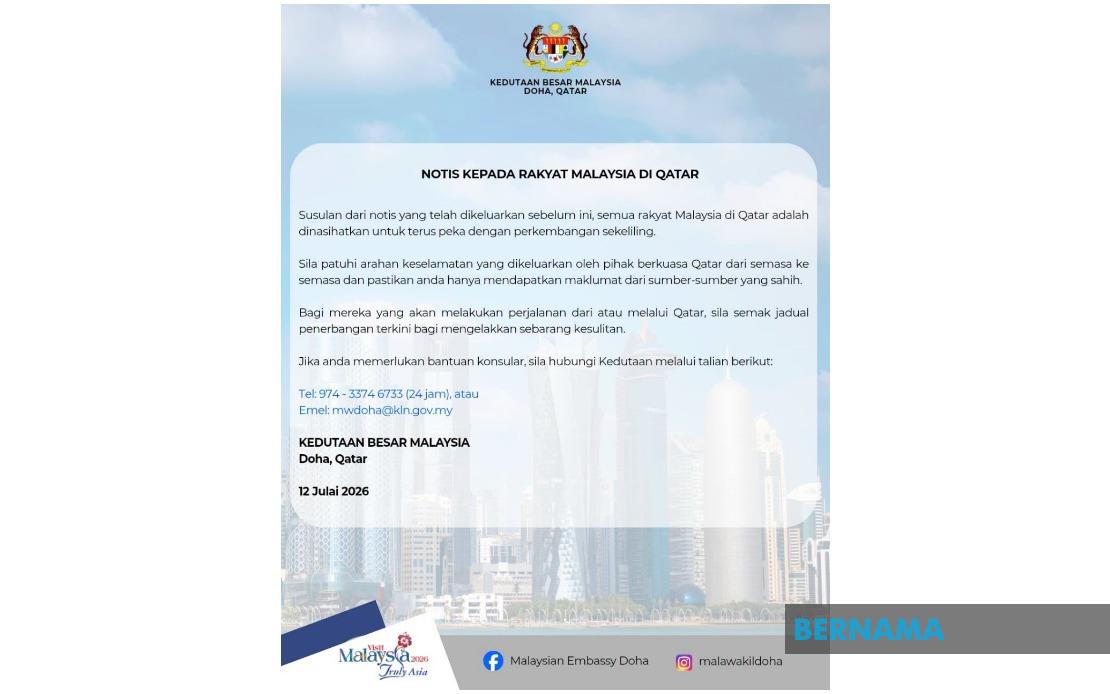
The Malaysian Embassy in Doha has issued a security advisory to all Malaysian nationals residing in or transiting through Qatar, instructing them to remain vigilant and adhere strictly to guidance from Qatari authorities in the wake of intensifying hostilities between Washington and Tehran. The diplomatic mission posted the warning on its official Facebook page on July 12, emphasising the importance of situational awareness and compliance with local security protocols as tensions in the Persian Gulf region continue to escalate.
The timing of the embassy's alert reflects genuine concern about the broader security implications of this week's military escalation. On Sunday, the United States military conducted what marked its third offensive wave against Iranian targets within a single week, according to reporting from Anadolu Ajansi. This latest round of strikes followed an Iranian military attack on a commercial vessel navigating the Strait of Hormuz, underscoring how fragile the current ceasefire arrangement has become despite diplomatic progress achieved earlier.
The Iranian Islamic Revolutionary Guard Corps navy announced simultaneously that it was implementing an indefinite closure of the Strait of Hormuz, one of the world's most critical maritime chokepoints through which an estimated 20 per cent of global oil supplies transit daily. The announcement stressed that the waterway would remain sealed to all vessel traffic until what Tehran characterises as American interventionist activities in the region cease entirely, effectively weaponising one of international commerce's most strategically vital passages.
For Malaysian nationals and businesses, the implications of a sustained Strait of Hormuz closure carry significant economic weight. Malaysia's substantial energy imports and the exposure of its shipping industry to Persian Gulf trade routes mean that prolonged disruptions could elevate fuel costs and complicate supply chains. The embassy's specific instruction for travellers to monitor updated flight schedules acknowledges the real possibility of aviation disruptions cascading from the broader regional instability, as airlines adjust routes and schedules to avoid conflict zones.
The source of this week's violence traces back to a June agreement that many observers believed had fundamentally altered the trajectory of US-Iran relations. Brokered by Pakistan, the memorandum of understanding between Tehran and Washington called for an immediate cessation of hostilities across all theatres, the removal of the American naval blockade that has strangled Iranian commerce, and the restoration of traffic through the Strait of Hormuz. For several weeks, the accord appeared to provide a framework for de-escalation and normalisation of regional tensions that have plagued the area since late February.
Yet this week's renewed violence demonstrates how fragile such agreements remain without sustained diplomatic engagement and confidence-building measures. Both sides have attributed the breakdown to the other's bad faith, with each claiming the opposite party breached the terms first. This cyclical pattern of allegation and counter-allegation suggests that underlying grievances remain unresolved and that military posturing continues to serve political purposes for both governments despite the existence of a formal framework for peace.
The escalation carries particular significance for Southeast Asian nations like Malaysia, which maintain important diplomatic and commercial relationships with both American and Iranian interests. Malaysia's substantial Iranian expatriate community and its significant trading relationships create a web of dependencies that make regional instability increasingly untenable. The embassy's 24-hour hotline and email contact protocols underscore the readiness of Malaysian diplomatic staff to provide emergency consular assistance, reflecting acknowledgment that situations can deteriorate rapidly in active conflict zones.
The embassy's explicit instruction that Malaysians obtain information exclusively from verified sources reflects legitimate concern about the spread of misinformation and inflammatory rhetoric during periods of heightened tension. Social media and unofficial channels often amplify worst-case scenarios and sensationalised accounts that can trigger panic or encourage risky behaviour. By directing citizens toward authoritative information channels, the embassy attempts to maintain rational decision-making among its nationals even as events spiral beyond anyone's full control.
Qatar itself, where the embassy operates, occupies an unusual position within this conflict. As a Gulf Cooperation Council member with close ties to Saudi Arabia and the United States, yet simultaneously maintaining important commercial and diplomatic relationships with Iran, the emirate faces its own pressures to balance competing interests. The Qatari government's security apparatus will likely intensify precautions, and Malaysian nationals should expect increased checkpoint activities and more stringent access controls at public gathering places and transportation hubs throughout the country.
The humanitarian and economic costs of sustained regional conflict have become increasingly apparent to policymakers across Asia. Energy price volatility, disrupted supply chains, and the broader uncertainty created by unpredictable military escalation impose real costs on economies far from the Middle East. Malaysia's dependence on stable global energy markets and reliable shipping corridors makes every day of Strait of Hormuz closure a tangible economic drag, regardless of the political positions taken in Kuala Lumpur's foreign policy statements.
Looking ahead, the key question facing diplomatic players involves whether the June memorandum can be salvaged through renewed negotiations or whether this week's violence signals its effective collapse. Should the current trajectory continue, regional powers may feel compelled to choose sides more explicitly, potentially drawing in additional actors and widening the scope of conflict. For Malaysian citizens and interests in the immediate zone, the embassy's advisory represents prudent acknowledgment of genuine risk, even as it stops short of recommending evacuation or recommending departure from Qatar altogether.

