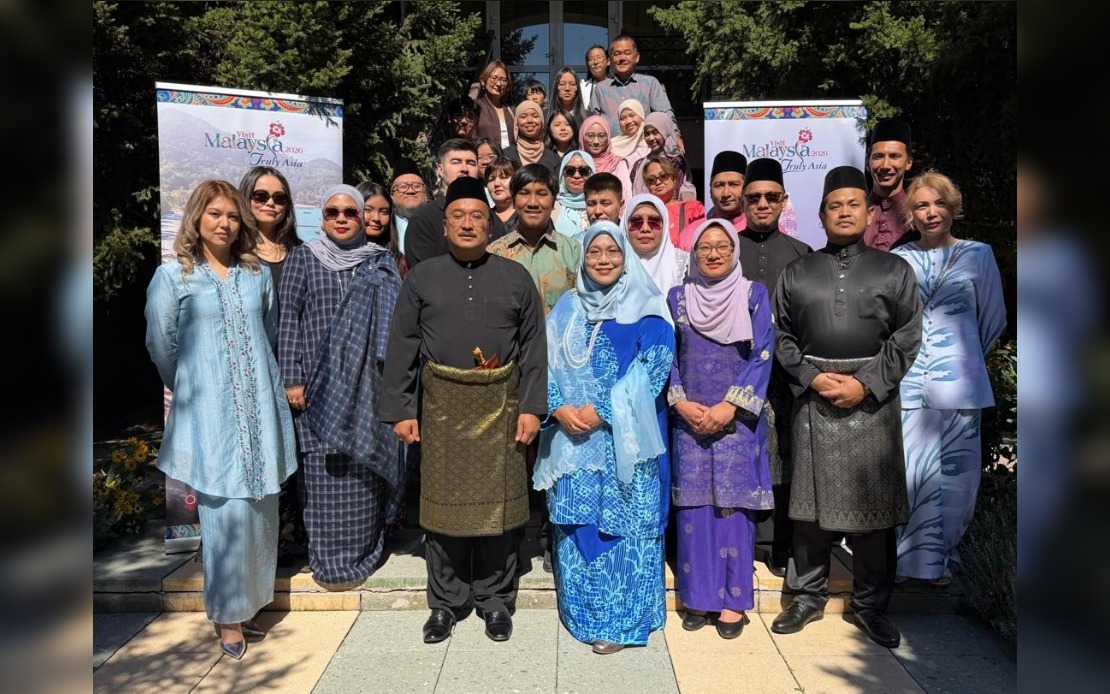
Thousands of kilometres from home, Malaysia's expatriate community in Kazakhstan gathered at Malaysia House in Astana on Saturday to commemorate the nation's 69th National Day, demonstrating how Malaysians abroad maintain their patriotic connection despite geographical distance. The ceremony, organised by the Embassy of Malaysia in Astana, featured the ceremonial raising of the Jalur Gemilang alongside renditions of the national anthem Negaraku and the Rukun Negara, establishing the traditional foundation for the broader celebration of Malaysian identity and values that would follow throughout the reception.
Malaysian Ambassador to Kazakhstan Mohd Adli Abdullah used the occasion to articulate a critical reframing of what national progress truly means within Malaysia's contemporary development framework. The 2026 National Day and Malaysia Day theme, titled "Malaysia MADANI: Prosperity Enjoyed," fundamentally shifts the measurement of national achievement away from purely quantitative metrics such as economic growth rates or infrastructure expansion. Instead, Ambassador Adli emphasised that genuine progress must be assessed by evaluating whether the fruits of development are distributed equitably across all demographic segments and geographic regions, ensuring that prosperity reaches vulnerable and marginalised populations, not merely accumulates among already-privileged groups.
This philosophical repositioning holds particular significance for Southeast Asian nations grappling with inclusive development challenges. Malaysia's MADANI concept acknowledges that rapid economic expansion can mask underlying inequalities and social fractures if benefits remain concentrated. For Malaysian expatriates in Kazakhstan—a nation itself pursuing economic diversification beyond energy sectors—the messaging reinforces how emerging economies must balance growth ambitions with equitable distribution frameworks. The reception thus served as a subtle diplomatic communication channel, subtly conveying Malaysia's thinking on inclusive development to host-nation observers and Kazakh officials attending the event.
Ambassador Adli called upon the Malaysian community present to embody and propagate MADANI values throughout their daily lives and professional endeavours in Kazakhstan. He specifically invoked five pillars—hard work, integrity, discipline, courtesy, and mutual assistance—as foundational qualities that should guide Malaysian expatriates in all contexts. This appeal represented more than ceremonial rhetoric; it functioned as a framework for maintaining Malaysian identity and values among citizens living abroad, acknowledging the reality that expatriate communities often face pressures to assimilate or adopt host-country norms that may not align with Malaysia's ethical and social standards.
Crucially, Ambassador Adli reframed the role of overseas Malaysians as de facto diplomatic representatives of their homeland. Every interaction between Malaysian expatriates and Kazakhs, he suggested, carries implications for how Malaysia is perceived internationally. This conceptualisation transforms individual Malaysians into informal ambassadors whose professional conduct, social behaviour, and cultural engagement directly influence Malaysia-Kazakhstan relations. For a nation seeking to strengthen its soft power and international standing, particularly within Central Asian contexts where Southeast Asian presence remains relatively limited, expatriate communities represent invaluable assets in relationship-building and image cultivation.
The Malaysia House reception incorporated an additional strategic dimension through its concurrent hosting of the Malaysia Technical Cooperation Programme (MTCP) Alumni Get-Together 2026. This programme, established in 1980, embodies Malaysia's commitment to South-South cooperation by providing training, capacity-building, and postgraduate study opportunities to developing nations. By 2025, Kazakhstan had benefited from MTCP initiatives that trained 196 officials across various sectors, representing substantial human capital investment flowing from Kuala Lumpur to Astana. The co-location of National Day celebrations with MTCP alumni gatherings symbolically linked Malaysia's domestic development narrative with its international development assistance mission.
The MTCP operates on a distinctive philosophical foundation: that developing nations possess valuable experiential knowledge and technical expertise that can benefit other nations on similar developmental trajectories. Rather than merely receiving knowledge from industrialised nations, programme participants engage in horizontal learning exchanges where Malaysian expertise in specific sectors—whether agriculture, public administration, technology, or healthcare—transfers directly to Kazakh contexts. This model carries particular relevance for Southeast Asian-Central Asian relations, where geographical and political distance has historically limited sustained engagement, and where shared developmental challenges create natural foundations for cooperation.
For Kazakhstan specifically, the 196 trained officials represent institutionalised knowledge pipelines that extend far beyond individual trainees. Each MTCP graduate returns to their government ministry or agency carrying Malaysian approaches to problem-solving, administrative frameworks, and professional standards. These officials subsequently influence policy implementation, mentor junior colleagues, and occasionally advance into senior positions where their Malaysia-informed perspectives shape national decision-making. The cumulative impact of such human capital development transcends simple statistics, gradually embedding Malaysian institutional models and diplomatic relationships into Kazakhstan's governance structures.
The Embassy's emphasis on strengthening Malaysia-Kazakhstan relations through "strategic cooperation between governments, close people-to-people ties, and expertise-sharing" reveals a sophisticated diplomatic strategy recognising that bilateral relationships require multiple reinforcing channels to achieve durability. Government-to-government relations provide formal frameworks and policy coordination, while people-to-people ties—including expatriate communities, student networks, and cultural exchanges—create organic affinity and mutual understanding resistant to political fluctuations. Expertise-sharing initiatives like the MTCP simultaneously generate professional networks and institutional dependencies that bind nations together through practical collaboration rather than merely diplomatic ceremony.
The gathering of Malaysian students, MTCP alumni, embassy staff, and "friends of Malaysia" in Astana reflects deliberate diplomatic inclusion strategy. By welcoming non-Malaysian participants, the Embassy extended the MADANI message beyond ethnic or citizenship boundaries, positioning Malaysia's development philosophy as universally relevant and applicable. This inclusivity serves dual purposes: it demonstrates Malaysia's confidence in the universal value of its governance framework while simultaneously building constituency support among influential Kazakh professionals who have directly experienced Malaysian development approaches and institutions.
For Malaysian readers observing celebrations from their distant Central Asian posts, the Astana event provides reassurance that the government actively maintains engagement with overseas communities and views them as extensions of Malaysia's national project. The systematic commemoration of National Day across embassies worldwide, coupled with substantive programming addressing development philosophy and bilateral cooperation, signals that being Malaysian abroad does not diminish one's connection to national purpose. Instead, it transforms that connection into a vehicle for international relationship-building and soft-power projection.
Looking forward, the integration of National Day celebrations with MTCP alumni activities establishes a model potentially replicable across Malaysia's diplomatic missions. By linking patriotic commemoration with practical developmental cooperation, the Embassy frames Malaysian identity not merely as historical or cultural identity, but as an active developmental and professional identity grounded in concrete cooperation and shared progress. This approach may increasingly characterise how Southeast Asian nations project power and influence in regions where traditional colonial legacies carry diminished weight and where development cooperation offers more credible pathways for establishing durable partnerships.

