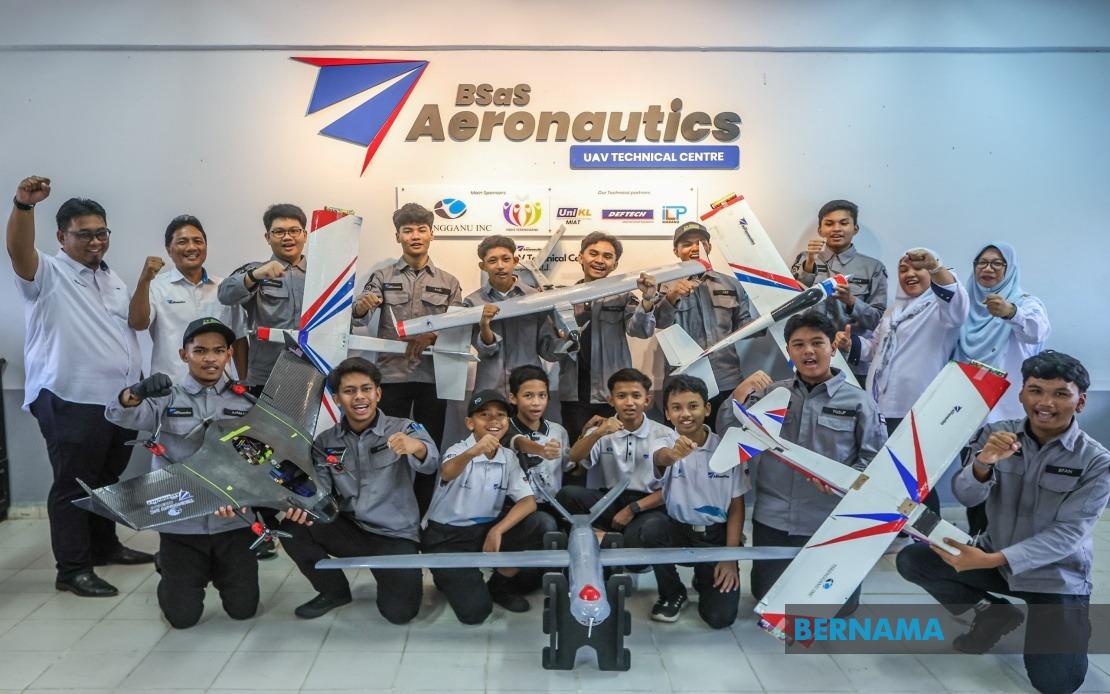
Secondary school students at SMK Bukit Sawa in Marang, Terengganu, are gaining hands-on experience in advanced aviation technology by designing and constructing their own unmanned aerial vehicles, marking a significant effort to develop local talent in a high-tech sector that Malaysia has identified as strategically important. The initiative, coordinated by English teacher Badrul Hisyam Zakaria, has engaged 35 students in building more than five fully-functional UAVs since the programme's inception in 2023, each vehicle representing a substantial investment of between RM6,000 and RM10,000 in components and materials.
What distinguishes this school-based project from typical educational activities is its commitment to industrial-grade standards and methodologies. The students work with the same engineering techniques and materials employed by the aviation industry itself, though adapted to a smaller scale appropriate for secondary school facilities and capabilities. This approach ensures that participants acquire genuine technical competency rather than merely theoretical knowledge, positioning them advantageously should they pursue related tertiary studies or employment opportunities. The current generation of UAVs relies on Global Positioning System technology for autonomous target detection and navigation, representing a meaningful step beyond simple remote-controlled aircraft.
Looking ahead, the programme is advancing toward incorporating artificial intelligence capabilities into the next generation of vehicles the students will construct. Rather than depending solely on pre-programmed GPS coordinates, these upgraded UAVs will employ visual recognition systems to identify and track targets autonomously, a technological leap that mirrors developments occurring in professional aerospace applications globally. This trajectory of continuous technical advancement within the student cohort demonstrates how extended engagement with emerging technologies can drive genuine innovation rather than simply replicating existing capabilities.
The programme has already demonstrated measurable success in terms of student outcomes and industry recognition. SMK Bukit Sawa secured the championship position in the UAV Avionics Integration Challenge for secondary schools during the MyAERO Challenge 2026 competition held at MAEPS in Serdang, Selangor, last June. Beyond competitive accolades, the initiative has successfully channelled former participants into further education aligned with aviation careers: two alumni have enrolled in aircraft engineering programmes at Universiti Kuala Lumpur, whilst three others have progressed to science studies at the matriculation level, indicating that the school-based exposure has effectively motivated students to pursue formal qualifications in related disciplines.
Badrul Hisyam's vision for the programme extends considerably beyond immediate secondary school achievements. He articulates a long-term perspective in which the school monitors student development trajectories not only during their secondary years but also as they transition into tertiary education and eventually the professional workforce. The coordinator projects that within three to four years, the first cohort of SMK Bukit Sawa participants will complete aviation engineering degrees and enter the industry, potentially establishing a pipeline of locally-trained professionals who have acquired their foundational skills within the Malaysian education system rather than relying exclusively on overseas training.
The programme's strategic importance lies partly in its potential contribution to Malaysia's broader aspirations regarding technological self-sufficiency and local industry development. By cultivating domestic expertise in UAV design and manufacture, the initiative addresses a recognised gap in Malaysia's capacity to develop indigenous aerospace technology without depending on foreign manufacturers or technology transfers. This objective carries economic implications, as the ability to design, build, and operate advanced aerial systems domestically could eventually generate employment opportunities and reduce reliance on imported technologies within the defence and civilian sectors.
Financial support for the TI-BSAS UAV In School programme has been provided substantially by Terengganu Incorporated, the state's investment and development company. Since the programme's launch in 2023, Terengganu Inc has contributed a total of RM75,000 through its corporate social responsibility allocation, demonstrating meaningful institutional commitment to educational and technological development within the state. The initial RM45,000 commitment in 2023 established the programme's foundational infrastructure, whilst an additional RM30,000 allocated in 2026 sustains ongoing activities and enables further technological development and student engagement.
Terengganu Inc president and group chief executive officer Datuk Burhanuddin Hilmi Mohamed emphasised that the company's investment strategy specifically targets skills acquisition in high-demand sectors and prioritises access for economically disadvantaged students. By directing resources toward the B40 income group within Terengganu, the programme attempts to democratise access to advanced technical training that might otherwise remain restricted to households with greater financial capacity. This equity-focused approach aligns with broader national objectives to reduce socioeconomic disparities in educational opportunity and ensure that talent development benefits extend across income demographics.
The collaboration between SMK Bukit Sawa, the Terengganu State Education Department, and multiple corporate sponsors including Terengganu Inc exemplifies how public-private partnership models can address skill gaps and technological development needs within Malaysia's education system. Rather than treating such partnerships as peripheral or supplementary to core educational functions, this initiative integrates industry engagement directly into the secondary curriculum and student experience. The model offers potential replicability across other Malaysian states and schools, particularly in regions seeking to develop specialised technical capabilities aligned with emerging industries.
For Malaysian educators and policymakers observing this programme's trajectory, the outcomes suggest that sustained, well-resourced engagement with cutting-edge technology at the secondary level can generate measurable impacts on student career pathways and aspirations. The transition of programme participants into university-level engineering studies and aviation careers demonstrates that the exposure and practical experience acquired through hands-on projects exerts genuine influence on educational and occupational choices. As Malaysia seeks to develop a more technically skilled workforce capable of competing in high-value manufacturing and technology sectors, such secondary school initiatives warrant attention and potential scaling.
Looking toward the medium term, the success of the TI-BSAS programme may prompt similar initiatives at other Malaysian institutions, particularly in states with aerospace or defence sector interests. The demonstrated ability to engage secondary school students in genuine engineering challenges whilst maintaining educational rigor provides a template that could be adapted to other advanced technologies. Whether through UAV development, robotics, renewable energy systems, or other emerging fields, the core principle of integrating real-world technical challenges into secondary education appears increasingly relevant to Malaysia's skills development priorities.

