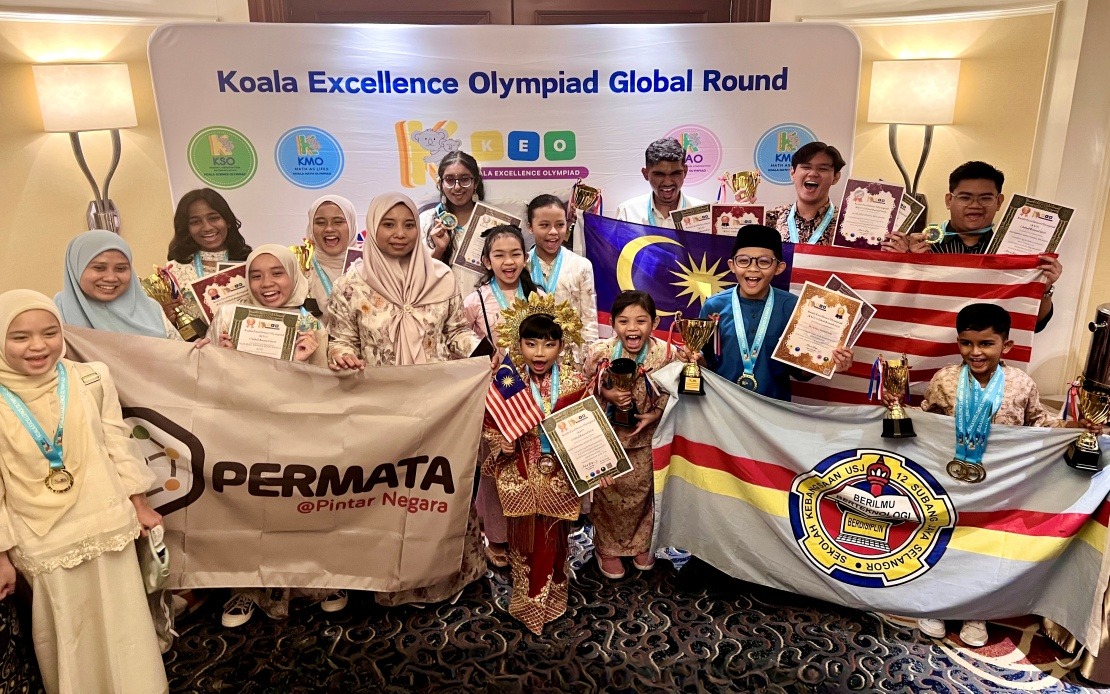
Malaysia's academic standing on the international stage received a significant boost this week as seventeen students returned from the Koala Excellence Olympiad 2026 in Macau with an impressive haul of nine overall awards and 22 medals in total. The delegation, which concluded its participation yesterday, demonstrated the calibre of young talent emerging from Malaysian schools across multiple academic disciplines, marking a substantial achievement for the nation's educational system.
Coordinating the Malaysian contingent was Aidah Misran from the Malaysian Young Scientists Organisation (MYSO), an institution instrumental in nurturing scientific excellence among the country's youth. The team's medal tally comprised five gold medals, six silver medals, and eleven bronze medals—a distribution that underscores consistent high-level performance rather than reliance on isolated standout results. This balanced achievement across multiple award categories suggests that Malaysia's educational institutions are producing well-rounded competitors capable of excelling in rigorous international academic environments.
The competition itself represents a distinctive approach to student assessment and development. Organised jointly by the Koala Excellence Olympiad, Miss Man International Group, and coordinated within Malaysia by MYSO, the event drew contestants from various nations to compete across four distinct olympiad categories: English, Mathematics, Science, and the Arts. Unlike traditional examinations that often emphasise rote memorisation, the KEO framework—developed by Australian educational specialists—prioritises critical thinking, creativity, and the practical application of knowledge to real-world scenarios. For Malaysian students accustomed to conventional assessment methods, participation in such internationally-oriented competitions offers valuable exposure to alternative pedagogical approaches.
The composition of Malaysia's delegation reflected a deliberate selection process spanning both primary and secondary education levels. Four students came from Kolej PERMATA@Pintar Negara at Universiti Kebangsaan Malaysia, while Sekolah Menengah Kebangsaan Ungku Aziz contributed six competitors. Sekolah Sultan Alam Shah, Sekolah Kebangsaan Convent (2) Bukit Nanas, and four other primary schools rounded out the fifteen-institution representation. This distribution across different school types—from premier colleges to conventional national schools—indicates that academic excellence in Malaysia is not confined to elite institutions but flourishes across the broader educational landscape.
The standout performer of the Malaysian contingent was Mukridz Mardzuki, a Year Six student from Sekolah Kebangsaan Seri Hartamas, who secured the overall Science Olympiad championship in the primary school category. This achievement represents more than individual success; it signals that Malaysian primary education is producing students capable of competing at the highest international levels in rigorous scientific disciplines. The significance of such an accolade extends beyond personal achievement, offering inspiration to younger students and validation of Malaysia's investment in science education at foundational levels.
At the secondary level, two Malaysian students distinguished themselves as runners-up in the Science Olympiad category. Sarah Isabel Maryam Ahmad Suhael from Sekolah Kebangsaan Convent (2) Bukit Nanas claimed the primary category runner-up position, while Alfie Rizq Danial Azlan from Sekolah Sultan Alam Shah achieved the equivalent distinction in the secondary bracket. Complementing these science achievements, Ayra 'Adani Muhammad 'Aizat from Kolej PERMATA@Pintar Negara at UKM earned recognition as overall runner-up in the English Olympiad, demonstrating that Malaysian excellence encompasses linguistic proficiency alongside scientific knowledge.
The delegation's success extended further with five third-place finishes distributed across multiple competitors and disciplines. Marvyn Zef Mark Philip emerged as a particularly accomplished participant, securing two category wins in Science and English before placing third overall, underscoring the potential for individual students to demonstrate versatility across distinct academic domains. Other third-place finalists included P Prem in Science, Muhammad Khairul Mauidz Khairul Azman in Mathematics, and AK Shashini in English, collectively showcasing breadth of Malaysian talent across the four olympiad categories.
The performance at KEO 2026 carries implications for Malaysia's broader educational aspirations. As Southeast Asia's economies increasingly compete for skilled talent in knowledge-intensive sectors, demonstrating consistent academic achievement at international competitions becomes a mechanism for attracting investment and talent. Furthermore, for Malaysian students themselves, participation in such platforms builds confidence, exposes them to international standards of excellence, and cultivates networks with peers from other nations—connections that may prove valuable as they progress to tertiary education and professional careers.
The Koala Excellence Olympiad's emphasis on alignment with curriculum standards whilst simultaneously pushing beyond conventional assessment methods addresses a fundamental challenge in modern education: preparing students who can both master foundational knowledge and apply it creatively to novel problems. Malaysian schools, through their students' strong showing, have demonstrated readiness to embrace this educational philosophy. The concentration of medals across multiple institutions suggests that institutional quality in Malaysia is sufficiently distributed that excellence is not anomalous but represents an achievable standard across well-managed schools with committed educators.
Looking forward, Malaysia's success at KEO 2026 invites reflection on how such international competitions might be leveraged more systematically to identify and develop academic talent. The diversity of schools represented in the delegation suggests that talented students exist throughout Malaysia's educational system rather than clustering exclusively in elite institutions. Expanding access to preparation for international olympiads, particularly in underrepresented regions, could unlock additional potential whilst simultaneously raising educational standards nationally through the competitive pressure such platforms generate.
The return of seventeen medal-winning students also presents an opportunity for these young achievers to mentor and inspire their peers. Their experiences competing internationally, exposure to innovative assessment methodologies, and success against global benchmarks position them as valuable ambassadors for academic excellence within their respective schools. Malaysian institutions that systematically harness the knowledge and motivation of returning olympiad participants are likely to see ripple effects extending far beyond the initial competitors, potentially establishing sustainable cultures of intellectual ambition.

