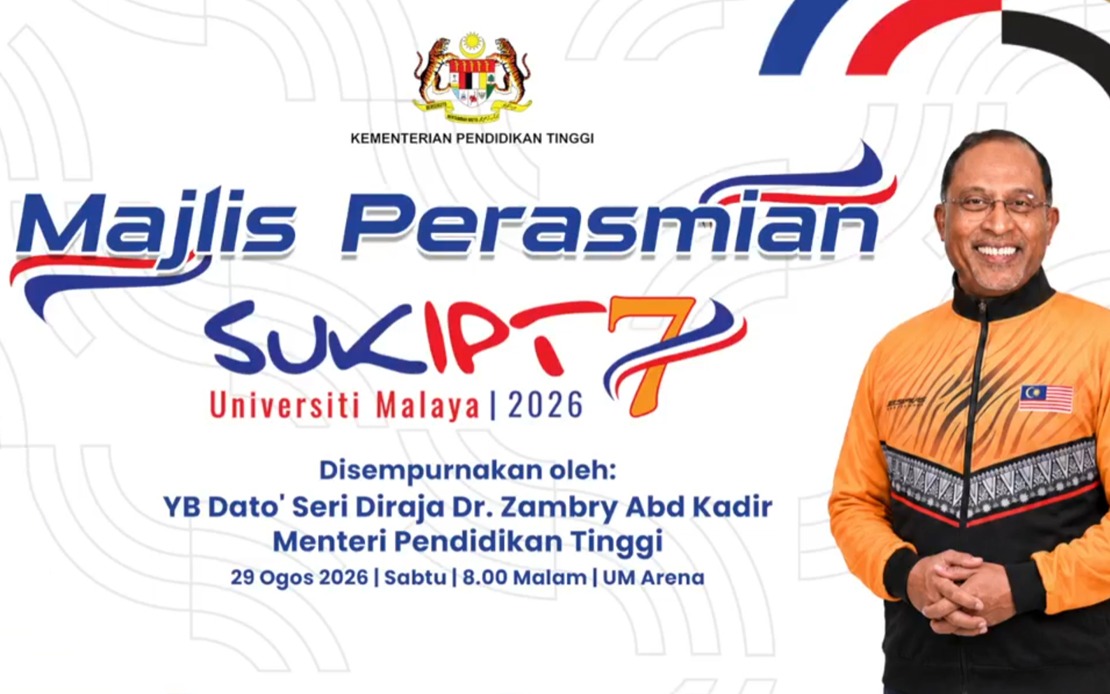
Higher Education Minister Datuk Seri Dr Zambry Abdul Kadir has championed Malaysia's university sports ecosystem as a springboard for developing elite talent capable of competing internationally. Speaking at the opening of the Higher Education Institution Games (SUKIPT) 2026 at Universiti Malaya Arena today, Zambry underscored how achievements by institution-based athletes on the global stage validate the strategic importance of investing in university sports programmes as vehicles for national sporting excellence.
The minister pointed to a constellation of recent triumphs demonstrating the calibre of Malaysia's tertiary-level competitors. Most notably, Amir Daniel Abdul Majid from Universiti Sains Malaysia secured Malaysia's first-ever Commonwealth Games gold medal in judo at Glasgow 2026, etching his name into the country's sporting history books. This breakthrough achievement carries particular significance for Southeast Asia's competitive judo landscape, where Malaysia has traditionally lagged behind regional powerhouses. Alongside this landmark success, weightlifters Muhammad Erry Hidayat from Universiti Putra Malaysia and Muhammad Aniq Kasdan from Universiti Teknologi MARA claimed gold medals in the men's 79-kilogramme and 60-kilogramme categories respectively at the same Games, demonstrating consistent strength in a discipline where Asian nations maintain high global rankings.
Beyond the Commonwealth stage, Zambry highlighted domestic records shattered by university-affiliated competitors, particularly in track and field where Malaysia traditionally struggles for international recognition. Omar Osman, representing Politeknik Sultan Ibrahim, joined forces with UiTM's Muhammad Fadwah and Universiti Pendidikan Sultan Idris sprinter Danish Iftikhar Muhammad Rosli in rewriting national standards. The latter pair's achievements proved especially remarkable, as Danish Iftikhar shattered Malaysia Games records in both the 200-metre individual event and the 4x100-metre relay, suggesting emerging depth in short-distance running—an area where Southeast Asian representation at elite international championships remains limited.
These performances acquire deeper significance when contextualized within Malaysia's broader athletic development strategy. The minister's emphasis on universities as talent incubators reflects a deliberate policy pivot toward harnessing the concentrated population of young, fit individuals within tertiary institutions. Unlike traditional sports academy models that demand substantial centralized funding, university-based systems leverage existing infrastructure, coaching networks, and competitive environments embedded within academic campuses. This decentralized approach has proven cost-effective across Southeast Asia, where countries like Thailand and Vietnam have similarly utilized their higher education sectors as talent recruitment pools.
The SUKIPT 2026 Games itself represents the institutional scale at which this talent nurturing occurs. Held from 28 August to 6 September at Universiti Malaya, the seventh edition assembles an unprecedented 64 contingents—comprising 20 public universities, 42 private higher education institutions, one polytechnic, and one community college—fielding 8,244 athletes and officials across 30 sporting disciplines. The sheer participation numbers indicate that university sports in Malaysia have evolved beyond peripheral recreational activity into a structured, competitive ecosystem where emerging talent faces consistent domestic benchmarking.
Financial incentives woven into the tournament's structure underscore the government's commitment to elevating performance standards. The Games offers 227 gold medals alongside cash rewards of RM3,000 for individual Sportsman and Sportswoman of the Games awards, RM7,000 for Best Male and Female Team distinctions, and notably, RM20,000 for athletes who break national records. This tiered incentive structure strategically targets record-breaking as a policy objective, encouraging competitors to pursue performances that transcend mere competitive victory and establish new benchmarks against which future generations must measure themselves. For athletes contemplating professional sporting careers, such financial recognition provides tangible validation that their university investments can yield monetary returns.
The 'Creating a Legacy of Champions' theme encapsulating SUKIPT 2026 articulates an implicit theory about athletic development spanning beyond individual tournament cycles. Rather than viewing university games as isolated events, the thematic framing positions each competition as a stone in a cumulative structure of excellence. Zamby's rhetoric similarly emphasized this temporal dimension—that today's university medal winners become tomorrow's international representatives, that records set now establish aspirational targets shaping future training methodologies, and that the culture of championship-mindedness cultivated in university settings persists throughout athletes' careers even after graduation.
The minister's emphasis on universities 'daring to challenge records' and 'elevating Malaysia's name on the world stage' articulates an ambitious vision for how tertiary sport can function as a nationalist project. This framing resonates particularly within Southeast Asia, where sporting achievement frequently carries symbolic weight in regional rivalries and broader geopolitical positioning. Malaysia's historical underperformance in certain Olympic disciplines—particularly athletics, where regional competitors from Thailand and Vietnam have occasionally surpassed Malaysian rankings—makes institutional commitment to university-level development strategically meaningful beyond mere athletic pursuits.
The success of private institutions competing alongside public universities within SUKIPT's framework—42 private higher education entities versus 20 public ones—suggests Malaysia's university sports ecosystem transcends government monopoly. This privatized participation introduces market-based competition and potentially diversified talent recruitment networks, as private institutions often maintain different student demographic profiles and athletic scholarship structures than their publicly-funded counterparts. The resulting diversity in institutional approaches may actually strengthen the overall talent identification and development landscape.
Looking forward, Zambry's pronouncements signal sustained government backing for university sports infrastructure and athlete support systems. The minister's willingness to publicly celebrate specific athletes and institutions creates a performative commitment that future policy decisions must honor. For Malaysian universities, this political attention validates administrative investments in sports facilities, coaching recruitment, and athlete welfare—expenditures that board members might otherwise scrutinize. For athletes themselves, ministerial endorsement of university sports pathways legitimizes their pursuit of excellence within academic settings, potentially incentivizing talented young Malaysians to remain within domestic university systems rather than seeking development opportunities abroad.
The cascade of achievements Zambry enumerated—Commonwealth Games medals across weightlifting and judo, SUKMA records in athletics—suggests Malaysia's university system has begun maturing into a credible talent factory. Whether this nascent success can scale into sustainable international competitiveness across multiple Olympic disciplines, and whether Malaysia can translate university-based excellence into consistent podium finishes at regional and global championships, will ultimately determine whether SUKIPT 2026's legacy matches its aspirational branding.

