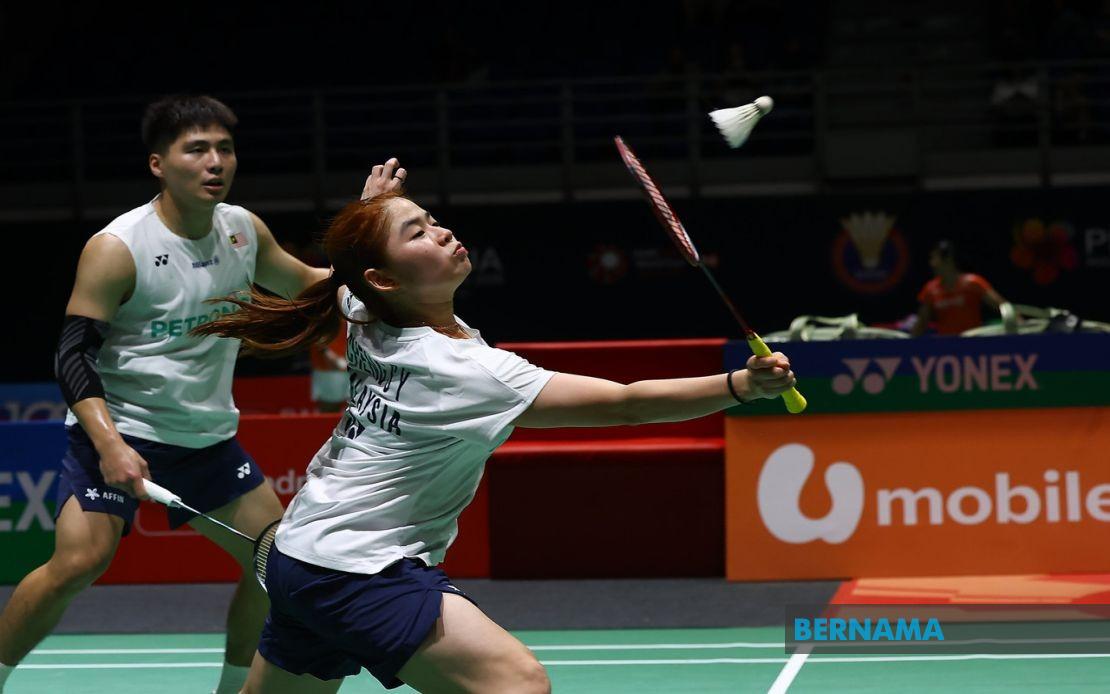
Malaysia's bid for a title run at the 2026 Japan Open came to an end on July 18 after the nation's last two pairs were eliminated in the semi-final round in Tokyo. The departure of mixed doubles combination Jimmy Wong-Cheng Su Yin and men's doubles pairing Goh Sze Fei-Nur Izzuddin marks the conclusion of what had been a competitive tournament showing for Malaysian badminton, despite ultimately falling short of championship glory.
The unseeded mixed doubles partnership of Jimmy Wong and Cheng Su Yin had captured considerable attention with their impressive run through the draw, eliminating higher-ranked opponents along the way. Their journey came to a halt against Hong Kong's experienced duo of Tang Chun Man-Tse Ying Suet, who proved too composed in the decisive moments. The match stretched to nearly 70 minutes, reflecting the competitive nature of the encounter, but Malaysia's pair ultimately fell short 17-21, 21-18, 21-15. Despite the loss, their performance throughout the tournament demonstrated that they belong among the world's elite mixed doubles partnerships, having navigated a challenging path to the semi-finals.
The loss was particularly poignant given the momentum Wong and Cheng Su Yin had built by defeating more fancied opponents earlier in the championship. Their giant-killing run resonated with Malaysian badminton fans and underscored the potential within the national programme to challenge established powers. However, Tang Chun Man and Tse Ying Suet's experience and tactical acumen ultimately proved decisive in a match that hinged on crucial rallies in the closing stages.
The men's doubles pair of Goh Sze Fei and Nur Izzuddin faced an even more daunting opponent in world number one ranked Kim Won Ho-Seo Seung Jae of South Korea. The Malaysian combination demonstrated fighting spirit throughout their 58-minute encounter but could not find the consistency needed to trouble the top seeds. The opening game proved particularly challenging for the Malaysians, who were comprehensively outplayed in losing 12-21 as the Korean pair imposed their superior court control and attacking prowess.
What followed, however, suggested that Goh Sze Fei and Nur Izzuddin possessed the resilience to compete at the highest level. They executed a dramatic turnaround in the second game, dominating the Korean partnership to claim a 21-11 victory and force a decisive third set. This comeback demonstrated the Malaysian pair's capacity to read the game and adapt their tactics under pressure, providing a glimmer of hope that they could upset the odds. Yet the decisive game ultimately belonged to Kim Won Ho and Seo Seung Jae, who regrouped effectively to win 21-13 and progress to the final.
The history between these two pairings adds context to the semi-final result. Malaysia's men's doubles duo has now fallen to the South Korean combination in three of their five meetings, indicating a pattern that has not worked in their favour. This statistical reality highlights the gap that remains between Malaysian badminton and the elite international level, particularly in the men's doubles category where countries like South Korea have invested heavily in technical development and conditioning programmes.
From a broader perspective, Malaysia's performance at the 2026 Japan Open reflects the current state of the national badminton programme. While the country continues to produce players capable of reaching the latter stages of prestigious tournaments, converting those advances into titles remains an ongoing challenge. The tournament also illustrated how depth in pairings affects a nation's overall prospects; with both Malaysian pairs eliminated, the medal count reflects the reality that success in badminton, particularly at Asian level, often requires multiple medal-winning combinations.
For the athletes involved, the semi-final exits will sting, particularly given how close Goh Sze Fei and Nur Izzuddin came to a potential final. Nevertheless, their efforts against the world's top-ranked pair should provide motivation and valuable tactical learning for future tournaments. Similarly, the mixed doubles pair's continued improvement suggests they possess the ingredients for breakthrough victories in coming competitions, provided they can maintain their current development trajectory.
The implications of these results extend beyond the Japan Open itself. As Malaysia looks toward major continental and world championship events, performances against top-ranked opposition like South Korea's men's doubles team and Hong Kong's mixed doubles pair offer diagnostic information about where the national programme stands. Badminton Association of Malaysia coaches will likely study the semi-final performances closely to identify tactical adjustments and fitness improvements needed to close the gap separating Malaysia from sustained success at the highest competitive levels.
Looking ahead, Malaysia's badminton fraternity will hope that the experience gained in Tokyo translates into improved showings in subsequent tournaments. The return of high-level exposure and competitive matches against world leaders serves as a laboratory for development, and the nation's best pairs must convert these learning opportunities into victories at future competitions. The 2026 Japan Open campaign may have concluded prematurely for Malaysian interests, but the platform provided has reinforced both the potential and the work remaining for the country's badminton aspirations.

