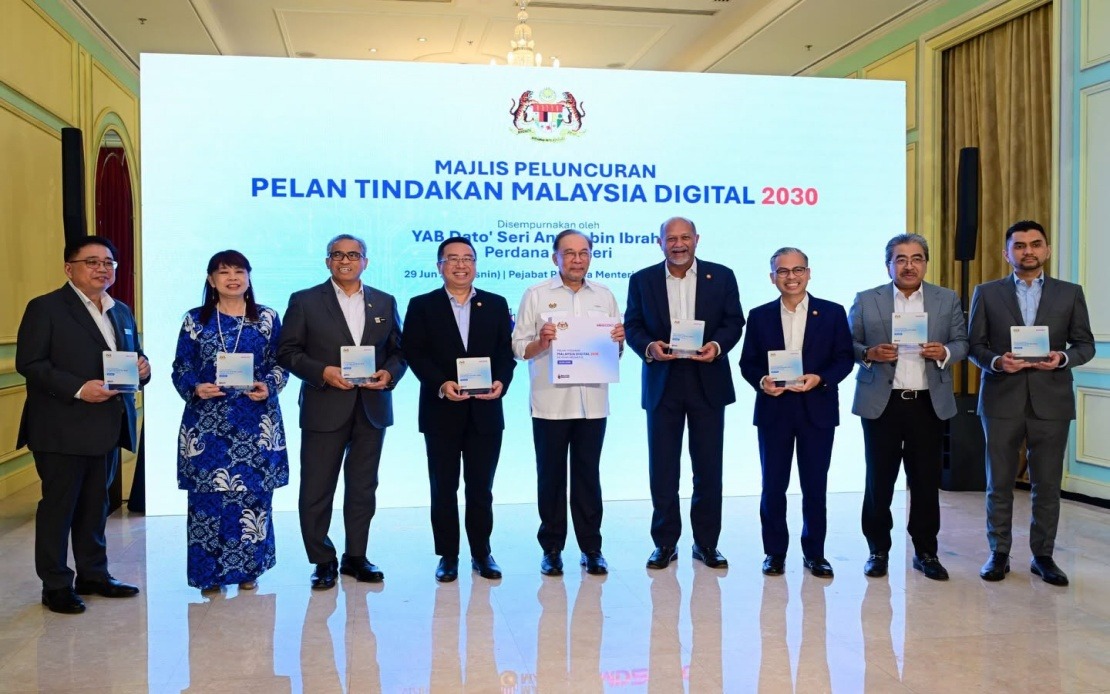
Malaysia's push toward digital governance has reached a measurable milestone, with the civil service successfully eliminating more than 116,000 reams of paper and generating nearly RM2 million in cost savings through its paperless initiative. The achievement underscores the government's commitment to modernizing administrative operations while simultaneously reducing environmental impact—a dual objective that appeals to both fiscal responsibility and sustainability concerns. Chief Secretary to the Government Tan Sri Shamsul Azri Abu Bakar disclosed the figure during deliberations of the Digital Economy and Fourth Industrial Revolution Council, a high-level policy forum chaired by Prime Minister Datuk Seri Anwar Ibrahim.
The paperless transition represents one of several concurrent initiatives designed to accelerate Malaysia's journey toward becoming a comprehensive digital nation. During the MED4IR council meeting where the savings were announced, government leadership concentrated on three principal areas: the expansion of MyDigital ID functionality, advancement of the MyGov digital platform, and broadening digital service availability across Malaysia's higher education sector. These interconnected projects share a common objective of rendering government services more accessible and efficient for citizens and businesses alike, reducing bureaucratic friction at points where citizens typically interact with state institutions.
Tan Sri Shamsul Azri, operating simultaneously as Government Cluster Chairman, emphasized that the paperless initiative forms part of a larger strategic ambition articulated through Malaysia Digital 2030, a comprehensive roadmap unveiled by Prime Minister Anwar Ibrahim during the same council session. This framework positions digital transformation as central to the nation's economic and social development through the current decade. The initiative explicitly targets artificial intelligence adoption and development, reflecting global recognition that AI capabilities will define competitive advantage in the decades ahead.
The journey toward paperless government operations commenced earlier in 2024, when Tan Sri Shamsul Azri announced that the civil service would implement digital-first processes for routine administrative transactions beginning in February. Rather than attempting an instantaneous overhaul of all government paperwork, planners adopted a phased methodology, initially focusing on straightforward, high-volume transactions where digital alternatives could be rapidly deployed without disrupting essential services. This measured approach allowed civil servants to adjust workflows and systems incrementally while maintaining operational continuity.
The RM1.99 million in documented savings carries implications extending beyond simple accounting ledgers. For a region like Southeast Asia, where many nations wrestle with infrastructure constraints and budget pressures, Malaysia's demonstrated ability to achieve simultaneous cost reductions and efficiency improvements through digital transition offers a practical template. The figures provide concrete evidence that digital transformation need not remain an abstract corporate aspiration but can deliver tangible financial benefits when properly implemented across large institutional structures.
Environmental considerations amplify the significance of eliminating 116,405 reams of paper annually. Each ream represents roughly 500 sheets, suggesting the initiative prevented the consumption of approximately 58 million pages of paper. Beyond the direct conservation of forest resources, the reduction in paper production diminishes associated environmental costs including water usage, chemical processing, and carbon emissions inherent to manufacturing and transporting paper products. For a nation increasingly attentive to environmental sustainability, these benefits reinforce the business case for digital government.
The MyDigital ID initiative merits particular attention given its foundational role in Malaysia's digital infrastructure. This unified digital identity system serves as a gateway enabling citizens to access multiple government services through a single authenticated credential. Reducing reliance on paper documentation supports this system's core functionality, as citizens can maintain and present credentials digitally rather than managing physical documents. The ecosystem created by MyDigital ID and MyGov together constructs the backbone supporting continued digital expansion across government services.
Malaysia's explicit commitment to emerging as an AI Nation by 2030 connects directly to the paperless initiative and broader digital infrastructure development. Artificial intelligence systems require structured digital data to function effectively; a civil service still entrenched in paper-based processes cannot harness AI capabilities to enhance decision-making or service delivery. The transition to digital administration simultaneously creates the informational foundation necessary for AI implementation while demonstrating organizational capability to execute large-scale technological transitions—a prerequisite for successfully deploying more complex emerging technologies.
The MyMAHIR National AI Council for Industry, referenced during the MED4IR meeting, represents institutional mechanisms for nurturing AI talent development across Malaysian industries. By coupling infrastructure investment through initiatives like the paperless program with dedicated talent development frameworks, government leadership pursues a balanced approach recognizing that technological adoption depends equally on human capability and institutional readiness. The council's establishment signals recognition that Malaysia must develop domestic expertise rather than remaining dependent on imported solutions.
For Malaysian businesses and entrepreneurs, the government's demonstrated commitment to digital transformation creates opportunity. As civil service operations become increasingly digital, private sector service providers positioned to supply digital solutions, cybersecurity services, data analytics expertise, and AI applications will find expanding market opportunities. The government's own transformation serves as a proof-of-concept, validating digital business models for potential clients hesitant about technological transitions.
The paperless initiative also carries implications for public sector employment and skills development. As administrative workflows shift from paper-based to digital systems, civil servants require different competencies. Training programs must emphasize digital literacy, data management, and cybersecurity awareness. This transition, while potentially disruptive, creates opportunities for workforce development that positions Malaysian public sector employees for greater productivity and career advancement within modernized administrative structures.

