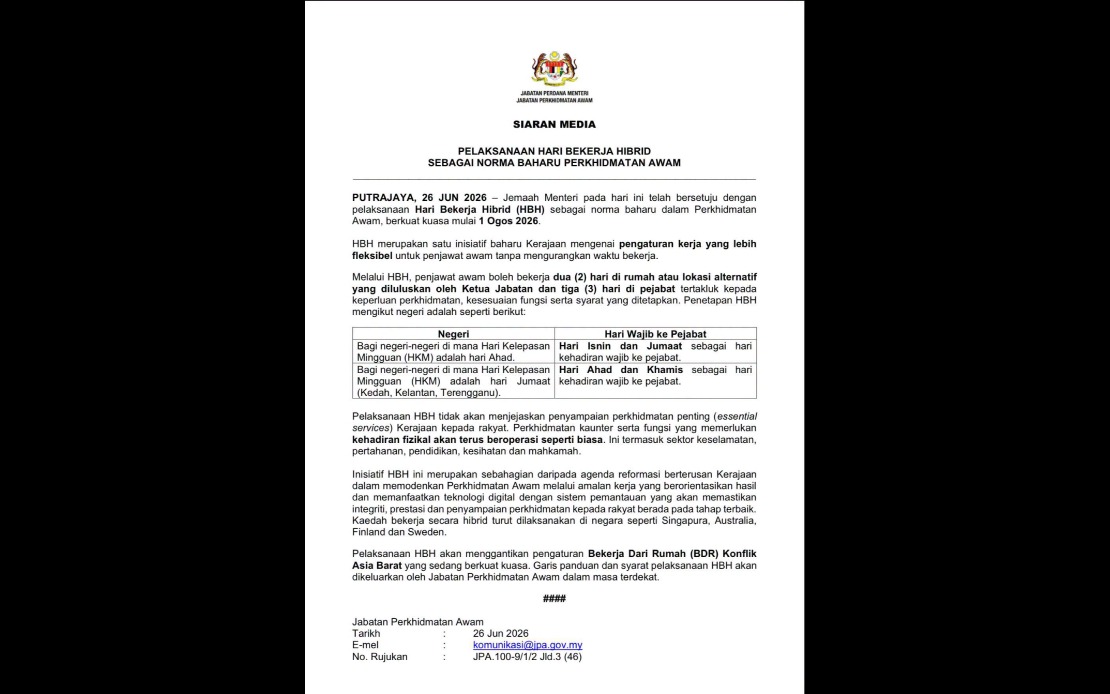
Malaysia's Cabinet has approved a formal shift toward hybrid working arrangements for the nation's civil service, with implementation commencing on August 1. The Public Service Department announcement represents a structured modernisation of government workplace practices, moving beyond ad-hoc remote work policies into a standardised framework designed to balance operational efficiency with employee flexibility. This decision reflects broader international trends toward flexible work arrangements whilst maintaining the delivery of essential public services.
Under the new Hybrid Work Day system, civil servants across the public sector will follow a consistent schedule: two days working from home or an alternative location sanctioned by their departmental head, coupled with three mandatory days at the office. The arrangement is not universal, however; implementation remains subject to individual service requirements, job suitability assessments, and departmental conditions. This flexibility acknowledges that different government functions operate under varying operational constraints—a recognition that administrative roles may adapt to remote arrangements differently than frontline service delivery positions.
The HBH framework replaces the existing Work From Home arrangement that has operated in the civil service since the COVID-19 pandemic forced rapid adaptation of government operations. Rather than maintaining emergency-era protocols indefinitely, policymakers have chosen to formalise remote work as a permanent component of the civil service work culture. The transition signals confidence that hybrid arrangements can function sustainably within government structures whilst addressing workforce expectations for flexible work conditions that have become increasingly standard across Southeast Asia's competitive labour market.
Critical to the implementation strategy is the protection of essential public services. Counter-facing functions and roles requiring physical presence—encompassing security, defence, education, healthcare and judicial sectors—will continue operating under traditional in-office arrangements. This segmented approach recognises that not all government functions can be delivered remotely and that certain public services demand uninterrupted, in-person availability. The PSD's explicit commitment to maintaining service delivery standards seeks to preempt concerns that flexibility might compromise government responsiveness or operational capacity.
Geographical variations in the policy reflect Malaysia's diverse state-level administrative structures. States observing Sunday as the Weekly Rest Day will designate Monday and Friday as compulsory office attendance days, ensuring consistent weekly in-office presence around the weekend structure. Conversely, Kedah, Kelantan and Terengganu—jurisdictions with Friday as the weekly holiday—will require civil servants to be physically present on Sunday and Thursday. This calibration demonstrates attention to local administrative practices and religious observances, avoiding a one-size-fits-all approach that might disrupt state-specific governance patterns.
The government frames HBH as integral to its broader public service modernisation agenda, emphasising that the arrangement maintains full working hours whilst introducing operational flexibility. This distinction matters for civil service morale; employees receive genuine schedule flexibility without any implicit reduction in expected productivity or output. The approach aligns with contemporary management philosophy that productivity depends on results and outcomes rather than physical presence, a conceptual shift that requires supporting digital infrastructure and performance measurement systems.
Accounting for implementation complexities, the PSD indicates that a monitoring mechanism will be established to track performance, integrity, and service delivery standards across the hybrid workforce. This surveillance framework appears designed to address potential concerns from traditionalists within government and the public that remote work might erode accountability or create productivity gaps. By committing to measurable oversight, policymakers signal that flexibility comes with corresponding responsibility and measurable outcomes.
International precedent provides legitimacy to Malaysia's approach. The statement references adoption of hybrid arrangements in Singapore, Australia, Finland and Sweden—developed nations with mature public service frameworks and strong institutional capacity. This global context positions Malaysia within an international mainstream of governance modernisation, particularly relevant given the nation's aspirations as a regional economic and governance leader. The reference subtly addresses any perception that hybrid work represents a retreat from professional standards.
For Malaysian organisations and individuals navigating the rapidly evolving Southeast Asian workplace, this policy shift carries broader implications beyond government employment. Private sector practices increasingly mirror public sector approaches; government adoption of hybrid work normalises the arrangement across the economy and signals that flexible arrangements represent forward-thinking management rather than temporary expedients. This carries particular significance for Malaysia's competitiveness in attracting regional talent, where workforce flexibility increasingly influences location decisions for multinational companies and skilled professionals.
The August 1 implementation date provides a two-month adjustment window for departmental planning, technology preparation, and guideline development. The PSD's commitment to releasing detailed implementation guidelines suggests that the framework remains nascent, with operational specifics still under development. Civil service leaders will require clear direction on performance expectations, equipment provision for remote workers, data security protocols, and escalation procedures when remote work proves unsuitable for particular roles or circumstances.
Challenges will inevitably emerge during implementation. Departmental cultures vary significantly; some government agencies possess digital infrastructure and results-oriented management frameworks conducive to hybrid arrangements, whilst others may struggle with coordination, oversight, and output measurement. The effectiveness of the transition will depend substantially on management capability at departmental level and the adequacy of investment in collaboration tools, cybersecurity, and training.
This policy evolution also reflects changing demographic expectations within Malaysia's civil service. Younger professionals increasingly demand workplace flexibility as a condition of employment, making formal hybrid arrangements necessary for recruitment and retention. By institutionalising flexible work, the government acknowledges evolving workforce preferences whilst attempting to modernise public service culture—a cultural shift that may prove as significant as the practical operational changes. The success of this initiative will likely influence similar policy discussions across Southeast Asia's public sectors in coming years.

