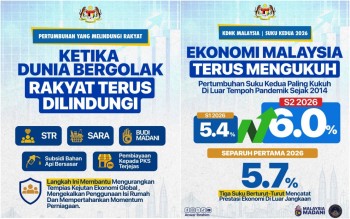
Malaysia's economy demonstrated remarkable resilience in the second quarter of 2026, expanding at a six per cent rate that surpassed analyst forecasts and represented the nation's strongest quarterly performance outside crisis periods in over a decade. The expansion emerged despite significant international headwinds, including slowing global economic activity, ongoing supply chain disruptions, and regional instability affecting commodity prices and trade flows across Southeast Asia and beyond.
Prime Minister Datuk Seri Anwar Ibrahim attributed this outperformance to the MADANI Government's deliberate policy framework designed to insulate Malaysian households from external shocks. He emphasised that the administration had actively worked to prevent widespread economic hardship despite mounting global inflationary pressures triggered by successive crises in West Asia, which have reverberated through international energy markets, shipping costs, and input prices for manufacturers throughout the region.
The government's protective measures extended across multiple channels, including targeted cash assistance schemes. The BUDI MADANI programme, alongside Sumbangan Tunai Rahmah (STR) and Sumbangan Asas Rahmah (SARA), provided direct financial relief to vulnerable populations and helped sustain domestic consumption. These initiatives functioned as automatic stabilisers, preventing sharp reductions in household spending that might otherwise have dampened economic activity during inflationary periods.
Beyond visible subsidy and cash transfer programmes, Anwar highlighted less publicised government interventions aimed at price stabilisation and supply chain management. The administration had coordinated efforts to maintain adequate domestic supplies of essential commodities and moderate retail price increases, preventing the kind of severe consumer cost shocks that typically accompany global supply disruptions. Such measures reflected recognition that political stability and social cohesion depend partly on protecting purchasing power for ordinary Malaysians.
The Q2 2026 result carries particular significance for Malaysia's regional positioning. While developed economies struggled with monetary tightening and slowing investment, and regional peers grappled with similar inflationary and supply challenges, Malaysia's six per cent expansion demonstrated the effectiveness of combining targeted fiscal support with pragmatic supply management. This performance provides a counterpoint to narratives of inevitable economic slowdown during global disruption, suggesting that policy design and implementation quality matter substantially.
However, Anwar acknowledged that achieving sustained expansion required sustained commitment to reform and structural improvement. He noted that temporary relief measures and price controls, while necessary during crisis periods, could not permanently address underlying economic challenges. The government recognised that long-term prosperity depended on generating higher-quality employment opportunities, raising real incomes beyond nominal wage growth, and creating sustainable pathways for vulnerable groups to participate meaningfully in economic expansion.
The prime minister's emphasis on ongoing reform reflects awareness that Malaysia faces medium-term challenges typical of upper-middle-income economies seeking advancement toward high-income status. These include productivity growth, industrial upgrading, workforce skills development, and ensuring that gains from expansion reach beyond elite sectors and urban centres. The Q2 performance provided room for such structural initiatives without immediate crisis management consuming all policy attention.
Sector-specific drivers of Q2 growth remain crucial context for Malaysian stakeholders. Manufacturing activity, driven partly by continued technology supply chain rebalancing, likely contributed significantly alongside services sectors including tourism, finance, and professional services. Understanding which sectors expanded and which lagged matters for assessing whether growth rests on sustainable foundations or temporary export surges vulnerable to reversal as global conditions shift.
For Southeast Asia more broadly, Malaysia's quarterly expansion offers data points relevant to regional economic assessments. Whether Malaysia's performance reflects specifically effective domestic policies, temporary commodity price advantages, or broader regional cyclical improvements will influence how other governments calibrate policy responses. The region's interconnected trade and investment networks mean that Malaysia's sustained growth contributes to stability and demand across Indonesia, Thailand, Singapore, Vietnam, and beyond.
Looking ahead, Anwar's framing prioritised balancing near-term stability with longer-term development. Maintaining growth momentum while managing inflation, reducing inequality, and building productive capacity required disciplined policy sequencing. The government intended to preserve existing relief programmes protecting lower-income Malaysians while simultaneously advancing structural reforms that improve competitiveness and income generation capacity across the economy.
The six per cent expansion validated the government's chosen policy direction at a critical moment. Strong economic performance during global uncertainty strengthens political credibility for pursuing more ambitious reforms that might carry short-term adjustment costs. Citizens and investors more readily accept structural changes and productivity-enhancing measures when delivered within context of visible economic expansion and rising employment opportunities rather than during contraction or stagnation.
Ultimately, Malaysia's Q2 2026 performance reflected both effective crisis management and proactive economic stewardship. The government had navigated multiple simultaneous challenges—international supply disruptions, regional instability, and inflationary pressures—without allowing these external shocks to translate into domestic economic contraction. Yet Anwar's emphasis on continued reform suggested recognition that six per cent growth alone, without productivity improvements and inclusive development, provided insufficient foundation for Malaysia's aspirations as a developed nation.

