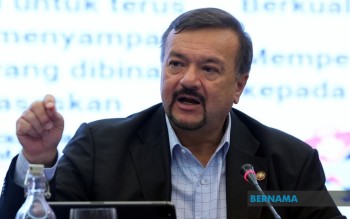
Malaysia's economic performance continues to demonstrate resilience in the face of a challenging global backdrop, according to Finance Minister II Datuk Seri Amir Hamzah Azizan, who highlighted impressive growth trajectories that position the nation on a steady path toward developed-economy status. Speaking at the GEAR-uP Progress Report press conference in Putrajaya, Amir Hamzah outlined a series of encouraging economic indicators that suggest Malaysia's policy framework is yielding tangible results despite persistent headwinds from international trade disputes and regional geopolitical tensions.
The numbers paint an optimistic picture for policymakers and observers tracking Southeast Asia's second-largest economy. Malaysia achieved 5.2 per cent gross domestic product growth in both 2024 and 2025, while the first quarter of this year saw that rate climb to 5.4 per cent. The government's advance estimate for the second quarter projects an acceleration to 5.8 per cent, translating to a blended average growth rate of 5.6 per cent across the first half of 2025. Such sustained growth above the 5 per cent threshold is noteworthy when considered against the backdrop of trade tensions and Middle Eastern instability that have constrained activity elsewhere in the region and across major developed economies.
These results underscore the effectiveness of Malaysia's economic policy framework at a time when external shocks would ordinarily dampen expansion. The government attributes much of this momentum to the MADANI Economy Framework, an overarching development agenda designed to reorient the economy toward greater productivity, inclusivity, and sustainability. By focusing on structural improvements rather than short-term stimulus measures, Malaysian authorities have constructed a policy platform that appears capable of weathering external uncertainty while building foundations for long-term prosperity. The framework's emphasis on quality growth rather than mere numerical expansion reflects lessons learned from previous cycles and represents a conscious shift in development philosophy.
A cornerstone of this strategy involves the GEAR-uP programme, which the Ministry of Finance has stewarded since 2024. This initiative mobilises domestic direct investment worth RM120 billion across the 2024 to 2028 period, channelling capital into priority sectors and supporting industries that contribute to sophisticated economic activity. Rather than relying on external capital flows that can prove volatile during turbulent periods, the government has deliberately designed mechanisms to activate domestic investment capacity and harness the resources of government-linked investment companies and corporations already embedded within Malaysia's economic fabric.
Government-linked investment companies and government-linked companies functioning under the GEAR-uP umbrella serve as critical catalysts for industrial transformation and ecosystem development. These entities, which wield significant financial resources and strategic mandates aligned with national development priorities, facilitate knowledge transfer and talent circulation that benefits the broader Malaysian business community. By positioning GLICs and GLCs as facilitators rather than mere investors, the government creates channels through which private enterprises can access not only capital but also expertise, management practices, and networks that accelerate their competitive development.
Amir Hamzah articulated a nuanced understanding of what effective capital deployment requires, distinguishing between the mere injection of funds into an economy and the strategic utilisation of investment that generates distributed benefits across the population. He noted that while Malaysia possesses adequate financial resources, the fundamental challenge involves deploying those resources through frameworks that ensure ordinary Malaysians benefit materially from economic expansion. This perspective reflects growing recognition among policymakers that sustainable development depends on inclusive growth patterns rather than capital concentration, particularly as Malaysia transitions toward higher income levels.
The attraction of international capital and expertise constitutes another dimension of Malaysia's economic strategy. By establishing institutional frameworks that facilitate inbound investment while ensuring such capital serves domestic development objectives, the government seeks to unlock synergies between foreign funds and Malaysian talent. This approach acknowledges that global capital flows respond to investment climates shaped by institutional credibility, regulatory transparency, and proven capacity to deploy capital productively. Malaysia's demonstrated macroeconomic management and its established investor relationships position it advantageously for capturing foreign direct investment that might otherwise gravitate toward competing jurisdictions in Asia.
The resilience demonstrated across 2024 and into 2025 acquires additional significance when placed alongside the external pressures buffeting the global economy. International trade tensions have intensified, particularly disputes between major trading blocs that threaten to fragment integrated supply chains across Asia. Regional geopolitical instability in West Asia, with potential consequences for energy markets and shipping routes critical to Malaysia's trade networks, represents another persistent challenge. That Malaysia has maintained steady growth amidst these crosscurrents suggests either that economic fundamentals remain sound or that the MADANI-GEAR-uP framework has insulated domestic activity from external shocks with greater effectiveness than observers might have anticipated.
Looking forward, the Finance Minister expressed confidence that Malaysia remains positioned to achieve its long-term development aspirations, contingent upon sustained implementation of the MADANI agenda and cooperation from stakeholders across government, business, and civil society. This emphasis on collective commitment reflects an understanding that economic transformation transcends fiscal policy and central banking, requiring alignment across multiple institutions and actors. The progress evident in growth figures suggests that such coordination, while imperfect, has achieved sufficient cohesion to drive results.
For Malaysian business observers and policymakers, these indicators offer reassurance about economic trajectory during a period when regional uncertainty might otherwise provoke defensive postures. The path to developed-economy status, which Malaysia has pursued for decades, appears not to have materially narrowed despite recent global volatility. However, the underlying premise—that government-led investment programmes and institutional coordination can reliably deliver sustained high growth—warrants ongoing scrutiny as the GEAR-uP initiative progresses through subsequent implementation phases and as external conditions potentially shift.

