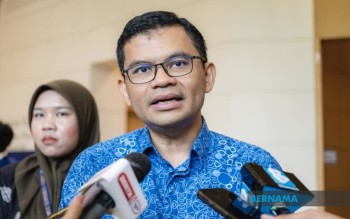
Economy Minister Akmal Nasrullah Mohd Nasir has expressed confidence that Malaysia will sustain its economic momentum through the remainder of 2026, signalling the government's upbeat assessment of the country's medium-term growth prospects. Speaking at the Association of Malaysian Economics Undergraduates (AMEU) Economics Summit 2026 in Kuala Lumpur, Akmal Nasrullah pointed to the first half's solid performance as evidence that underlying economic fundamentals remain resilient, even as policymakers acknowledge the volatile external environment continues to present significant challenges.
The first half of 2026 delivered encouraging results, with Malaysia recording cumulative growth of 5.6 per cent compared with 4.5 per cent in the corresponding period of 2025, according to data from the Department of Statistics Malaysia (DOSM). This represents a meaningful acceleration, with momentum building through the first two quarters as the second quarter posted an even stronger 5.8 per cent expansion from 5.4 per cent in the opening quarter. The improvement reflects a broad-based recovery rather than gains confined to one or two sectors, with strength evident particularly in services and manufacturing activities, alongside a notable rebound in the mining and quarrying sector and continued expansion in construction.
Government policy measures aimed at maintaining stable petroleum supplies throughout the year will provide essential support to sustain this trajectory during the coming months, according to Akmal Nasrullah. These deliberate interventions underscore the administration's awareness that energy security directly influences economic stability and competitiveness, particularly for an economy with significant petroleum-linked revenues and export-dependent manufacturing operations. By securing supply continuity, the government aims to prevent the kind of supply-driven inflationary pressures or operational disruptions that could derail growth momentum heading into the final quarter.
However, the Economy Minister tempered optimism with appropriate caution, noting that whilst Bank Negara Malaysia maintains its 2026 growth projection between 4.0 and 5.0 per cent, the government must prepare for contingencies even as it hopes for sustained strong performance. This balanced messaging reflects official acknowledgement that Malaysia operates within a highly interconnected global economy where unforeseen developments can rapidly transmit shocks across borders. The minister's framing suggests the government is neither complacent nor unduly pessimistic, positioning itself to respond nimbly should external conditions shift.
Geopolitical tensions in West Asia, particularly escalating friction around the Strait of Hormuz, present the most tangible downside risk to Malaysia's economic outlook. As a trading nation heavily reliant on unimpeded maritime commerce and with significant exposure to global energy markets, any disruption to one of the world's most critical shipping chokepoints could reverberate through Malaysian supply chains and increase operational costs for exporters. Akmal Nasrullah's explicit mention of these tensions underscores how closely Kuala Lumpur monitors developments thousands of kilometres away, recognising that Middle Eastern instability translates directly into Malaysian economic vulnerability. The uncertainty surrounding whether such tensions will stabilise or intensify makes contingency planning prudent.
Beyond conventional economic metrics, the government is pursuing growth through major events that generate inbound spending and enhance Malaysia's global profile. The confirmation that Malaysia will host the Gulf Air Bahrain Grand Prix at Sepang International Circuit from October 2 to 4 represents a significant soft power achievement and potential economic stimulus mechanism. Formula One races have historically proven highly effective at attracting international tourists and media attention, with visitor spending extending beyond ticket purchases to encompassing accommodation, dining, entertainment, and retail expenditure across host cities and regions.
Akmal Nasrullah's comments on the F1 event reflected explicit alignment with Prime Minister Datuk Seri Anwar Ibrahim's vision of ensuring that major event hosting generates inclusive economic benefits rather than accruing narrowly to large corporations or specific segments. The minister emphasised that spillover effects should deliberately extend to small traders and marginal enterprises, acknowledging that whilst Formula One attracts considerable foreign visitor spending, capturing that spending requires intentional distribution mechanisms rather than assuming benefits percolate automatically. This inclusive growth framing, repeated consistently by government officials, indicates serious engagement with equity considerations rather than treating growth simply as an aggregate metric.
The Sepang circuit's selection follows formal agreements signed between F1, the International Automobile Federation (FIA), and Malaysian and Bahraini governmental entities, representing institutional confirmation of Malaysia's capacity to execute world-class sporting events. The October timing positions the race during a period when Malaysia's tourism infrastructure will showcase the country to a global audience, with racing enthusiasts and international media coverage providing promotional value extending well beyond the event itself. For a nation increasingly emphasising its position within the Asia-Pacific region and its capacity to host internationally significant activities, such events carry symbolic weight beyond their immediate economic impact.
The convergence of steady underlying economic performance, supportive government policy intervention, and high-profile events scheduled for the coming months constructs a multifaceted support structure for growth. Malaysia's economic trajectory thus reflects not only cyclical factors and global conditions but also deliberate policy construction and event-driven stimulus. Whether this combination proves sufficient to maintain the 5.6 per cent first-half growth rate into the second half depends partly on factors beyond government control, including global oil prices, international demand for Malaysian exports, and the trajectory of Middle Eastern tensions. Nonetheless, the government's demonstrated confidence, backed by concrete policy measures and scheduled events, signals that policymakers enter the second half from a position of reasonable optimism whilst maintaining appropriate vigilance toward external risks.

