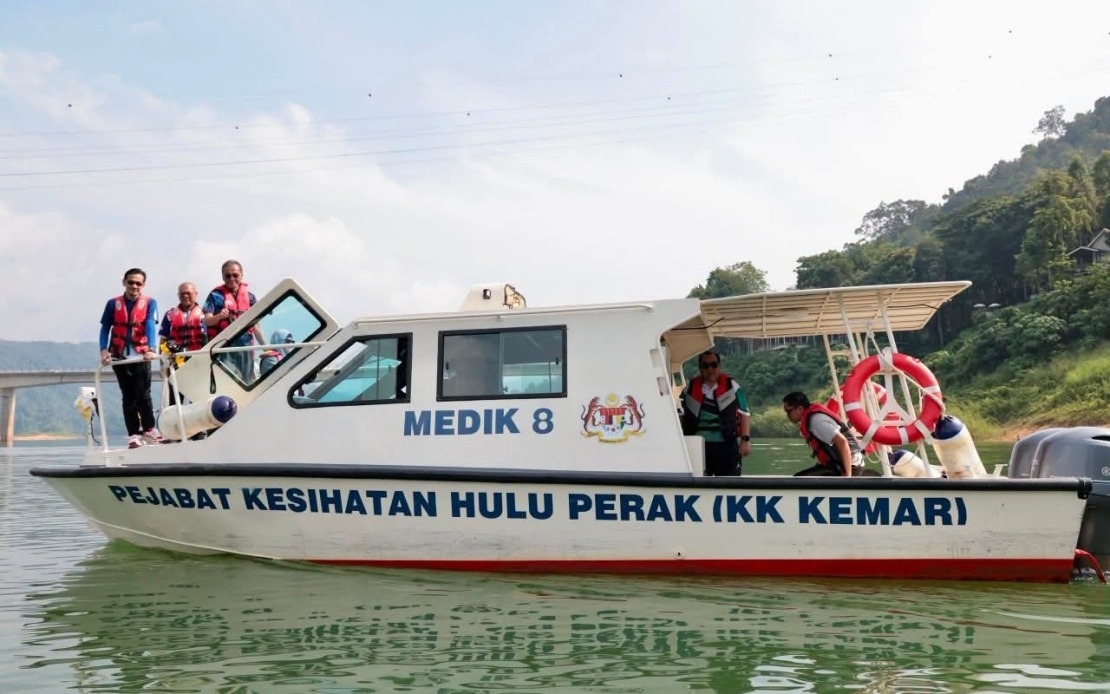
The Ministry of Health has taken a significant step toward closing the healthcare gap in Malaysia's interior regions by introducing a specialised medical boat service targeting Orang Asli settlements in Hulu Perak. Medic Boat 8, which costs RM350,000, was formally launched by Health Minister Datuk Seri Dr Dzulkefly Ahmad at the Belum Rainforest Resort jetty, marking an expansion of the government's commitment to reach vulnerable communities where conventional transport remains impractical.
The vessel joins an existing fleet of six medical boats operated by the Ministry of Health, bringing the total capacity to address healthcare emergencies across waterway-dependent regions. With the ability to carry 12 passengers at a time, Medic Boat 8 represents a crucial lifeline for the Kemar Resettlement Scheme in Gerik, home to more than 4,500 Orang Asli residents whose geographical isolation has historically created significant barriers to timely medical intervention. For these communities, river transport is not merely a convenience but the primary—and often only—viable means of reaching health facilities.
The introduction of dedicated medical boats reflects a broader policy shift within Malaysia's healthcare system to operationalise the Malaysia MADANI framework, which emphasises equitable access to essential services regardless of terrain or population density. Dr Dzulkefly Ahmad highlighted this commitment by stating that geographical challenges and remote locations should never obstruct residents from receiving quality healthcare. This declaration carries particular weight given the well-documented disparities in health outcomes between urban centres and interior settlements, where emergency response times and preventive care access remain considerably lower.
Orang Asli communities have historically faced compounded disadvantages in health service utilisation. Beyond physical distance, these populations contend with language barriers, limited awareness of available services, and socioeconomic constraints that hinder health-seeking behaviour. The waterway-dependent nature of settlements in Hulu Perak means that conventional ambulance services prove ineffective, particularly during monsoon seasons or periods of river swelling when water currents become treacherous. By establishing a dedicated boat service with trained personnel, the Ministry of Health addresses both the infrastructure gap and the urgent need for rapid response capacity in life-threatening situations.
The operational reality of deploying Medic Boat 8 involves considerable demands on health personnel working in challenging conditions. Doctors, nurses, and specialised boat operators must navigate unpredictable river conditions, manage limited onboard medical equipment, and maintain readiness across extended service areas. The minister's acknowledgment of these personnel reflects recognition that policy initiatives depend fundamentally on frontline workers willing to operate in environments where weather hazards and geographical obstacles are constant considerations. This workforce dimension is often overlooked in discussions of healthcare expansion but remains essential to understanding the viability and sustainability of such programmes.
For the broader Southeast Asian context, Malaysia's approach to addressing healthcare access in indigenous and remote communities offers instructive lessons. The region contains numerous populations inhabiting areas where water transport constitutes the primary infrastructure link. The investment in dedicated medical watercraft, combined with trained personnel capable of delivering emergency care in transit, represents a pragmatic response to terrain-based service delivery challenges that many neighbouring countries continue to struggle with. The model also demonstrates how targeted capital investment coupled with human resource commitment can meaningfully improve health service equity.
The Kemar Resettlement Scheme itself represents a significant policy intervention, having relocated Orang Asli families from deeper forest settlements to areas with greater accessibility to government services, including education and healthcare. However, even resettled communities remain geographically isolated by Malaysian standards, underscoring why conventional health infrastructure proves insufficient. Medic Boat 8 functions as a necessary adaptation layer within this broader resettlement framework, ensuring that relocated populations benefit from improved service access promised through their relocation.
Implementing the boat service requires careful attention to maintenance schedules, fuel supply chains, and personnel rotation systems. Hulu Perak's monsoon patterns create seasonal variations in river navigability, necessitating flexible operational protocols and potentially alternative service delivery mechanisms during high-water periods. The Ministry of Health must establish robust logistics infrastructure to sustain the programme, including shore-based support stations, equipment storage facilities, and crew accommodation that enable continuous operations throughout the year. These unglamorous but essential support systems often determine whether such initiatives succeed or gradually decline due to maintenance challenges.
The investment signifies a measurable commitment to reducing health inequities within peninsular Malaysia, though questions remain regarding scalability and resource allocation across other underserved regions. Sabah and Sarawak contain numerous communities similarly dependent on river and sea transport, yet equivalent dedicated health boat services remain limited. As Malaysia pursues universal health coverage and improved health outcome targets, replicating successful models from Hulu Perak in other geographically challenging regions could represent a logical policy extension. However, budgetary constraints and competing priorities mean that expansion will likely proceed gradually.
The success of Medic Boat 8 will be measured not merely by its operational existence but by concrete improvements in emergency response times, maternal and child health indicators, disease detection rates, and community health outcomes among Orang Asli beneficiaries. Establishing baseline health metrics and monitoring systems will be crucial for assessing impact and justifying continued investment. Public health researchers and policy evaluators should prioritise documenting the programme's effects, particularly regarding reduction in preventable mortality and improvements in chronic disease management within served communities.

