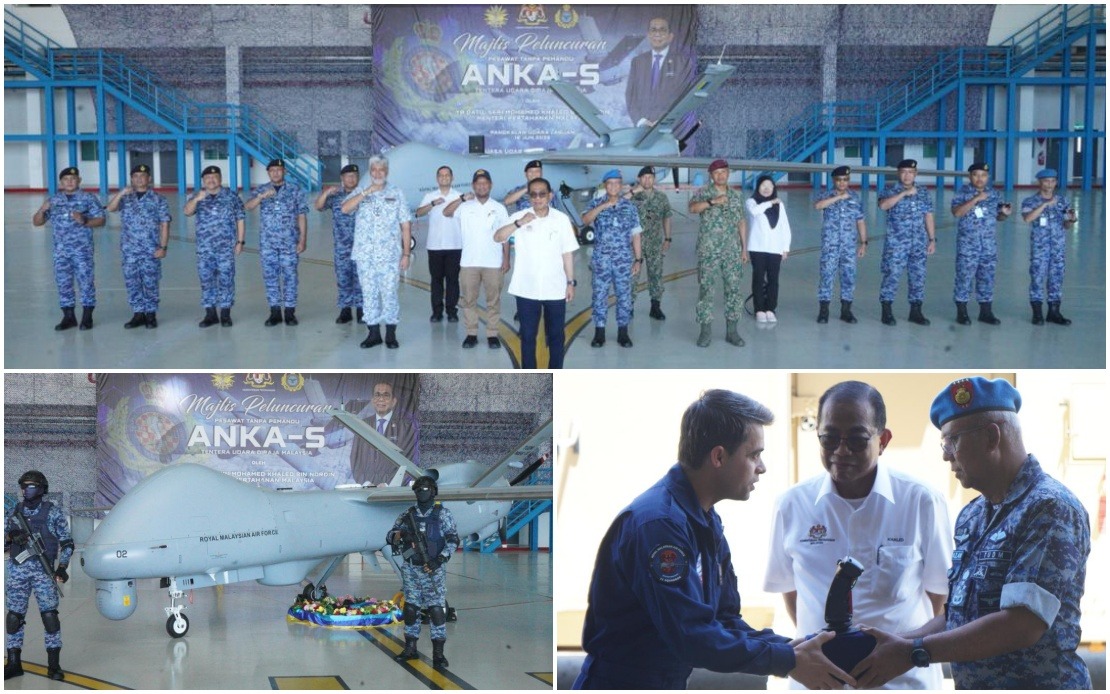
Malaysia has taken a significant step in modernising its maritime defence infrastructure with the operational deployment of the ANKA-S Unmanned Aircraft System, a medium-altitude long-endurance platform that promises to fundamentally reshape how the nation monitors its contested waters. Defence Minister Datuk Seri Mohamed Khaled Nordin formalised the launch of the system at RMAF Labuan Air Base this month, describing it as a watershed moment for the country's ability to project persistent surveillance across strategically vital territories, particularly throughout the South China Sea.
The three aircraft acquired by Malaysia represent a substantial investment totalling RM423.8 million, encompassing not merely the platforms themselves but also their associated ground control infrastructure and a comprehensive two-year training programme for operating personnel. This significant financial commitment underscores the Defence Ministry's recognition that modern maritime security demands technological capabilities far beyond conventional manned aviation, especially in regions where presence must be continuous yet resource consumption must remain efficient.
Central to the ANKA-S platform's operational value is its exceptional endurance profile, enabling sustained flight operations exceeding 24 hours at altitudes reaching 30,000 feet. For a nation managing one of the world's most strategically sensitive maritime zones, this capacity to maintain airborne presence without interruption addresses a persistent vulnerability in Malaysia's surveillance architecture. Previously, monitoring vast oceanic expanses required either dedicated naval patrols or short-duration manned aircraft sorties, both approaches inherently limited by crew fatigue requirements and fuel constraints.
The positioning of the ANKA-S fleet at Labuan represents a deliberate geographical choice, placing the system within operational distance of critical shipping lanes and disputed territorial waters. From this forward location, the unmanned platforms can conduct layered surveillance operations across the South China Sea, monitoring vessel movements and establishing patterns of activity that inform broader strategic assessments. This capability proves particularly valuable given the region's notoriously congested shipping environment and the presence of multiple competing maritime claims.
Beyond mere presence, the system's technical specifications offer Malaysia substantive operational advantages. The ANKA-S carries sophisticated sensor packages capable of accurately identifying and tracking vessel profiles with sufficient fidelity to enable precise asset deployment decisions. Rather than conducting unfocused patrols that consume resources inefficiently, Malaysia's military planners can now direct manned assets directly to specific intrusion locations based on actionable intelligence generated through unmanned surveillance. This represents a meaningful evolution from reactive to proactive maritime management.
The cost differential between deploying unmanned platforms versus manned aircraft or large surface vessels for purely surveillance purposes constitutes another significant operational factor. Maintaining a fighter jet or dedicated maritime patrol aircraft aloft demands substantial fuel consumption, crew rotations, and maintenance cycles, rendering extended surveillance missions prohibitively expensive when repeated across multiple operational areas. The ANKA-S, operating with substantially lower fuel burn and minimal crew requirements beyond the ground control station, permits extended surveillance missions at a fraction of traditional operational costs, thereby enabling more frequent and comprehensive maritime monitoring without proportional budget increases.
A particularly revealing aspect of Malaysia's ANKA-S deployment involves the conscious decision to maintain the aircraft in an unarmed configuration despite their documented weapons-carrying capabilities. Defence Minister Mohamed Khaled explicitly framed this choice as a deliberate signal, positioning Malaysia's defence posture as fundamentally protective rather than aggressive. This messaging holds particular significance within Southeast Asia's sensitive geopolitical environment, where military modernisation frequently generates anxiety among neighbours regarding potential power imbalances or escalatory intentions. By publicly committing to unarmed operation, Malaysia communicates that enhanced surveillance capabilities reflect security consolidation rather than offensive ambitions.
The Defence Ministry has indicated preliminary interest in acquiring three additional ANKA-S platforms under a second procurement phase, contingent upon successful integration of the initial fleet and formal approval through existing national development planning mechanisms. Such expansion would effectively double Malaysia's unmanned maritime surveillance capacity, enabling simultaneous operations across multiple geographical sectors and providing redundancy for maintenance requirements. For a nation managing sprawling maritime responsibilities across the South China Sea, Strait of Malacca, and Sulu-Sulawesi maritime corridor, expanded capability represents a logical progression in systematic defence modernisation.
The ANKA-S system's integration into RMAF operations comes amid broader regional trends toward unmanned platform adoption among Southeast Asian militaries. Countries including Indonesia, Thailand, and the Philippines have pursued comparable systems, reflecting widespread recognition that persistent maritime surveillance constitutes an essential component of modern national security. Malaysia's deployment, therefore, represents participation in an evolving regional defence paradigm rather than isolated procurement, though the Labuan positioning and South China Sea focus reflect Malaysia's particular strategic concerns.
Operationally, the system's intelligence, surveillance and reconnaissance capabilities extend beyond maritime vessel monitoring to encompass broader environmental and security pattern analysis. The Data Exploitation Centre established at Labuan processes raw sensor data into actionable intelligence, transforming continuous unmanned observation into strategic information supporting national security policy formulation. This transformation from data to intelligence represents the system's true value proposition, as persistent surveillance proves meaningless without corresponding analytical capacity to extract policy-relevant insights.
For Malaysia's broader defence strategy, the ANKA-S acquisition signals a deliberate shift toward technology-enabled force multiplication, compensating for personnel and platform limitations through enhanced situational awareness. Rather than attempting to match larger regional militaries through conventional force expansion, Malaysia pursues asymmetric advantages through technological sophistication and operational innovation. The unmanned aircraft system exemplifies this approach, delivering capabilities previously beyond practical reach while simultaneously demonstrating restraint through conscious operational limitations.
The successful operationalisation of the ANKA-S at Labuan also carries implications for Malaysia's ability to participate meaningfully in regional security dialogues and maritime cooperation frameworks. Enhanced surveillance capacity strengthens Malaysia's evidentiary foundation when discussing maritime security concerns with regional partners and international stakeholders, supporting evidence-based diplomatic engagement. Within forums addressing South China Sea stability, nations equipped with sophisticated persistent surveillance capabilities command greater credibility when advancing their security perspectives.