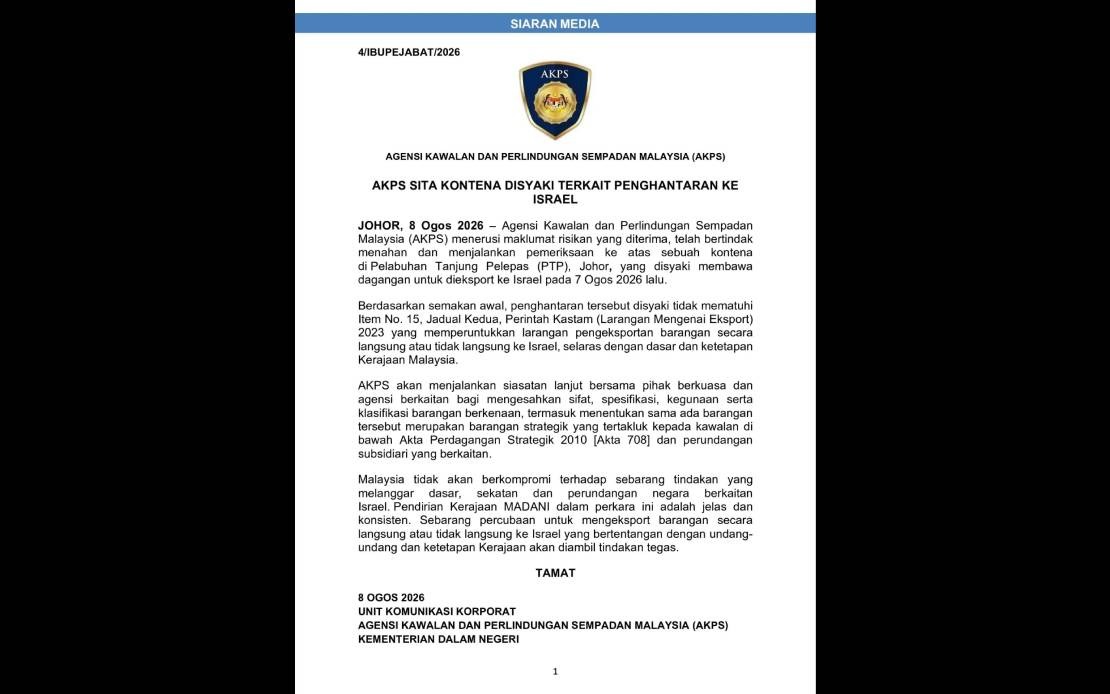
Prime Minister Datuk Seri Anwar Ibrahim has lauded the swift intervention by the Malaysian Border Control and Protection Agency (AKPS) following the interception of a container holding goods believed bound for Israel at the Port of Tanjung Pelepas in Johor. The seizure, executed yesterday and acknowledged by the Prime Minister through a social media statement, represents another manifestation of Malaysia's resolute approach to preventing its maritime infrastructure from becoming conduits for commerce that could bolster what the government characterises as Israeli atrocities targeting Palestinians.
The container detention underscores Malaysia's determination to maintain strict oversight of goods transiting through its ports, particularly those with potential strategic implications for international conflicts. The AKPS identified the shipment as potentially contravening Item No. 15 of the Second Schedule of the Customs (Prohibition of Exports) Order 2023, which explicitly forbids direct or indirect export of commodities to Israel. This regulatory framework reflects a deliberate policy choice by Malaysia's government to enforce material consequences on trade relationships with the Israeli state through its control of port facilities and customs enforcement.
Anwar's public commendation of the agency's actions carries symbolic weight beyond the immediate seizure itself. By elevating the incident to the level of prime ministerial recognition, the government signals that such enforcement operations align with its broader foreign policy orientation and merit institutional appreciation. This public acknowledgement serves to reinforce internal accountability mechanisms and demonstrate to the international community, particularly nations with similar stances on the Israeli-Palestinian conflict, that Malaysia actively implements its declared principles rather than treating them as rhetorical postures.
The government's invocation of Malaysia's alignment with The Hague Group adds an international dimension to the domestic enforcement action. The grouping represents a coalition of nations committed to coordinated approaches on matters of international justice and humanitarian concerns. By positioning Malaysia within this framework, officials contextualise the port seizure not as an isolated protectionist measure but as participation in a broader international consensus regarding accountability and support for Palestinian rights. This framing attempts to elevate the policy from unilateral action to multilateral coordination.
The existing prohibition on Israeli vessels and cargo vessels carrying Israeli-bound shipments from using Malaysian ports, which commenced in December 2023, forms the regulatory bedrock underlying yesterday's interception. This blanket maritime embargo represents one of the most comprehensive trade-based measures Malaysia has implemented regarding Israel, extending beyond conventional sanctions to fundamentally restrict the operational capacity of Israeli maritime commerce. The recent container seizure demonstrates that this policy framework remains actively enforced rather than dormant or selectively applied.
For Malaysia's position within the Southeast Asian region, these actions carry implications extending beyond bilateral Malaysian-Israeli relations. As a major maritime hub with significant port infrastructure, Malaysia's enforcement choices influence the operational calculus for global shipping companies and logistics providers. Corporations managing international supply chains must now factor Malaysia's export prohibitions into routing decisions, potentially redirecting trade flows away from Malaysian facilities toward competitor ports in neighbouring jurisdictions. This enforcement intensity could shape the competitive landscape of regional maritime commerce.
The emphasis on preventing Malaysia from becoming a "transit route" for Israel-bound trade reflects concern about transhipment activities and indirect export mechanisms. Strategic goods could theoretically pass through Malaysian ports destined for third countries before reaching Israel, creating compliance challenges for customs authorities. The AKPS seizure suggests elevated vigilance regarding such indirect pathways, with inspectors examining container documentation and cargo manifests more thoroughly to identify potential circumvention attempts. This administrative sophistication indicates that officials recognise the technical complexity of enforcing export prohibitions in global supply chains.
The government's reiteration of commitment to "principles of humanity, justice and international law" provides the normative foundation for these enforcement measures. Rather than presenting the export ban as purely political, official rhetoric frames it as grounded in universal humanitarian principles transcending national interest or partisan alignment. This justificatory approach attempts to insulate the policy from criticism by anchoring it to broadly accepted international norms regarding civilian protection and humanitarian responsibility, positioning Malaysia as upholding international consensus rather than pursuing nationalist grievance.
The specific invocation of Palestinian rights protection in the Prime Minister's statement reflects the domestic political salience of this issue within Malaysia's coalition government and broader political landscape. Palestinian solidarity commands significant public support across diverse Malaysian constituencies, including religious, civil society, and opposition political groups. By publicly championing enforcement actions that demonstrably implement pro-Palestinian policies, the government reinforces its credentials among these constituencies and inoculates itself against criticism from political competitors positioning themselves as more steadfast advocates for Palestinian causes.
Looking forward, the AKPS seizure and official responses suggest that Malaysia's customs enforcement apparatus will maintain heightened scrutiny of Israel-bound shipments. Port operators and customs officials appear equipped with clearer guidance regarding the categories of goods subject to restriction and the verification procedures required to prevent violations. Shipping companies utilising Malaysian facilities should anticipate that containers with Israeli destinations or Israeli-origin documentation will face intensive examination, potentially extending processing timelines and increasing compliance costs for affected operators.

