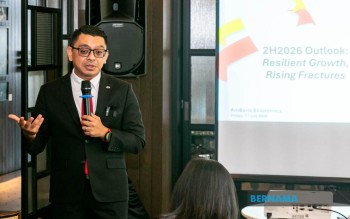
Malaysia's port sector stands to capture significant commercial advantages from the combination of reshuffled international supply chains and a growing commitment to sustainable maritime operations, according to analysis from AmBank (M) Bhd's chief economist Firdaos Rosli. The country's strategic location along the Strait of Melaka continues to make it an attractive alternative for shipping companies navigating geopolitical risks, particularly those circumventing supply chain disruptions stemming from tensions in West Asia. This positioning has strengthened Malaysia's appeal as a neutral, secure transhipment destination even as global logistics costs remain stubbornly elevated.
The performance data underscores this momentum. Port Klang, the nation's busiest container facility, processed 15.14 million twenty-foot equivalent units in 2025, while the Port of Tanjung Pelepas recorded 14.03 million TEUs during the same year. Both facilities have sustained growth momentum into 2026, with Port Klang expanding its container volumes by five percent year-on-year in the first five months of the year, while Port of Tanjung Pelepas achieved a more robust eight percent increase over the same period. These figures demonstrate that Malaysia's ports are not merely surviving in a volatile trading environment but actively expanding their market share.
The strategic importance of maintaining this competitive edge cannot be overstated. Firdaos cautioned during AmBank's media briefing on its 2HFY2026 outlook that while diversifying supply chains and growing transhipment activity will continue to support port operations, Malaysia cannot afford complacency. Sustained competitiveness demands continuous investment in capacity expansion and sophisticated infrastructure initiatives that enhance efficiency and operational capabilities. Without such commitments, the country risks losing ground to regional competitors who are equally aggressive in pursuing port modernisation.
Parallel to these trade-driven opportunities, Malaysia is making deliberate moves to position itself as a regional leader in environmentally sustainable maritime practices. The government has unveiled a Green Bunkering Regulatory Roadmap that sets an ambitious target of ensuring low-carbon fuels account for 40 percent of maritime fuel consumption by 2050. This forward-looking policy framework reflects both environmental commitments and commercial foresight, as shipping companies increasingly seek ports that can supply alternative fuels complying with tightening international environmental standards.
Port of Tanjung Pelepas has already begun operationalising this vision, with the facility now offering liquefied natural gas and methanol bunkering services. These alternatives to conventional marine fuel represent a critical capability gap that competing regional ports have yet to fully address. By moving ahead of the curve, Malaysia's ports are attracting environmentally conscious operators seeking to decarbonise their fleets while complying with evolving international maritime regulations. This capability creates a durable competitive advantage that extends beyond simple cost considerations.
However, the operating environment presents persistent headwinds that warrant close monitoring. Freight rates, as measured by the Baltic Exchange Index, surged more than 120 percent year-on-year during both February and May of 2026, remaining elevated at 64.6 percent in June. These elevated rates reflect deeper structural challenges in global shipping capacity rather than temporary market disturbances. Historically, shipping costs have dropped sharply once supply disruptions ease, but the sustained elevation of freight rates suggests something more fundamental is at work in transportation markets.
Firdaos attributed this stability in high shipping costs to enduring supply-side constraints that continue to plague maritime transportation. While the acute geopolitical tensions in West Asia may no longer be directly destabilising global oil markets, their ripple effects persist across shipping routes and logistics networks. Many vessel operators have recalibrated their routes to avoid areas of elevated risk, creating bottlenecks in alternative corridors and stretching shipping capacity. This dynamic means that Malaysian port operators face a paradoxical situation: their facilities are busier and more strategically valuable, yet the broader cost environment for shippers remains challenging.
For Malaysian businesses reliant on international trade, these elevated freight rates translate into sustained pressure on import and export costs. Manufacturing exporters face competition from producers in jurisdictions where logistics expenses are lower, while importers pass increased shipping costs to local consumers. The implication is that while Malaysia's ports benefit from increased throughput, the country's broader economy may feel constrained by the persistently high cost of moving goods internationally. This tension suggests that port expansion alone cannot fully insulate Malaysia from global shipping cost pressures.
The convergence of trade rerouting and green shipping imperatives creates a unique moment for Malaysia's port sector. Companies seeking to establish supply chain resilience are simultaneously seeking to reduce carbon intensity in their logistics operations. Port facilities that can satisfy both requirements possess distinct competitive advantages. Malaysia's emerging capability in green bunkering, combined with its established role in transhipment, positions the country to attract premium-paying customers willing to pay for security, efficiency, and environmental compliance in a single destination.
Looking forward, the sustainability of these benefits hinges on implementation. Port Klang and Port of Tanjung Pelepas must continue expanding their physical capacity to accommodate larger vessels and higher throughput volumes. Infrastructure investments in terminal automation, deepwater channels, and cargo handling equipment are essential to prevent capacity constraints from limiting growth. Simultaneously, the rollout of the Green Bunkering Regulatory Roadmap must proceed on schedule, ensuring that Malaysia's ports have adequate supply chains for LNG, methanol, and potentially other zero-carbon marine fuels.
The regional context matters significantly. Singapore, which dominates regional bunkering and transhipment, possesses substantial advantages in capital, technology, and operational expertise. Port of Tanjung Pelepas and Port Klang must differentiate themselves through cost competitiveness, service quality, and specialisation in green fuel capabilities that larger competitors may be slower to develop. The window for establishing market leadership in sustainable bunkering may be limited, making rapid execution on the Green Bunkering Regulatory Roadmap strategically urgent.
For Malaysian policymakers and port operators, the present environment represents an opportunity to entrench the country's role in global commerce while simultaneously advancing environmental objectives. However, realising this potential requires sustained investment, regulatory clarity, and vigilance regarding evolving competitive dynamics. The combination of trade rerouting and green shipping transformation is unlikely to persist indefinitely, suggesting that Malaysia should move decisively to maximise these advantages before global supply chains stabilise and competitive dynamics shift once more.

