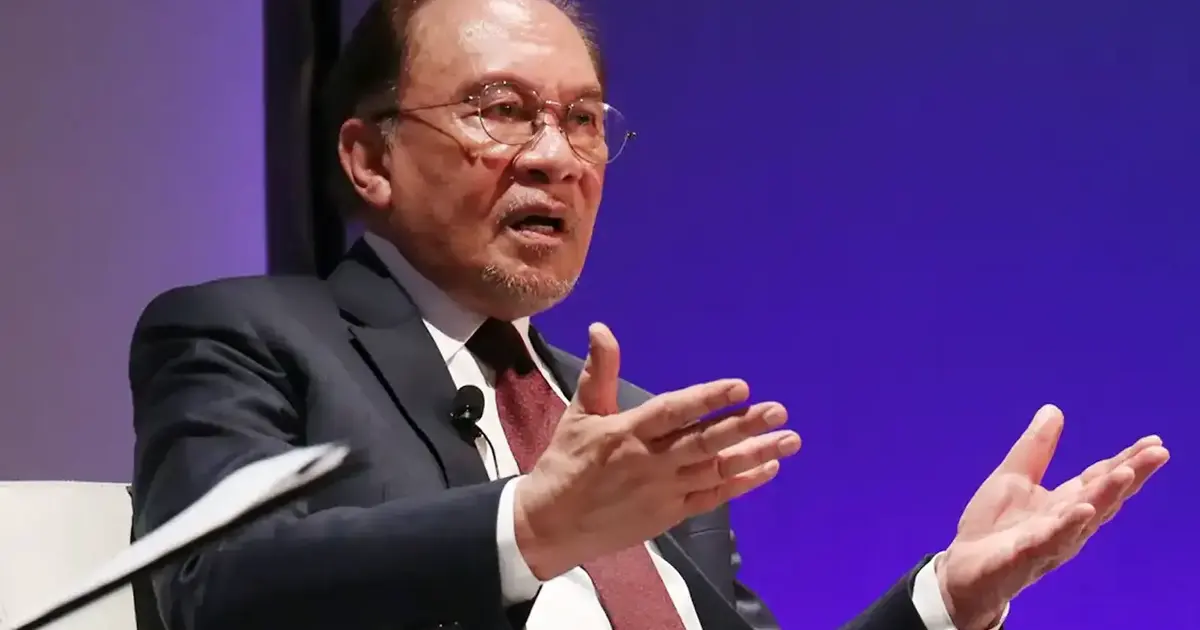
Prime Minister Anwar Ibrahim has pointed to Malaysia's second-quarter gross domestic product performance as evidence that the country's economy remains fundamentally sound, attributing the expansion to three years of deliberate reforms and policy initiatives implemented by his administration since assuming office.
The government's efforts to enhance economic resilience form a cornerstone of Anwar's broader narrative about steering Malaysia through regional and global challenges. Rather than viewing growth in isolation, the Prime Minister frames quarterly performance data as validation of a sustained strategy to rebuild institutional capacity and investor confidence following previous years of political uncertainty and economic headwinds that had characterised Malaysia's recent past.
Anwar's emphasis on structural economic strengthening reflects a shift in policy priorities toward longer-term sustainability rather than short-term stimulus measures. The administration has concentrated on reforming regulatory frameworks, improving fiscal discipline, and attracting foreign direct investment in sectors aligned with digital transformation and green energy transitions. These measures aim to position Malaysia competitively within the Association of Southeast Asian Nations and globally.
The timing of such statements carries significance within Malaysia's political context. As Putrajaya continues navigating coalition complexities and preparing for inevitable electoral cycles, demonstrating economic competence becomes essential for maintaining public confidence and securing continued parliamentary support. Growth data provides quantifiable backing for government claims of effective stewardship and forward momentum.
For Malaysian businesses and investors, the Prime Minister's framing suggests continuity in policy direction. Companies operating across manufacturing, technology, and financial services sectors will likely interpret signals of durable growth as justification for investment decisions and expansion plans. Regional investors watching Malaysia's trajectory are equally attentive, as the nation competes with Thailand, Vietnam, and Indonesia for capital flows and manufacturing relocations from China.
The reference to three-year reform cycles acknowledges that economic transformation requires sustained commitment beyond electoral terms. Anwar's government inherited a complex inheritance including debt challenges, infrastructure gaps, and competitive disadvantages in attracting high-value investments. Framing current growth through the lens of accumulated reforms suggests these policy foundations are now yielding measurable returns, though economists remain cautious about whether growth rates are sufficient to meet development aspirations or adequately address per-capita income challenges.
Southeast Asian observers note that Malaysia's growth performance carries implications for the broader region's economic health. As a middle-income nation with significant trade linkages throughout ASEAN and beyond, Malaysian momentum can influence regional confidence and investment allocation decisions. Anwar's public optimism about fundamentals may signal to regional counterparts that Malaysia's policy environment remains stable despite domestic political complexities.
The government's message also addresses international credit rating agencies and foreign portfolio investors who scrutinise emerging market fundamentals continuously. Consistent statements about policy discipline and structural improvement help maintain investor perception that Malaysia presents acceptable risk-return profiles compared to regional peers. Rating agencies particularly monitor whether governments maintain reform momentum during periods of reasonable growth, as reversions to populism or spending excess during upturns often precede subsequent downturns.
Domestically, the growth narrative requires careful management across competing constituencies. While economic expansion provides resources for government programmes, uneven distribution of growth benefits can generate political friction. Anwar's emphasis on systemic strengthening rather than immediately apparent improvements in living standards suggests awareness that growth alone insufficient to address expectations, particularly in rural areas and among vulnerable populations affected by inflation in essential goods.
The Malaysian context also includes ongoing competition between federal and state-level administrations, many controlled by opposition coalitions. Economic performance claims by Putrajaya may face counter-narratives from state governments arguing that their own policies or local initiatives deserve credit for performance. This dynamic shapes how growth stories are interpreted politically beyond purely economic dimensions.
Looking forward, Malaysia faces external pressures including potential global trade disruptions, technology competition, and climate transition costs. The government's framing of current growth as underpinned by structural reforms suggests confidence in weathering such challenges, though economists track whether growth is sufficiently diversified and resilient to absorb significant external shocks without reverting to contraction cycles that have periodically interrupted Malaysia's development trajectory historically.
The broader significance of Anwar's statement extends beyond quarterly statistics. It encapsulates his administration's attempt to redefine Malaysia's economic narrative after years of stagnation and uncertainty, positioning the nation as genuinely reformed and repositioned for competition in evolving global markets. Whether such confidence proves justified depends on sustained policy implementation and favourable external conditions over coming quarters.

