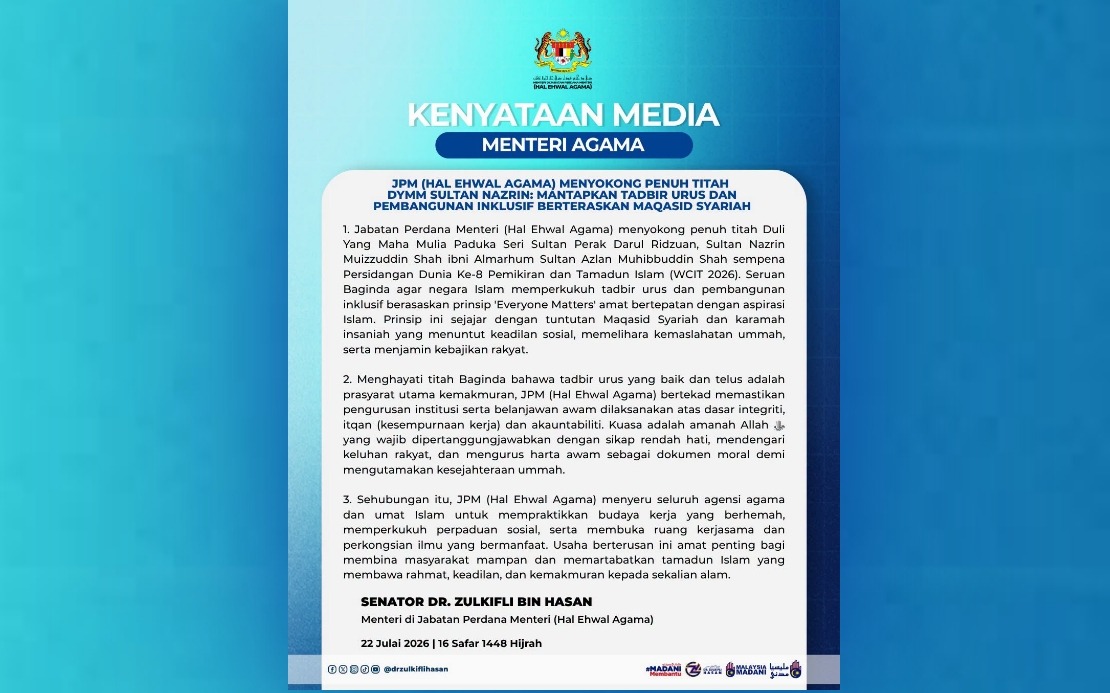
The Prime Minister's Department (Religious Affairs) has pledged to deepen its commitment to good governance across Malaysia's religious institutions, drawing explicit guidance from Sultan Nazrin Shah's recent articulation of the "Everyone Matters" principle. Minister in the Prime Minister's Department (Religious Affairs) Dr Zulkifli Hasan outlined the department's vision to anchor institutional management and public resource allocation in three foundational pillars: integrity, accountability, and public welfare. The announcement signals a strategic pivot toward embedding governance frameworks that extend beyond bureaucratic efficiency to encompass broader social cohesion and equitable service delivery across the nation's diverse religious landscape.
Sultan Nazrin's intervention into governance discourse carries particular weight given Perak's ceremonial and symbolic leadership role within Malaysia's constitutional monarchy. In his address at the 8th World Conference on Islamic Thought and Civilisation, the Sultan articulated a vision of public administration that transcends sectarian boundaries, emphasising that genuinely inclusive governance serves every citizen regardless of ethnic or religious affiliation. This conception challenges a persistent disconnect between formal democratic institutions and lived experiences of marginalisation, particularly among minority communities and underserved populations. The Sultan's emphasis on "humble leadership that listens to the people before making laws" represents a counterweight to top-down policymaking that has historically characterised portions of Malaysia's administrative machinery.
Dr Zulkifli's statement positions the "Everyone Matters" principle as inherently consonant with Islamic jurisprudential objectives. The minister invoked Maqasid Syariah—the overarching purposes underpinning Islamic law—arguing that social justice, collective welfare protection, and human dignity constitute the theological scaffolding supporting inclusive governance models. This theological framing proves strategically significant, as it dismantles a false dichotomy between progressive administrative reforms and Islamic orthodoxy. By demonstrating that inclusive development aligns with core Islamic jurisprudential commitments rather than contradicting them, the Religious Affairs Ministry seeks to legitimise governance modernisation within Malaysia's Islamic institutional ecosystem. The reference to karamah insaniah, or human dignity, extends this analysis beyond institutional mechanics toward fundamental questions of how state apparatus treats individual persons and communities.
The Sultan's observation regarding economic interconnectedness and national isolation carries direct implications for Malaysia's developmental trajectory. His argument that no nation can credibly pursue prosperity in isolation—regardless of resource endowments—responds to certain insular policy currents that have periodically gained traction within Malaysian political discourse. Trade, investment, knowledge exchange, and technological diffusion constitute the circulatory systems through which modern economies generate wealth and social progress. Malaysia's historical reliance on external capital, expertise, and market access underscores the empirical accuracy of this analysis. Religious governance frameworks, therefore, must accommodate rather than obstruct these transnational flows, particularly in sectors where Malaysia competes globally for talent, investment capital, and technological partnership.
Dr Zulkifli's framing of authority as a divine trust requiring humble stewardship introduces a moral-theological dimension often absent from secular governance discourse. The invocation of humility alongside listening functions as a corrective to bureaucratic insularity and technocratic distance. The minister's emphasis on managing public funds as a moral responsibility toward the ummah's wellbeing establishes an accountability framework rooted in spiritual obligation rather than purely institutional regulation. This approach potentially resonates across Malaysia's Muslim majority while signalling to non-Muslim communities that religious governance operates within parameters emphasising communal welfare rather than sectarian preference. The emphasis on listening to grievances before implementing policy decisions responds to persistent complaints regarding insufficient consultation with affected populations in religious affairs administration.
The call for enhanced workplace culture, strengthened social cohesion, and collaborative knowledge-sharing among religious agencies reflects acknowledgment that institutional fragmentation undermines governance effectiveness. Malaysia's religious administration apparatus has historically operated through vertically siloed structures with limited horizontal coordination between state religious departments, federal bodies, and civil society organisations. Enhanced collaboration mechanisms could reduce redundancy, accelerate best-practice dissemination, and create feedback loops through which ground-level practitioners inform policy evolution. The emphasis on courtesy and social unity addresses documented tensions within Malaysia's religious institutional ecosystem, where occasional public disputes between state and federal religious authorities have generated confusion among Muslim populations and raised concerns about coordinated governance capacity.
The timing of this articulation proves significant given Malaysia's broader governance reform agenda. The ministry's explicit commitment to itqan—excellence in work execution—introduces quality benchmarking into religious institution management. This shift toward performance-oriented standards, embedded within Islamic theological language, potentially overcomes resistance to managerial modernisation from constituencies viewing such initiatives as Western imposition. By couching excellence-seeking within Islamic conceptual frameworks, Dr Zulkifli positions governance improvement as theologically consistent with Muslim aspirational values rather than as alien administrative transplantation.
For Malaysian stakeholders beyond the religious bureaucracy, this announcement carries implications for institutional transparency and stakeholder engagement. Religious institutions throughout Malaysia historically operated with limited public accountability mechanisms and restricted community participation in governance processes. The articulated commitment to integrity and accountability suggests potential expansion of consultation processes, clearer performance reporting, and more accessible grievance redressal systems. Non-Muslim communities, which frequently interface with religious administration regarding personal law matters and community-level religious administration decisions, may experience improved service standards if accountability frameworks achieve effective implementation.
The resonance between Sultan Nazrin's governance vision and the Religious Affairs Ministry's operational commitments reflects broader Southeast Asian trends toward stakeholder-inclusive institutional frameworks. Thailand, Indonesia, and the Philippines have each experimented with consultative governance models within religious institutions, with mixed success. Malaysia's attempt to formalise this approach through explicit ministerial commitment and theological justification creates observable conditions for assessing implementation effectiveness. Should the Religious Affairs Ministry successfully institutionalise these principles, it would establish a regional model potentially influencing how neighbouring Muslim-majority states conceptualise religious governance in pluralistic contexts.
The gap between rhetorical commitment and institutional reality remains substantial. Religious institutions throughout Malaysia demonstrate variable capacity, resources, and political insulation from parochial pressures. Implementation of integrity and accountability frameworks requires sustained investment in personnel development, systems modernisation, and cultural transformation among administrative cultures often characterised by hierarchical deference and limited transparency precedents. The Religious Affairs Ministry must navigate competing pressures from traditional constituencies favouring existing arrangements, resource constraints limiting reform scope, and external expectations for rapid institutional modernisation. The success or failure of this governance initiative will significantly influence Muslim confidence in religious institutional management and broader assessments of Malaysia's capacity for institutional reform.

