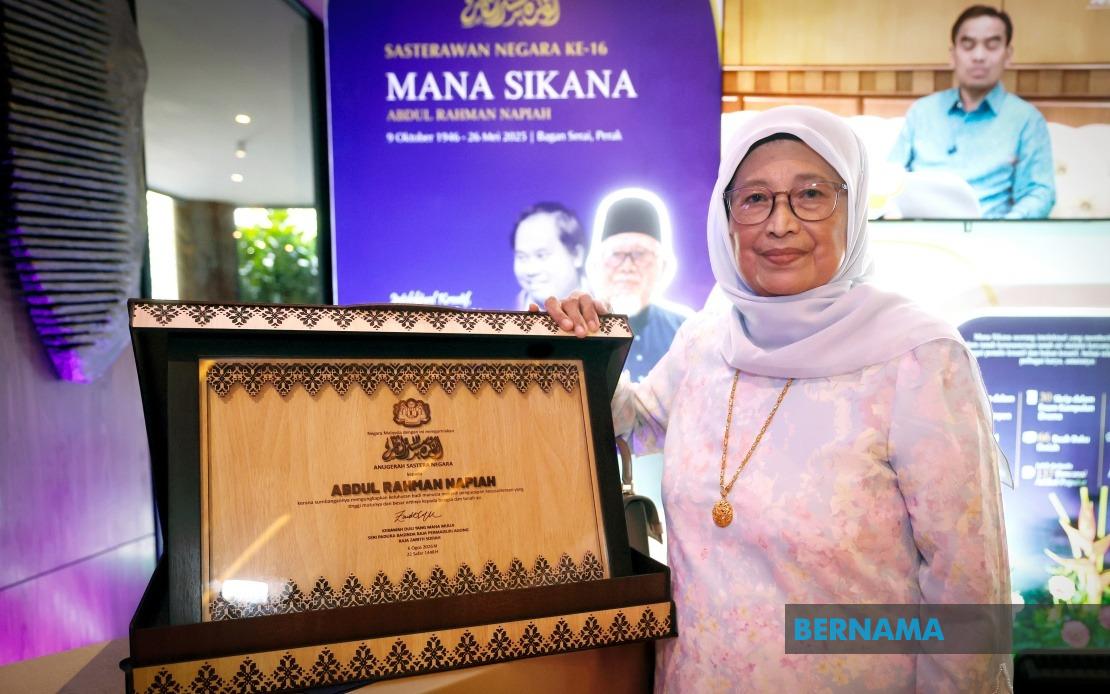
Malaysia's literary community has received long-overdue recognition of one of its most influential figures with the posthumous conferment of the 16th National Laureate award upon the late Dr Abdul Rahman Napiah, known professionally as Mana Sikana. His widow, Salmah Ali, accepted the honour on his behalf during a ceremony in Kuala Lumpur on August 6, with the award presented by Her Majesty Raja Zarith Sofia, Queen of Malaysia. Education Minister Fadhlina Sidek was also present at the presentation, underscoring the significance of the recognition within government and cultural circles.
Salmah Ali, aged 82, spoke with evident emotion about what the accolade meant to her late husband, characterising it as vindication of a lifetime devoted to advancing Malaysian literature. She recalled how Mana Sikana had cherished the prospect of receiving this particular honour, having accumulated numerous literary awards throughout his career dating back to his school years. The timing of his death in May last year at age 80, caused by heart complications, robbed him of the opportunity to receive the award in person, a reality that weighed heavily on his widow as she stood before the assembled audience.
The circumstances surrounding Mana Sikana's final days illustrated his unwavering commitment to his profession. On the very day he fell ill, he had been engaged in presenting a working paper for Dewan Bahasa dan Pustaka, Malaysia's premier language and literary institution. Only after suffering sudden stomach pain and vomiting was he hospitalised, an interruption to his scholarly activities that proved to be his last. Before his death, Salmah disclosed, her husband had been informed of the possibility of receiving the National Laureate recognition, giving him hope during his final months even as his health deteriorated.
Mana Sikana's influence on Malaysian culture extended far beyond the written word. Throughout his multifaceted career, he maintained active involvement in television and radio drama production, demonstrating a versatility that bridged creative and academic spheres. During his years in Johor Bahru, he produced drama works for both Singaporean and Malaysian broadcasters while simultaneously teaching students, establishing himself as a bridge between Malaysia's media and educational institutions. His television dramas frequently aired on Malaysian screens, reaching audiences well beyond academic circles and introducing literary concepts to the general public through the entertainment medium.
His academic trajectory reflected increasing recognition of his scholarly capabilities. Mana Sikana eventually pursued postgraduate studies at Universiti Kebangsaan Malaysia, ultimately achieving the rank of professor—a position that allowed him to shape the next generation of writers and literary scholars. His reputation transcended national boundaries, leading to invitations to serve as a visiting lecturer at Indonesian universities, cementing his status as a regional figure in literary studies. Throughout his various institutional affiliations, including time at Nanyang Technological University in Singapore and Universiti Pendidikan Sultan Idris in Malaysia, he maintained the same dedication to his craft and to mentoring emerging talent.
Born in Bagan Serai, Perak, on October 9, 1946, Mana Sikana commenced his professional journey as a schoolteacher before progressing into higher education. This pathway from classroom instruction to academic leadership informed his approach to literature, grounding theoretical concepts in practical pedagogy. His early teaching experience cultivated an ability to communicate complex literary ideas to diverse audiences, a skill that sustained him throughout his transition into academia and established him as an unusually accessible intellectual figure within Malaysian literary circles.
The recognition as National Laureate acknowledged Mana Sikana's comprehensive contributions across multiple dimensions of literary culture. According to Education Minister Fadhlina Sidek, his selection reflected his instrumental role in reinforcing national literature through several interconnected approaches: original creative writing that demonstrated literary technique, theoretical frameworks that advanced scholarly understanding, critical analysis that evaluated and contextualised works, and academic discourse that professionalised literary studies in Malaysian universities. This multifaceted impact distinguished him from writers who excel in single domains, as he had successfully operated across creative, critical, and pedagogical fields simultaneously.
The National Laureate honour represents Malaysia's highest formal recognition of literary achievement, making the bestowal upon Mana Sikana particularly significant for the Malaysian literary establishment. His widow emphasised that the award represented not merely personal validation but acknowledgment of her husband's service to the nation's broader cultural development. Salmah expressed profound gratitude that her husband's decades of labour in advancing Malaysian letters had finally received official recognition at the highest levels of state, even though she mourned his absence from the ceremony.
Mana Sikana's influence extended into his family, where he cultivated appreciation for literature among his four children and twelve grandchildren. Salmah recounted how he continued sharing his knowledge and passion for writing and literature with family members throughout his life, suggesting that his legacy encompasses not only published works and academic contributions but also informal mentorship within his own household. This personal transmission of literary values reflects a commitment to cultural advancement that transcended professional boundaries and institutional contexts.
The conferment of this award arrives at a moment when Malaysia is reassessing its literary heritage and the contributions of figures who helped establish contemporary Malaysian letters as a serious cultural and intellectual domain. Mana Sikana's career spanned decades during which Malaysian literature was establishing its distinctive voice, transitioning from colonial-era frameworks toward independent expression rooted in Malaysian experience. His work in criticism and theory helped provide the intellectual scaffolding upon which this transition occurred, making him instrumental to understanding modern Malaysian cultural identity. For regional scholars and writers throughout Southeast Asia, his recognition underscores the significance of literary figures who operate across borders and languages, enriching the broader cultural ecosystem of the region.

