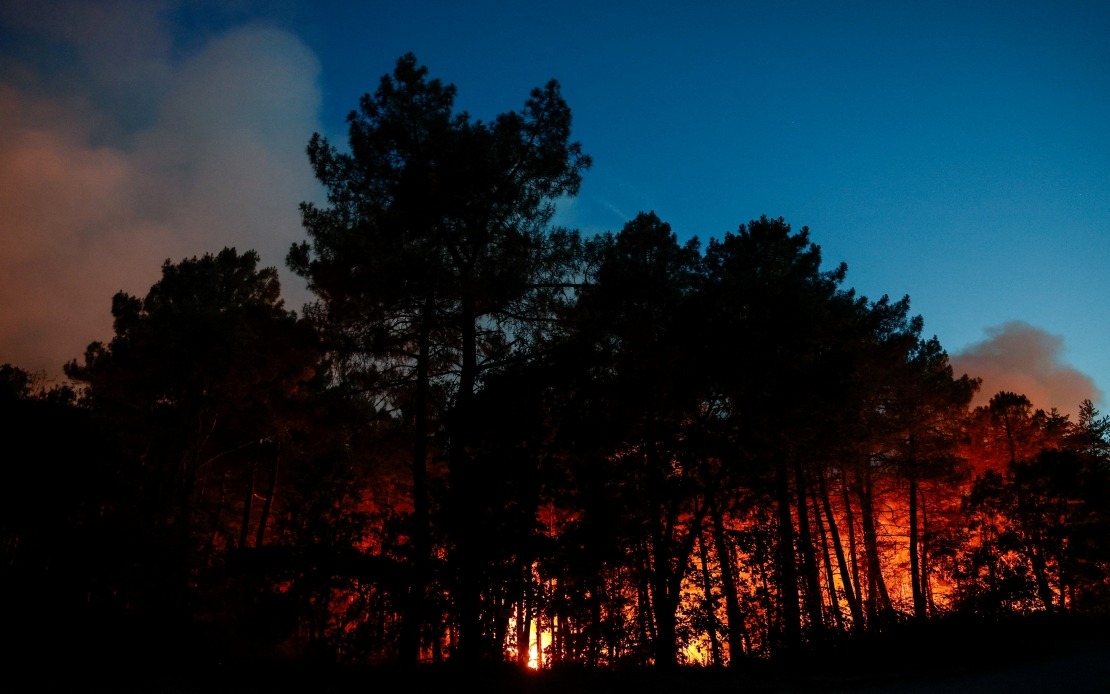
France faced an escalating environmental crisis on Monday as approximately 400 firefighters worked to contain a massive wildfire consuming the historic Fontainebleau forest, a sprawling woodland reserve located south of Paris. The blaze, which ignited late Sunday evening near a major motorway, has already engulfed roughly 800 hectares of densely forested terrain, transforming this cherished natural landmark into a landscape of destruction and smoke. The scale of the emergency prompted authorities to deploy two water-bombing aircraft that drew supplies directly from the nearby Seine river, highlighting the severity of the situation and the resources required to combat such an unprecedented conflagration in a region where large-scale wildfires remain uncommon.
Investigators have opened a preliminary inquiry into the fire's origins following statements from Interior Minister Laurent Nuñez, who visited the disaster site and suggested intentional ignition. His assessment was based on a troubling pattern: multiple separate fire outbreaks were detected within a radius of just 1,000 metres, a clustering that strongly suggests coordinated arson rather than natural causes or a single accidental ignition. This possibility has sent alarm bells through the French government, raising questions about whether the blaze represents a criminal act during a period of acute vulnerability when the entire nation grapples with dangerous heat conditions.
The Fontainebleau forest carries profound significance extending far beyond its role as a natural resource. The woodland encompasses the historic Château de Fontainebleau, a former royal residence of considerable cultural importance, and constitutes one of Western Europe's most substantial continuous forested expanses. The forest has long attracted nature enthusiasts, historians, and tourists from across the continent. For Malaysian and Southeast Asian observers, such devastation underscores how climate vulnerability affects even wealthy, developed nations with sophisticated disaster response infrastructure. The incident demonstrates that extreme heat and environmental stress transcend geographic boundaries and economic development levels.
The human toll proved immediate and substantial. Authorities evacuated more than 1,000 residents and tourists from surrounding communities as the fire advanced with frightening speed. The mayor of Le Vaudoué, a village at the forest's edge, depicted a harrowing scene to media outlets, describing what he characterised as a massive wall of flames bearing down rapidly on residential areas. Residents witnessed the fire reaching the initial houses bordering their community, a terrifying experience that highlighted how swiftly such natural disasters can transition from distant threats to immediate dangers requiring emergency exodus.
Government officials characterised the situation as exceptional, reflecting the unusual nature of such a large-scale wildfire in northern France. Maud Bregeon, serving as French government spokeswoman, emphasised that authorities had mobilised all obtainable resources to combat the flames and prevent further territorial losses. Her comments acknowledged an uncomfortable reality: wildfires of this destructive magnitude have historically remained rare in northern French regions, meaning emergency response systems and community preparedness were designed for less severe scenarios. The current situation thus stretched existing protocols and forced improvisation in real time.
The broader context involves France's struggle against a relentless succession of heat waves, with the current conflagration representing merely one manifestation of an exceptionally hot summer. This was the country's third major heat wave within a single calendar year, creating widespread dry conditions and elevated temperatures that transformed forests into tinderboxes. Throughout France, firefighters confronted multiple simultaneous blazes, a dispersion of resources that complicated efforts to combat any single fire with the concentration that might otherwise have been possible. The cumulative stress on emergency services revealed the system-wide vulnerabilities exposed when extreme weather events cluster temporally.
Weather authorities underscored the severity of prevailing conditions by placing 37 separate administrative departments under the highest red heat alert designation at the week's beginning. This expansive geographic coverage indicated that dangerous conditions were not localised phenomena but rather symptomatic of a widespread atmospheric pattern creating hazardous circumstances across vast regions. For Malaysian readers accustomed to tropical climates but increasingly experiencing unpredictable weather patterns themselves, such alerts serve as cautionary signals about how climate disruption manifests differently across latitudes yet creates genuine peril everywhere.
The potential arson investigation adds a disturbing dimension to an already serious environmental catastrophe. If deliberate ignition is confirmed, it would represent not merely a natural disaster but a criminal act committed during precisely the conditions when fires spread most rapidly and prove most difficult to control. French authorities would face the dual challenge of combating an active blaze while simultaneously pursuing investigative leads and building prosecutorial cases. The timing, if indeed intentional, suggests either opportunistic criminal behaviour or possibly ideologically motivated destruction, though authorities have released no information about suspected motives or perpetrators.
For regional observers in Southeast Asia, the Fontainebleau incident carries instructive lessons about climate vulnerability transcending national boundaries and economic status. Malaysia itself has experienced devastating forest fires, particularly during El Niño events that create extended dry periods. The French situation demonstrates that even densely populated, wealthy nations with advanced infrastructure face significant challenges when managing large-scale wildfires in conditions of extreme heat. The incident also illustrates how environmental emergencies can coincide with criminal activity, requiring authorities to manage complex simultaneous crises. As climate patterns become increasingly unstable globally, such extreme events may become less anomalous, necessitating enhanced preparedness and international knowledge-sharing among nations facing similar environmental threats.

