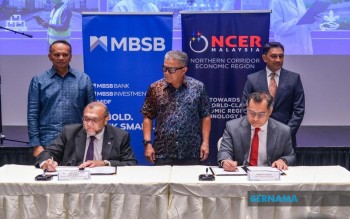
MBSB Bank Bhd has formalised a partnership with the Northern Corridor Implementation Authority to inject up to RM1 billion in dedicated financing support for small and medium enterprises across Malaysia's northern states. The memorandum of understanding, inked on July 17 at a ceremony in Petaling Jaya, represents a significant initiative to catalyse economic activity across the Northern Corridor Economic Region, which spans Perlis, Kedah, Penang and Perak.
The collaboration signals growing confidence in the growth potential of Malaysia's northern tier at a time when regional economies are competing fiercely for investment and talent. By directing substantial capital towards SME expansion in these states, the partnership aims to address a persistent challenge facing smaller enterprises: access to affordable, readily available funding for scaling operations and venturing into new markets. For businesses rooted in these states, the financing facility opens pathways to invest in capacity building, upgrade production infrastructure, and integrate into regional and global supply chains—competitive advantages increasingly critical in industries from electronics manufacturing to agricultural processing.
MBSB Bank chairman Datuk Wan Kamaruzaman Wan Ahmad emphasised how the funding would empower businesses to strengthen their operational footprint within the northern region. The RM1 billion commitment transcends mere financial assistance; it reflects deliberate policy alignment with Malaysia's long-term development agenda. Businesses gaining access to this capital can pursue expansion initiatives that might otherwise remain beyond reach due to conventional lending constraints, positioning them to capture emerging opportunities as the northern economy diversifies and internationalises.
The Northern Corridor has garnered recognition as one of Malaysia's fastest-expanding economic zones, having successfully attracted substantial investment flows across multiple high-growth sectors. Electronics and electrical manufacturing continues to dominate, but the region has progressively diversified into advanced manufacturing, logistics hubs, digital economy ventures, and agri-technology enterprises. This sectoral diversity reduces dependency on any single industry, creating resilience while generating multiple pathways for SME participation. The MBSB-NCIA partnership directly supports this diversification strategy by making capital available precisely where business appetite exists.
MBSB Bank group chief executive officer Rafe Haneef highlighted the strategic focus on export-oriented SMEs, recognising that internationalisation constitutes a natural progression for maturing domestic enterprises. His reference to the bank's partnership with Santander Group, a European banking conglomerate, underscores an important dimension often overlooked in domestic financing discussions: international reach and expertise. By linking northern Malaysian SMEs with a global banking platform, the initiative facilitates not just capital provision but also commercial network expansion and cross-border transaction facilitation—tangible assets for businesses pursuing overseas market entry.
The document was signed by MBSB Bank group chief commercial banking officer Noor Mohamed Amin and NCIA chief operating officer Hasri A Hassan, cementing institutional commitment from both organisations. Such formal ceremonies and signatory protocols matter because they establish accountability frameworks and operational blueprints. Both institutions now carry organisational responsibility for translating the memorandum into practical disbursement mechanisms, eligibility criteria, and support infrastructure that allow target businesses to access funds efficiently.
NCIA chief executive Datuk Mohamad Haris Kader Sultan contextualised the partnership within the broader 13th Malaysia Plan framework, positioning it as a strategic mechanism for constructing the foundational ecosystem necessary to attract fresh investment and accelerate project implementation timelines. This connection to national planning priorities elevates the initiative beyond a simple bilateral arrangement into an instrument of coordinated regional development policy. The explicit mention of strategic growth sectors—electrical and electronics, advanced manufacturing, agri-food, logistics, digital economy and green technology—provides clarity regarding sector preference, allowing prospective borrowers to understand where lending appetite concentrates.
The financing structure targets a recognised gap in Malaysia's SME landscape. While large corporations enjoy relatively straightforward access to capital markets and institutional financing, SMEs frequently encounter friction in securing loans proportionate to their growth ambitions. Banks hesitate to lend to enterprises lacking extensive track records or substantial collateral. This MoU attempts to bridge that divide by combining MBSB Bank's lending expertise with NCIA's deep knowledge of regional economic dynamics and business landscapes. Such partnerships have proven effective globally in de-risking SME lending through shared information flows and collaborative due diligence processes.
For Malaysian policymakers monitoring regional economic performance, this initiative reflects acknowledgment that the northern states, while economically vibrant, require targeted interventions to unlock their full growth potential. Competition from southern zones, particularly the Klang Valley and Iskandar Malaysia, persists in attracting enterprise headquarters and high-value functions. By establishing dedicated financing mechanisms, the MBSB-NCIA partnership signals that northern businesses can access capital on comparable terms to southern counterparts, potentially influencing location decisions for expanding enterprises.
The RM1 billion deployment timeline and disbursement criteria remain important details awaiting clarification through subsequent operational guidelines. The success of such initiatives ultimately depends on execution—how efficiently loans reach eligible businesses, what interest rate structures apply, and whether the application process balances due diligence with accessibility. These operational dimensions will determine whether the partnership becomes a transformative economic stimulus or a more modest contributory initiative.
Looking forward, this collaboration may establish a template for similar public-private partnerships across other Malaysian regions. If the northern corridor financing initiative demonstrably improves SME access to capital and measurably accelerates business growth in target sectors, comparable arrangements could be replicated in other development corridors. The partnership thus carries significance beyond its immediate RM1 billion scope, potentially influencing how Malaysia structures future economic development initiatives across its diverse regional economies. For northern Malaysian entrepreneurs, the immediate prospect is straightforward: a new institutional pathway to financing ambitions that previously faced institutional resistance.

