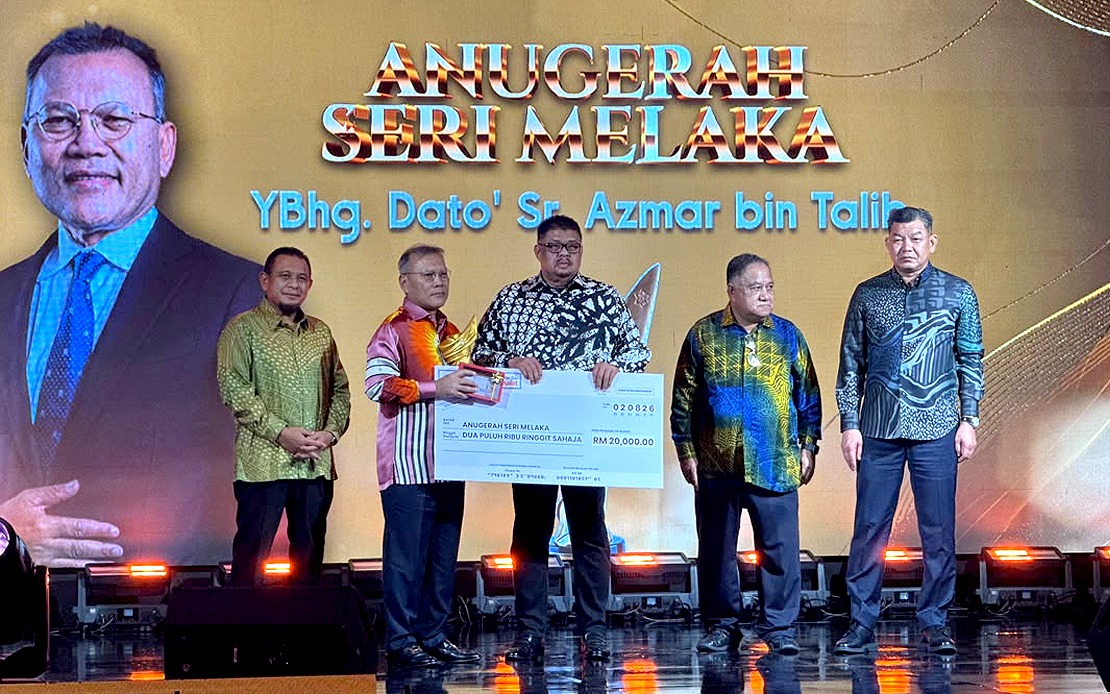
Melaka's Chief Minister Datuk Seri Ab Rauf Yusoh has made a direct appeal to the state's most accomplished citizens to transform their personal success into a collective advantage for the broader community. Speaking at the prestigious Anugerah Seri Melaka (ASM) Gala Night ceremony held at the Melaka International Trade Centre in Ayer Keroh, Ab Rauf articulated a vision where high-achieving individuals become active partners with the state government, channelling their accumulated experience, professional expertise and business networks towards fostering opportunities for younger generations attempting to establish themselves in their respective fields.
The Chief Minister's call reflects a strategic recognition that economic development and social progress depend not merely on government initiatives alone but on mobilising the talent and resources distributed throughout society. By positioning successful Melaka-born professionals as bridges between aspiration and achievement, the state government aims to create a mentorship ecosystem where accomplishment naturally translates into mentorship and opportunity creation. This approach acknowledges that those who have navigated competitive industries and built substantial careers possess invaluable practical knowledge that formal education and government policy alone cannot provide.
The Melaka Sayang Rakyat (MeSRa) initiative, under which this appeal was framed, seeks to document and publicise the achievements of outstanding Melaka talents rather than allowing such accomplishments to remain confined to individual recognition. By converting private success stories into public inspiration, the state government hopes to shift perceptions and demonstrate that prosperity and professional advancement are attainable for residents regardless of background. This documentation effort serves a psychological and motivational function, making abstract possibilities tangible and relatable for younger people deciding their own career trajectories.
The ASM awards programme itself reflects this philosophy through its comprehensive structure, encompassing four distinct categories that recognise excellence across different sectors of society. Public Service, Corporate, Sports, and Arts and Culture categories were selected to honour achievement across both traditional and creative domains, signalling that the state values diverse forms of contribution. The receipt of more than 200 nominations demonstrated substantial community engagement with the initiative, suggesting that recognition programmes resonate with Melaka residents and that the state has produced notable figures across multiple disciplines.
The narrative underpinning these awards emphasises the personal journeys that culminate in recognisable success. Each nomination, according to the Chief Minister, represents a testament to qualities including sustained hard work, personal sacrifice and unwavering perseverance. By highlighting these character elements, the state government consciously positions achievement not as luck or privilege but as the natural result of dedication and determination—a message designed to inspire others facing comparable obstacles to persist through comparable difficulties. This framing becomes particularly significant in a competitive regional context where Malaysian talents increasingly pursue opportunities across borders.
The award recipients themselves represent a cross-section of contemporary high achievers. Datuk Azmar Talib, chief executive officer of TRX City Sdn Bhd, secured the Corporate category award, reflecting the state's capacity to produce leaders in urban development and real estate sectors. National badminton player Aaron Chia, winner of the Sports category, embodies Melaka's contribution to Malaysia's athletic reputation. Performing arts director Lokman Abd Ghani's recognition in Arts and Culture celebrates creative excellence, while Datuk Zamri Misman's Public Service award acknowledges those dedicated to government administration and legal affairs. International medical science researcher Dr Saiful Anuar Singar's Special Category award further demonstrates Melaka's participation in cutting-edge global research.
The financial structure of the awards programme—RM20,000 cash prizes and trophies for the overall award recipient, with RM10,000 prizes for individual category winners—provides tangible recognition while establishing a meaningful acknowledgement of achievement. These sums, while modest in absolute terms, represent a state government commitment to celebrating and promoting excellence, functioning as both a material reward and a symbolic validation of accomplishment.
For Malaysian readers, particularly those based in other states, this initiative offers a template for talent retention and development. Melaka's approach recognises that rapid urbanisation and economic globalisation create centrifugal forces pulling talented individuals toward larger metropolitan centres or overseas opportunities. By actively celebrating and connecting with successful diaspora members, the state government attempts to maintain ties and create return incentives. This becomes increasingly relevant as Malaysian professionals throughout Southeast Asia and beyond develop expertise that could benefit their home states if institutional frameworks existed to facilitate meaningful engagement.
The Chief Minister's emphasis on creating a legacy through shared success introduces an intergenerational perspective often absent from conventional economic development strategies. Rather than viewing achievement as individual acquisition, Ab Rauf's rhetoric suggests that true legacy emerges when successful people consciously facilitate pathways for others. This philosophical stance, when adopted by multiple high-achieving individuals simultaneously, theoretically generates a multiplier effect where each generation consciously invests in the next, creating cumulative advantages that compound over decades.
The timing and venue of this announcement—a formal gala event at a major trade centre—underscore the importance the state government assigns to these initiatives. The ceremonial nature emphasises that achievement deserves recognition beyond private celebration. For younger Melaka residents observing these ceremonies and hearing their Chief Minister explicitly invite accomplished individuals to mentor and support them, the message communicates official endorsement of ambitious pursuits and promise of recognition upon success.
Beyond the immediate context of Melaka, this initiative reflects broader challenges facing Malaysian states and the nation more generally in an increasingly competitive regional economy. The need to document, celebrate and mobilise talent has become acute as neighbouring countries and developed nations intensify efforts to attract Malaysian professionals. Melaka's approach, while perhaps modest in immediate scope, signals a recognition that talent development requires active state engagement rather than passive reliance on market forces or national-level programmes.

