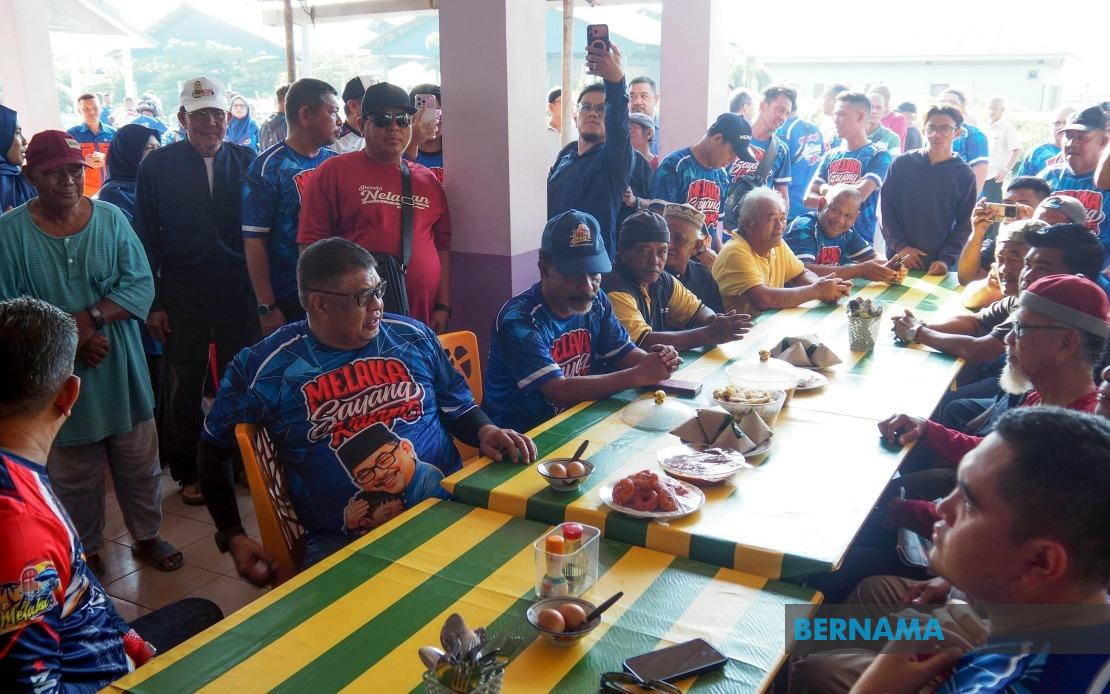
The Melaka state government has rolled out a comprehensive assistance programme aimed at strengthening the socioeconomic conditions of the fishing community, combining traditional social safety nets with modern technological tools to boost productivity and income security. Chief Minister Datuk Seri Ab Rauf Yusoh unveiled the initiatives during the Merlimau state constituency leg of his 'Jelajah Ketua Menteri Sayang Rakyat' grassroots engagement tour, signalling a strategic shift toward ground-level policy formulation that directly addresses sectoral needs rather than relying on bureaucratic assumptions about community welfare.
The two-pronged approach encompasses mandatory PERKESO (Pertubuhan Keselamatan Sosial) coverage for all registered fishermen alongside the distribution of fish-finder technology—a significant departure from conventional assistance models that typically focus on cash transfers alone. By mandating social security protection, the state government addresses a critical vulnerability in Malaysia's maritime workforce, where occupational hazards and income volatility have historically left fishing communities exposed to financial catastrophe during illness, injury, or seasonal downturns. The fish-finder component reflects a modernisation impulse, recognising that traditional fishing methods relying solely on experiential knowledge and intuition place local fishermen at competitive and economic disadvantage as commercial fishing becomes increasingly technology-dependent.
During the Kuala Sempang Jetty event, 107 registered fishermen received RM200 each under the 'Bantuan Jaring Nelayan' (Fishermen's Net Assistance) scheme, distributing a combined RM21,400 to support operational costs and equipment maintenance. Simultaneously, the government distributed 360 kilogrammes of fish valued at RM3,600 to the broader public at approximately 1.5 kilogrammes per household, effectively linking fishermen's welfare to community food security and demonstrating the ripple effects of supporting primary sector productivity. This distribution model acknowledges that fishing communities often function as informal food supply channels for lower-income urban and suburban populations, particularly in Peninsular Malaysia where proximity to coastal areas makes fresh fish an affordable protein source.
Amirul Shah Fuad Shah, a 35-year-old fisherman from Kuala Merlimau with over two decades of experience, articulated the practical significance of fish-finder technology adoption. He noted that commercial-grade fish finders typically command retail prices between RM1,000 and RM2,000, placing them beyond the reach of individual fishermen operating on thin margins. The technology enables rapid identification of fish schools and optimal casting locations, replacing guesswork with data-driven decision-making and materially improving catch efficiency and profitability. For ageing fishermen particularly—many of whom have accumulated decades of experiential knowledge but lack capital for technological upgrades—such government-provided tools represent a pathway to maintaining competitiveness and income as physical capacity declines.
Md Khalil Md Jadi, chairman of the Kampung Sempang Fishermen's Association at 67 years old, positioned the PERKESO coverage initiative as a profound recognition of the fishing community's economic and social contributions. He underscored that many association members are elderly individuals with limited alternative livelihood options, making occupational injury or illness potentially catastrophic for household survival. The PERKESO expansion addresses a long-standing gap in Malaysia's social protection architecture—informal and self-employed workers in primary sectors have historically fallen outside comprehensive safety nets, creating intergenerational poverty traps and vulnerability to sudden economic shocks. By extending standardised social security to registered fishermen, Melaka establishes a template potentially replicable across other maritime economies in Southeast Asia grappling with comparable welfare deficits.
The technology modernisation angle carries implications beyond individual income augmentation. Fish-finder adoption could facilitate more sustainable fishing practices by enabling precision targeting rather than indiscriminate netting, though this potential benefit remains largely unmentioned in current policy framing. As Malaysian and regional fishing stocks face mounting pressure from overharvesting and climate-driven ecosystem changes, even marginal improvements in catch efficiency—when combined with complementary conservation measures—could help preserve marine resources for long-term community livelihoods. Whether Melaka's initiative will incorporate marine stewardship components or regulatory safeguards remains unclear, suggesting an opportunity for integration of technology adoption with environmental sustainability objectives.
The 'Jelajah Ketua Menteri Sayang Rakyat' tour mechanism itself warrants examination as a governance approach. By systematically visiting grassroots communities and making real-time policy commitments based on direct constituent feedback, Chief Minister Ab Rauf Yusoh signals a departure from top-down policy design toward participatory problem-solving. This engagement model, if sustained, could generate policy innovations responsive to sectoral realities that remote bureaucratic planning often misses. However, the durability and scalability of such approaches depend on institutional capacity to coordinate cross-agency implementation and monitor outcomes beyond the initial announcement phase.
The fishing sector's particular importance to Melaka's economy and food security architecture cannot be overstated. Coastal Melaka communities have sustained maritime livelihoods for centuries, and contemporary policy must balance modernisation with cultural preservation and livelihood security. The PERKESO and fish-finder initiatives represent measured interventions that enhance rather than fundamentally restructure existing fishing practices, acknowledging that rapid technological or regulatory change could destabilise communities heavily dependent on traditional methods. The challenge ahead involves ensuring equitable access to these benefits across all registered fishermen, preventing technological adoption from concentrating advantages among larger operators, and integrating productivity improvements with environmental stewardship.
Regional significance extends beyond Melaka's borders. Malaysia's fishing communities across Peninsular Malaysia, Sabah, and Sarawak face structurally similar challenges: aging workforces, capital constraints, occupational vulnerability, and competition from technologically superior commercial operators. Should Melaka's model prove sustainable and generate measurable welfare improvements, it could catalyse comparable initiatives in other coastal states and inform federal fisheries policy. Southeast Asian neighbours including Thailand, Vietnam, and Indonesia—where fishing employs millions across comparable socioeconomic contexts—might similarly benefit from integrated approaches combining social protection with productivity-enhancing technology.

