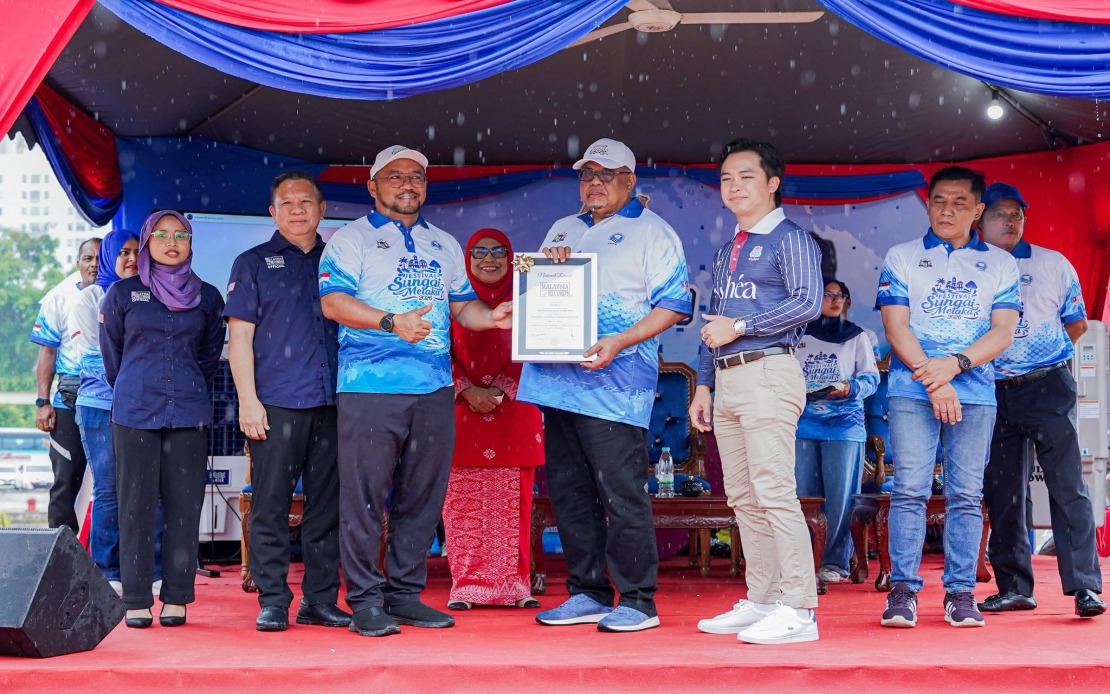
Melaka's tourism landscape continues to expand with the state claiming its fourth Malaysia Book of Records (MBOR) recognition in just over three years, signalling sustained momentum in the sector's competitive race for distinction and visitor appeal. Chief Minister Ab Rauf Yusoh unveiled the latest accolade during a ceremony at Dataran Pengkalan Rama, framing the achievement as evidence of the state's capacity for innovation and execution in crafting memorable tourism experiences. The announcement arrives amid broader efforts to position Melaka as a destination that transcends heritage alone, instead offering contemporary attractions and community-driven programmes that resonate with modern travellers.
Yusoh made clear that record certifications alone do not constitute meaningful success, cautioning against allowing the achievements to become merely decorative fixtures in government offices. Instead, he positioned each recognition as a launchpad for fresh entrepreneurial thinking within the tourism ecosystem, one where consecutive accomplishments build momentum and create spillover economic benefits throughout local communities. This framing reflects an emerging sophistication in how Malaysian state governments view tourism assets—not as isolated attractions but as catalysts for broader economic participation and employment generation among residents.
The Sungai Melaka Festival 2026, the platform for this latest announcement, exemplifies the strategy of animating heritage waterways through year-round programming rather than relying on static heritage conservation alone. The 17th iteration of the festival showcases how deliberate curation of diverse activities can transform a geographic asset into a genuine economic driver. By distributing over 30 programmes across Melaka's three districts, the festival extends benefits beyond the urban core and ensures that tourism growth engages rural and semi-urban populations, reducing geographical economic disparities within the state.
A freshwater fishing competition anchored the festival's community engagement, drawing 1,123 anglers from within and beyond Melaka's borders and distributing RM30,000 in prize money with the first-place award set at RM10,000. This scale of participation reflects the existence of a dedicated angling community that, until now, had largely remained untapped as a tourism constituency. The early-morning turnout of participants armed with rods, bait, and carefully developed strategies suggests a subculture with organisational depth and sustained engagement, characteristics that tourism planners can leverage to construct repeat-visitation patterns and visitor spending extensions.
Yusoh's observation that the fishing competition possesses untapped potential for larger-scale development signals recognition within state leadership that niche tourism products can achieve outsized economic returns if properly scaled and marketed. Unlike mass-market attractions that compete on brand recognition and reach, specialised experiences such as competitive fishing festivals often command premium participation fees, generate secondary spending in accommodations and meals, and foster social media amplification through dedicated hobbyist communities. The decision to expand the competition's scope, increase prize allocations, and broaden its appeal reflects learning from this iteration and commitment to treating tourism innovation as an iterative process.
Melaka's four MBOR recognitions within three years position the state as a growth leader within Malaysia's regional tourism hierarchy, a distinction carrying both opportunities and pressures. The recognitions validate the state government's tourism strategy and create psychological momentum internally, attracting talent and investment toward the sector. Externally, accumulating records signals to potential investors and tourism operators that Melaka presents a dynamic market with demonstrable capacity for generating newsworthy attractions and competitive differentiation. For regional competitors including Johor and Penang, Melaka's trajectory represents a case study in how sustained investment in experience innovation can yield measurable brand recognition gains.
The Melaka River and Beach Development Corporation (PPSPM), represented at the ceremony by chief executive officer Shaharul Azuar Idris, functions as the institutional engine behind these initiatives. The corporation's multi-year stewardship of waterfront activation programmes demonstrates how dedicated implementing agencies with clear mandates can execute tourism strategies that integrate environmental stewardship, community participation, and commercial viability. PPSPM's role suggests that tourism success in Malaysian states increasingly depends on institutional architecture and capacity, not merely policy intention or funding allocation.
The choice to frame record-setting achievements as catalysts for future invention rather than final accomplishments reveals a maturing approach to tourism competitiveness. In Southeast Asia, where many destinations compete on similar heritage and cultural foundations, differentiation increasingly requires continuous innovation in experience design and authentic community integration. Melaka's willingness to treat MBOR recognitions as stepping stones rather than destinations indicates alignment with global best practices in sustainable tourism development, where visitor satisfaction and economic resilience flow from genuine engagement with local populations and authentic place identity.
For Malaysian policymakers across other states observing Melaka's trajectory, the model suggests several replicable elements: dedicated implementation agencies with sufficient autonomy, diversified programming that extends beyond peak seasons, explicit linkage between record-setting achievements and economic outcomes for communities, and willingness to invest substantially in activating assets that lack immediate commercial appeal but possess latent community participation potential. The fishing competition exemplifies this last principle, as angling communities rarely feature in conventional state tourism marketing yet represent accessible pathways to visitor acquisition and extended stays.
Looking forward, Melaka's accumulation of recognitions and demonstrated capacity for scaling niche tourism products position the state to capture growing regional demand for experiential and activity-based tourism. As travellers increasingly seek authentic engagement over passive observation, destinations offering well-organised, community-embedded activities with clear competitive distinction stand to prosper. Melaka's strategy of leveraging record-setting not as endpoints but as validation of a repeatable innovation capacity suggests the state has internalized this competitive reality and is positioning itself to sustain tourism leadership beyond traditional heritage tourism markets.

