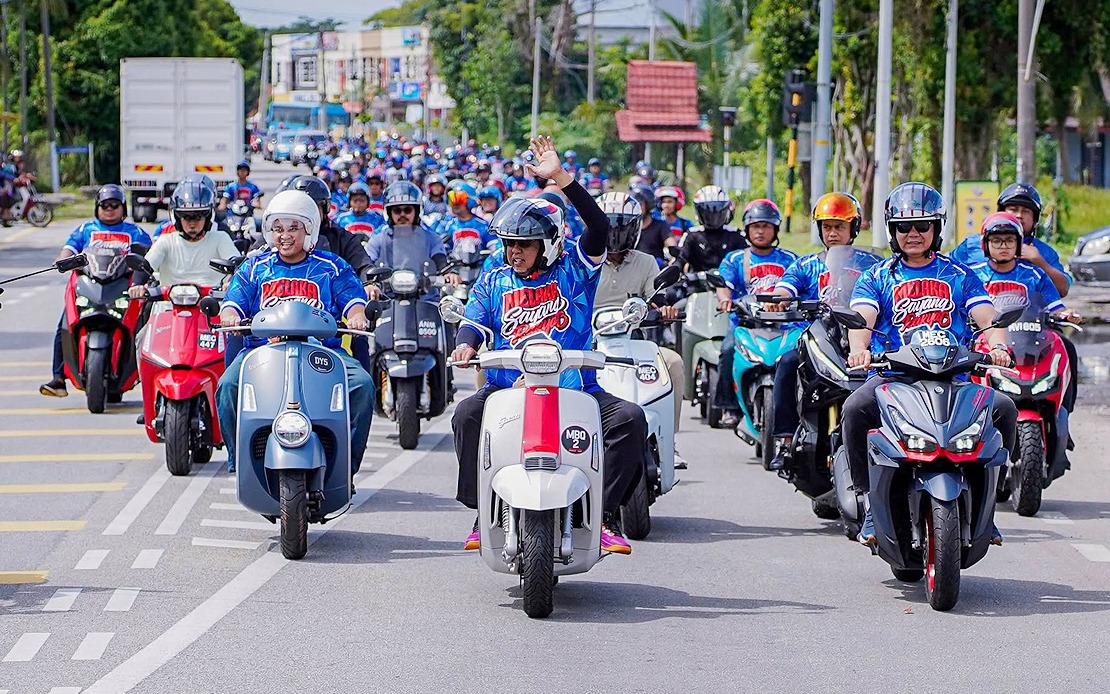
Melaka Chief Minister Datuk Seri Ab Rauf Yusoh has launched the next phase of the state government's flagship community engagement programme, known as WRUR, in the Tangga Batu parliamentary constituency. The expansion marks a significant shift in bringing concentrated grassroots outreach to two key state constituencies—Pantai Kundor and Paya Rumput—through what the Chief Minister described as a continuation rather than an experiment of ground-level governance.
The WRUR initiative operates on a comprehensive mandate that extends far beyond conventional political campaigning. Over 200 distinct programmes will be implemented across the two constituencies, encompassing welfare distribution, community development schemes, educational support, youth engagement, small business assistance, and targeted resolution of longstanding local grievances. This breadth of coverage reflects an attempt to address the full spectrum of constituent concerns, from immediate material needs to structural infrastructure deficiencies that have accumulated over years of neglect.
What distinguishes WRUR from typical political initiatives is its claimed consistency and systematic approach. Rather than positioning itself as a seasonal or election-driven exercise, the programme represents an ostensibly permanent reorientation toward continuous community feedback and responsive governance. Ab Rauf emphasised that this methodology has been maintained across 23 previous implementation phases, establishing a track record of institutional engagement that extends beyond individual political personalities or electoral cycles.
The quantitative results cited by the Chief Minister provide a framework for assessing the programme's effectiveness. Across the 23 phases, the initiative has received more than 4,000 formal complaints from residents, with nearly 70 per cent ultimately resolved through government intervention. These figures suggest either a significant backlog of unaddressed community concerns or a substantial capacity gap in routine local administration. Within the Tangga Batu constituency specifically, the programme previously operated in Sungai Udang and Kelebang, where 328 complaints were resolved from an initial intake of 359 cases, leaving 31 still under investigation or negotiation.
The financial commitment accompanying this phase demonstrates the state government's willingness to deploy substantial resources toward direct community support. In the sixth round alone, over RM150,000 in diverse assistance was distributed across multiple beneficiary categories. Fishermen received RM22,000 across 220 individuals, reflecting the constituency's maritime economic base. Boat owners affected by specific sinking incidents were compensated at RM1,500 per claim, while small and medium enterprise operators received business equipment and tools valued at RM14,000. Beyond these sectoral allocations, aid extended to religious institutions, places of worship, student bursaries, and emergency housing assistance for financially vulnerable residents.
Infrastructure investment forms a complementary pillar of the WRUR approach, addressing physical vulnerabilities that undermine community welfare. Recent flash flooding in Pantai Kundor damaged 73 residential properties, prompting the Department of Irrigation and Drainage to mobilise an immediate RM50,000 response targeting Sungai Seberang Gajah. This cleaning and maintenance work was expected to conclude within days of the Chief Minister's announcement. Beyond emergency response, medium-term hydraulic improvements at Sungai Lereh have been approved for procurement at RM100,000, suggesting capacity constraints in local drainage systems had been documented but remained unfunded prior to the WRUR programme.
The largest capital project announced reflects the cumulative impact of deferred maintenance on transportation infrastructure. The Public Works Department has sought federal approval for a RM16 million upgrade to the crossing culvert structure on Jalan Tangga Batu-Tanjung Minyak, a project scale that suggests the crossing represents a critical transportation chokepoint rather than a minor local road. The process of securing federal approval indicates that state budgets alone cannot accommodate all identified infrastructure needs, highlighting interdependencies between state and federal resource allocation in Malaysian federalism.
For Malaysian observers and regional analysts, the WRUR model presents several noteworthy dimensions. First, it demonstrates how state governments attempt to systematise political engagement through complaint collection and resolution, potentially creating institutional pathways that outlast individual administrations. Second, the programme reveals the extent of accumulated unresolved issues at grassroots level—the existence of 4,000 complaints across multiple phases suggests either that conventional administrative channels are insufficient or that residents perceive direct political intervention as necessary to secure action. Third, the financial allocations suggest that targeted welfare distribution remains politically valuable even as development progresses, indicating either persistent income inequality or strategic political calculation regarding the electoral utility of direct cash transfers.
The Tangga Batu expansion also reflects broader patterns within Malaysian state politics, where competitive federalism encourages state governments to demonstrate tangible delivery and responsiveness to justify governance legitimacy. By quantifying complaints received and resolved, the Melaka administration creates measurable performance metrics that can be cited in electoral campaigns and governance assessments. Whether these metrics accurately capture implementation quality or merely document transaction volumes remains an empirical question requiring independent verification.
Looking forward, the sustainability of the WRUR approach depends on maintaining political continuity and securing adequate ongoing funding. The programme's expansion signals confidence in this continuity, but shifts in state administration could interrupt institutional momentum. Additionally, the apparent resolution rate of approximately 70 per cent raises questions about the nature of unresolved complaints—whether they represent genuinely intractable problems, insufficient resource allocation, or cases where government intervention proved unsuccessful in meeting stated objectives.
For constituencies like Pantai Kundor and Paya Rumput, the programme represents a significant influx of attention and resources that may produce measurable improvements in local conditions, particularly infrastructure. However, the underlying question of whether systematic complaint response can substitute for preventive governance—addressing root causes of flooding, unemployment, or entrepreneurial barriers rather than responding after problems materialise—remains central to assessing whether WRUR represents genuine institutional reform or sophisticated political management of pre-existing deficits.

