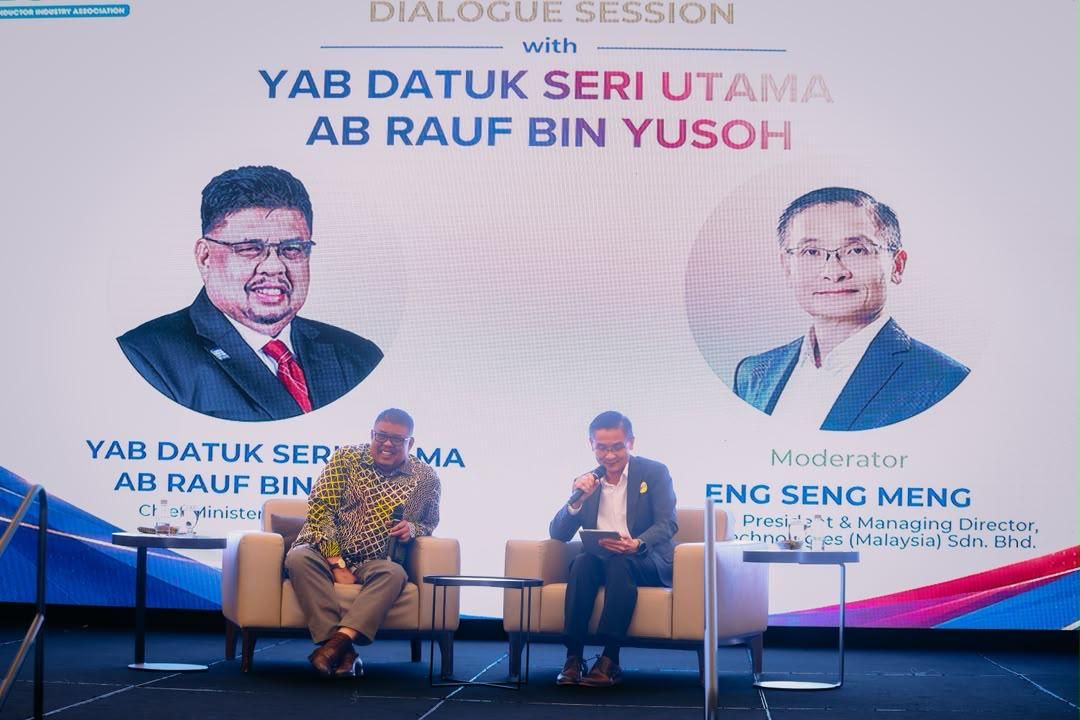
Melaka's semiconductor and electronics manufacturing sector has matured into a RM17.6 billion industry, marking a remarkable economic transformation from its humble beginnings half a century ago, according to Chief Minister Datuk Seri Ab Rauf Yusoh. Speaking during a dialogue with industry leaders at a Melaka hotel, Ab Rauf traced the sector's evolution from a small-scale operation launched by pioneering entrepreneurs to a globally significant manufacturing hub that now underpins the state's prosperity and employment landscape.
The roots of Melaka's semiconductor dominance trace back to the early 1970s, when an international corporation made the audacious decision to establish operations in the state. That foundational investment did not begin in sprawling modern facilities but rather in a modest setting at an Umno building on Jalan Hang Tuah, before expanding to Batu Berendam after Melaka established its first Free Industrial Zone in 1976. This inauspicious beginning belies the scale of what would eventually develop. What commenced with a handful of dedicated workers has blossomed into a sophisticated industrial ecosystem employing thousands and attracting continuous investment from multinational titans across the United States, Germany, China, Japan and beyond.
The semiconductor and electrical and electronics manufacturing sectors have become central to Melaka's economic identity. Manufacturing now contributes 36.1 percent to the state's gross domestic product, with more than 400 manufacturing companies operating across 18 industrial sectors. This diversification cushions the economy against sector-specific downturns while creating interdependencies that strengthen the overall industrial base. Beyond the headline figures, the industry's expansion has generated cascading economic opportunities throughout the state, supporting not merely the multinational corporations themselves but an extensive ecosystem comprising local suppliers, small and medium enterprises, technical workers and the broader families and communities dependent on manufacturing employment.
Ab Rauf emphasised that Melaka's five-decade track record in semiconductor and electrical and electronics manufacturing constitutes a strategic asset as the state positions itself within Malaysia's and Southeast Asia's technology supply chains. The accumulated experience, relationships with global suppliers, institutional knowledge embedded in the workforce, and established support services create significant barriers to competitors attempting to replicate Melaka's capabilities. This institutional depth means that companies already embedded in Melaka benefit from advantages extending far beyond the initial investment decision.
Three fundamental strengths continue to underpin Melaka's appeal to semiconductor manufacturers navigating global investment decisions. The state's strategic geography between Kuala Lumpur, Johor and Singapore provides convenient access to major markets, deep-water ports, international airports, established suppliers and an expanding talent pool, all while maintaining competitive land costs, operational expenses and living standards compared to more densely developed alternatives. The state currently has more than 2,600 hectares of industrial land earmarked for future development, offering companies substantial room for expansion as demand fluctuates and their operational requirements evolve. This land availability addresses a genuine constraint in manufacturing-dependent regions where existing industrial parks fill to capacity.
The second advantage lies in workforce development. Melaka is strengthening its position as a technical and vocational education training hub through 61 institutions producing graduates equipped with skills directly applicable to semiconductor manufacturing and advanced engineering roles. Critically, these educational institutions are increasingly aligning their curricula with the evolving technological requirements of semiconductor manufacturers, creating a pipeline of workers prepared for contemporary roles rather than outdated specialisations. This responsiveness to industry needs distinguishes Melaka's vocational training ecosystem and addresses a persistent challenge facing manufacturing-dependent economies.
The third pillar is demonstrated investor confidence. The sustained and expanding presence of multinational corporations headquartered across multiple continents and operating for more than 50 years in Melaka signals that the state delivers on implicit promises of stability, regulatory predictability and a business-enabling environment. Recent investment data reinforces this perception. Melaka recorded RM14.68 billion in investments across 312 projects during 2025, representing the highest annual investment value the state has achieved in 22 years. This performance attests to Melaka's continued appeal even amid heightened global competition for semiconductor manufacturing capacity and supply chain investments.
However, Ab Rauf issued a cautionary note that the semiconductor industry stands at an inflection point. Investment decisions being made in 2025 will substantially determine the geographic distribution of semiconductor production, technology development, talent concentration and supply chain architecture for the subsequent 10 to 20 years. This crystallisation process means that states failing to secure investments and manufacturing capacity during this window may find themselves marginalised as the global semiconductor industry consolidates around preferred locations. Melaka risks losing not only new manufacturing facilities but also the ancillary expansion projects, supporting industries and high-skilled employment opportunities that typically follow initial facility establishment. Local small and medium enterprises could face exclusion from global semiconductor supply chains if Melaka's manufacturing base shrinks relative to competitors.
The danger materialises should Melaka move sluggishly in responding to investor requirements. Global semiconductor manufacturers increasingly demand faster project delivery, enhanced manufacturing capabilities and greater certainty regarding regulatory treatment and infrastructure development. Regions offering slower approvals, more protracted negotiations or less predictable operating environments face competition from jurisdictions that streamline these processes. For Melaka, this dynamic creates urgency to maintain momentum and demonstrate continued commitment to facilitating investment rather than imposing unnecessary barriers.
Responding to these imperatives, Melaka has developed the Semiconductor Strategy 2035, a forward-looking framework aimed at securing higher-value semiconductor investments, consolidating local manufacturing capabilities and cementing Melaka's status as a preferred destination among global semiconductor players. The strategy extends beyond physical infrastructure and financial incentives. Ab Rauf pledged that the state government would actively engage with investors by expediting administrative approvals, resolving operational challenges and supporting projects across their complete lifecycle from initial planning through final implementation. This hands-on approach differentiates Melaka from passive investment destinations that assume companies will navigate bureaucratic complexities independently.
The state government's value proposition encompasses the full spectrum of semiconductor manufacturing requirements. Melaka offers strategic connectivity linking global markets, competitive operational costs that enhance profit margins, a workforce equipped with contemporary technical capabilities, an established industrial ecosystem with proven support services and governmental commitment to facilitating long-term investment rather than extracting short-term revenues. For semiconductor manufacturers evaluating global expansion or consolidation, Melaka presents a complete package addressing the multifaceted requirements that modern electronics production demands. The challenge lies in translating this proposition into sustained investment flows during a period when competing jurisdictions worldwide are aggressively pursuing similar objectives.

