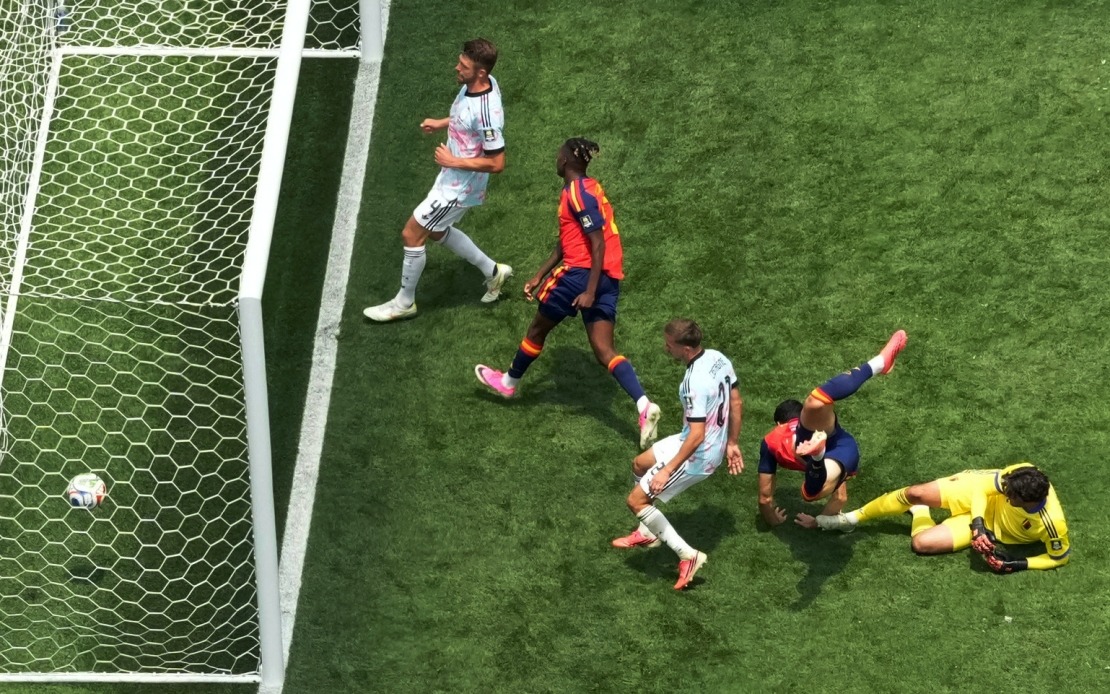
Spain has secured its place in the semi-finals of the FIFA World Cup 2026, defeating Belgium 2-1 in a quarter-final encounter at Los Angeles Stadium in California on Friday. The victory marks a return to the tournament's final four for the first time since 2010, when La Roja captured the world championship. Midfielder Mikel Merino proved instrumental in the triumph, demonstrating his growing importance to Luis de la Fuente's squad by delivering a late winner that ultimately proved the difference between the two teams.
Merino's emergence as a clutch performer comes after he made a decisive impact against Portugal in the previous round, finding the target with a second-half strike that secured Spain's 1-0 advancement. His ability to deliver in high-pressure moments has become one of the defining characteristics of Spain's tournament run, and his contribution against Belgium adds another chapter to his expanding legacy in this competition. The substitute's willingness to seize opportunities when introduced from the bench has provided De la Fuente with a valuable tactical weapon throughout the knockout stages.
Spain's offensive approach dominated large portions of the match, particularly in the opening stages when the team controlled possession and created several promising openings. The Spanish side looked threatening in the 21st minute when teenage sensation Lamine Yamal, just 18 years old, unleashed a curling attempt that narrowly missed the left post. Yamal's presence on the wing has injected pace and creativity into Spain's attacking play, offering a glimpse into the country's future generation of football talent.
Fabian Ruiz put Spain ahead in the 30th minute after capitalising on a rebound opportunity. The midfielder's goal came after Belgian goalkeeper Thibaut Courtois, at 34 years old, had produced an excellent save to thwart winger Dani Olmo's initial effort. Courtois's shot-stopping prowess was tested repeatedly throughout the first half, as the veteran custodian denied Yamal's free-kick attempt in the 35th minute with a sprawling low save. Despite playing in goal for a Belgian side seeking to challenge the tournament's elite, Courtois found himself under sustained pressure from Spain's creative attacking movements.
Belgium equalised unexpectedly in the 41st minute when full-back Timothy Castagne delivered a cross from the right flank that found forward Charles De Ketelaere unmarked in the penalty area. De Ketelaere's powerful downward header proved too difficult for Spain's goalkeeper Unai Simon to handle, levelling the score and marking Spain's first concession of the tournament. This defensive lapse represented a significant setback to De la Fuente's defensive record and gave Belgium genuine hope of progressing further in the competition under French coach Rudi Garcia.
Belgium mounted genuine threats during the second half, with full-back Maxim De Cuyper coming close to taking the lead approximately ten minutes after the interval. However, his effort sailed wide into the side netting, missing a golden opportunity to put Belgium ahead. Courtois continued to frustrate Spain's forward line with consecutive saves in quick succession, denying both Yamal and forward Mikel Oyarzabal before being forced off the pitch due to an apparent leg injury in the 71st minute.
The substitution of Courtois proved consequential for Belgium's tournament aspirations. Senne Lammels, the Manchester United goalkeeper, replaced him but made an immediate error that contributed directly to Spain's winning goal. When centre-back Pau Cubarsi's long-range effort came toward goal, Lammels fumbled the save, and Merino reacted with predatory instinct to pounce on the loose ball and convert from close range in the 88th minute. This moment encapsulated Merino's tournament impact, highlighting his positioning and composure in the game's decisive moments.
Spain now faces France in a highly anticipated semi-final clash scheduled for Dallas Stadium on July 15. France, the two-time champions, reached the last four by dismantling Morocco 2-0 on Thursday, establishing themselves as formidable opponents for De la Fuente's side. The matchup between these two European powerhouses promises to be a compelling encounter, with both nations boasting technical quality and tournament experience.
The FIFA World Cup 2026 represents a significant expansion from previous editions, featuring 48 participating nations—a substantial increase from the traditional 32-team format. This tournament is jointly hosted across Canada, Mexico, and the United States, marking the first time the competition will be staged across three countries. The expanded format and geographic spread reflect football's continued global growth, particularly in North America. The tournament commenced on June 11 and continues through July 19, providing extended football across multiple venues and time zones that have required significant logistical coordination from organisers.
For Malaysia and Southeast Asian football followers, Spain's advancement represents an important reminder of the technical and tactical standards required at the world's highest level. The manner in which Spain controlled possession, created chances, and ultimately secured victory despite defensive setbacks offers instructive lessons for regional football development. The tournament's broader significance lies in how it showcases different tactical philosophies, with Spain's possession-based approach contrasting sharply with more direct methods employed by other competitors, providing valuable viewing and analytical opportunities for developing football nations throughout the region.

