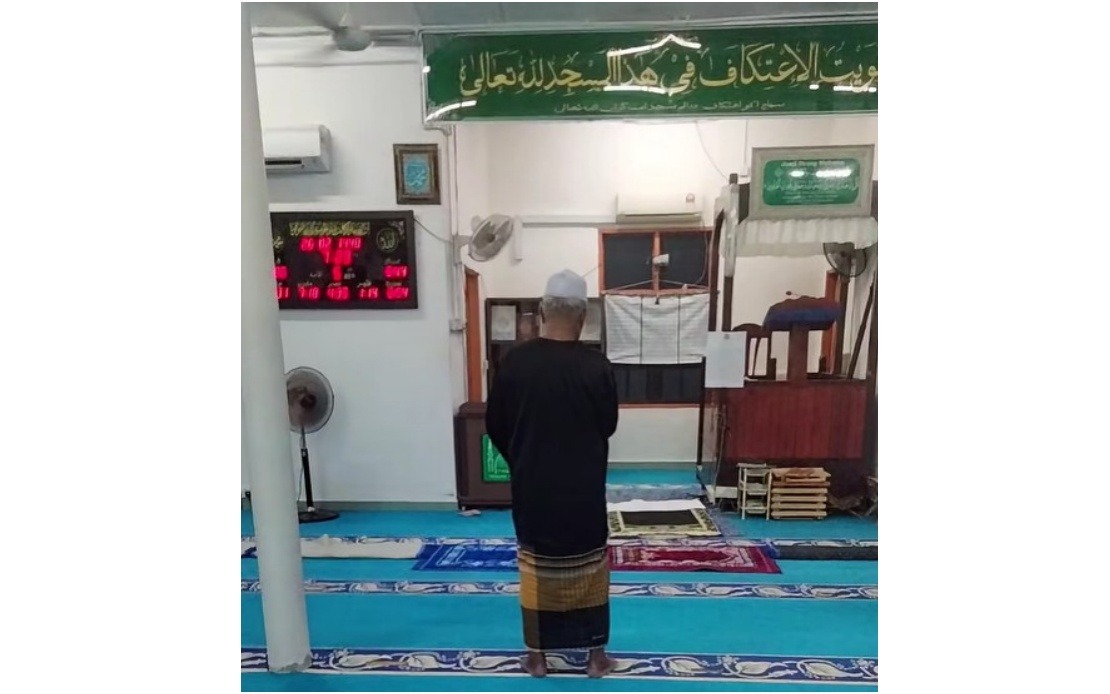
A brief video clip that spread rapidly across social media platforms has thrust Masjid Tanjung Resang in Mersing into the spotlight, capturing what appeared to be a solitary worshipper conducting prayers alone at the place of worship. The fifteen-second footage, which circulated on Facebook and WhatsApp, prompted wider discussion about congregational participation and mosque management in the rural Johor district, drawing responses from both local officials and religious authorities seeking to contextualise the situation.
Mersing Member of Parliament Muhammad Islahuddin Abas, a resident of the village, acknowledged that the mosque does indeed face challenges stemming from demographic shifts affecting the broader community. He explained that whilst the village contains numerous residential structures, the actual population occupying them has declined substantially, with many families relocating to urban employment centres and others moving away permanently. Despite these headwinds, he emphasised that the mosque's programme calendar operates uninterrupted, maintaining its regular schedule of activities and community engagement throughout the week.
The viral content caught even Muhammad Islahuddin by surprise when a friend in Kuala Lumpur forwarded a screenshot of the discussion to him via messaging applications, underscoring how internet circulation can reach far beyond a story's geographic origin. His initial shock gave way, however, to recognition that the unexpected media attention carried an inadvertent benefit for the institution. The video's circulation, whilst prompted by concerns about attendance levels, inadvertently served as publicity that brought awareness of the mosque's existence to audiences well beyond the immediate locality.
One of the most significant barriers facing Masjid Tanjung Resang appears to be its physical accessibility and visibility. Situated away from the main thoroughfare, the mosque had remained relatively obscure even to residents within the broader district who lacked specific reasons to venture into that section of the village. Muhammad Islahuddin highlighted that this geographic positioning had worked against the mosque's profile, leaving many potential users unaware of the facility entirely. In this context, the viral moment paradoxically functioned as a discovery mechanism, introducing the mosque to populations who might never have otherwise encountered it.
Beyond its primary religious function, the mosque serves a broader community purpose that extends across demographic and faith lines. Muhammad Islahuddin characterised the facility as exceptionally welcoming to all visitors, including non-Muslims, and pointed to its particular utility as a rest station for hikers undertaking the ascent of Gunung Arong. The provision of amenities specifically designed for trekkers reflects a thoughtful approach to utilising the mosque's infrastructure as a genuine community resource rather than a venue restricted narrowly to scheduled congregational worship. This multifaceted role positions the mosque as a valuable local institution beyond conventional measures of prayer attendance.
Abdul Syamil Abdul Fadzil, who chairs the mosque's management committee, moved quickly to address the narrative emerging from the video. He reported having been contacted by officials from the Johor Islamic Religious Affairs Department (JAINJ) seeking clarification about the footage and the circumstances it depicted. His response involved providing context about what the video actually showed and what it failed to represent about the mosque's genuine operational reality.
Crucially, Abdul Syamil clarified that the individual captured in the viral footage was performing a voluntary prayer rather than a mandatory congregational salah, and was not the sole worshipper at the mosque as viewers might have concluded. This distinction matters considerably when evaluating the appropriateness of attendance levels and the mosque's functional status. A single individual conducting optional prayers at a place of worship carries entirely different implications than evidence of abandonment or institutional failure.
The mosque chairman further asserted that the video bore no meaningful relationship to the mosque's actual operational circumstances. He documented that various religious programmes and activities continue operating on their established schedules, maintaining the mosque's role as an active spiritual and community centre despite the population constraints affecting the village. This continuity of programming suggests institutional resilience and commitment even under demographic stress.
The situation illuminates broader patterns affecting rural religious institutions across Malaysia, where urbanisation and migration have fundamentally altered population distributions. Many villages throughout the peninsula share Mersing's experience of shrinking resident populations despite continuing to maintain infrastructure originally built for larger communities. Mosques in these areas face genuine challenges in sustaining congregational prayer requirements and funding ongoing maintenance, yet they simultaneously serve crucial functions as cultural anchors and community gathering spaces.
The demographic reality facing Masjid Tanjung Resang reflects nationwide trends whereby younger residents and working-age adults gravitate toward employment and educational opportunities concentrated in urban centres. This human movement, whilst economically rational at the individual level, creates structural challenges for institutions designed around traditional village populations. The mosque's management response—acknowledging the constraint whilst maintaining programming and expanding community utility—represents a pragmatic adaptation to changed circumstances.
For Malaysian religious authorities and community leaders, the Mersing situation offers lessons about the importance of contextual understanding when evaluating mosque operations and attendance metrics. Raw statistics about congregational numbers divorced from demographic context can misrepresent institutional health and community commitment. The unexpected benefit of viral attention—raising awareness and introducing the mosque to potential users and supporters beyond the immediate area—suggests that strategic communication about such institutions' multifaceted roles might prove valuable.
Moving forward, Masjid Tanjung Resang's experience underscores the importance of integrating mosques more deliberately into broader community functions, particularly in areas experiencing population decline. The facility's existing role as a waystation for hikers and its openness to non-Muslim visitors represent practical models for maximising institutional relevance without compromising religious integrity. Other rural mosques facing similar demographic pressures might find in this example a useful framework for leveraging their physical and cultural assets to sustain their presence within evolving community landscapes.

