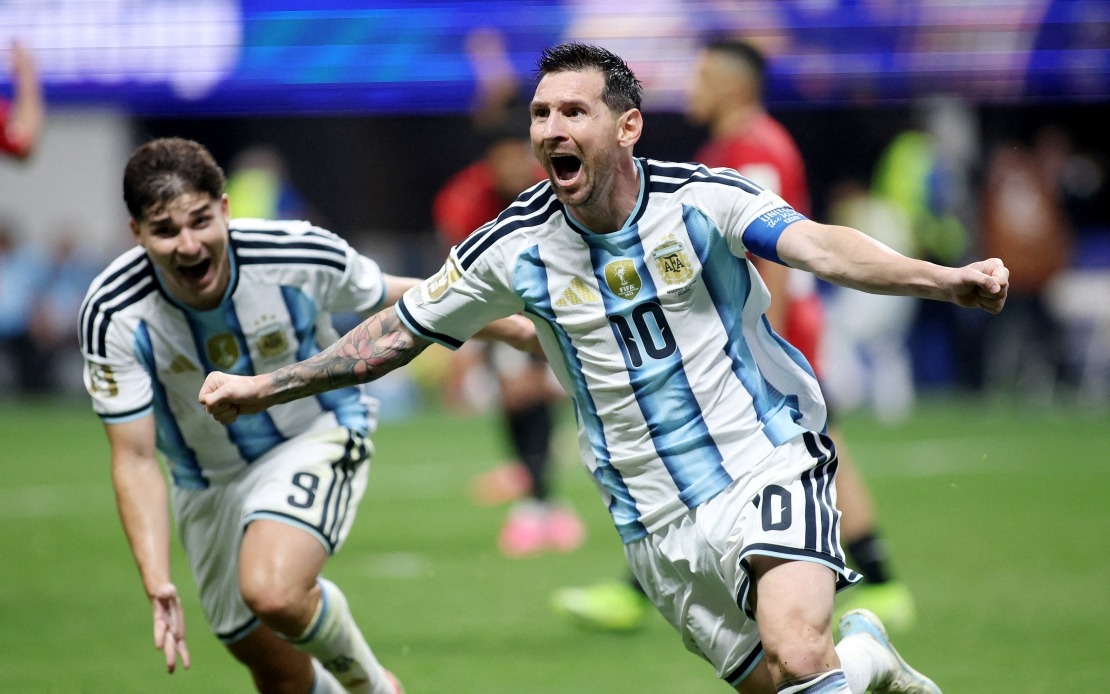
Lionel Messi stands at a crossroads in his storied World Cup narrative. At 39 years old, the Argentine maestro has already etched his name into the tournament's historical record books multiple times over, yet hunger for one more elusive trophy—the Golden Boot—continues to drive him forward in North America. As Argentina prepares to face England in Atlanta on Wednesday, Messi remains locked in a tight race with France's Kylian Mbappé for the competition's top scorer accolade, a prize that has managed to slip through his hands despite his dominance across six World Cup campaigns spanning two decades.
Messi's journey back to this stage just four years after Argentina's triumphant 2022 campaign in Qatar tells a story of defiance against the ravages of time. When he lifted the trophy in Doha at age 35, having scored seven goals including two in the final, many observers assumed the curtain had fallen on his World Cup ambitions. That victory appeared to carry the weight of a squad's collective determination to secure the sport's greatest prize before their talismanic leader retired. Yet Messi has confounded expectations by returning to international competition, and his form suggests the spirit that carried Argentina to glory two years ago remains undiminished.
The numbers paint a picture of sustained excellence at an age when most players have long since departed the world stage. With eight tournament goals to his credit, Messi shares the top of the scoring charts with Mbappé, whose superior assists and economical minutes played edge him marginally ahead on tiebreaker criteria. Behind this dynamic duo, England's Harry Kane and emerging sensation Jude Bellingham lurk on six goals apiece, while Norway's Erling Haaland's elimination has removed another serious contender from the Golden Boot race. The competitive intensity of this year's campaign underscores how the sport's elite continue to push the boundaries of what athletes can achieve even as they enter their fourth decade.
Beyond the immediate battle for the Golden Boot lies a broader context of historical significance. Messi has already surpassed the previous all-time World Cup scoring record of 16 goals held by Germany's Miroslav Klose, accumulating 21 goals across his six tournaments. Remarkably, Mbappé now trails by just one goal and appears positioned to eventually claim this record as his own, given his youth and trajectory. The competitive dynamic between these two players has defined modern World Cup football, with both players advancing the sport's standards for individual achievement on its grandest stage. Kane's ascent up the all-time list, now standing at 14 goals, demonstrates that the barrier for elite goal-scoring has been fundamentally raised during this era.
The longevity records Messi has established alongside Cristiano Ronaldo reflect an unprecedented commitment to international football excellence. Both players have competed in six World Cup tournaments, becoming the first men to achieve this distinction. They have collectively obliterated Lothar Mattheus' previous benchmark of 25 World Cup appearances, with Messi poised to record his 33rd appearance against England. This achievement alone represents a remarkable feat of durability and fitness, made even more extraordinary when one considers that Messi will set a new benchmark six matches ahead of Ronaldo's total. Such longevity speaks to the physical conditioning and mental resilience required to maintain elite performance across generations of football competition.
Examining Messi's goal-scoring trajectory across his World Cup history reveals interesting patterns in his development as a tournament player. When he made his debut in 2006 at just 19 years old, he recorded one goal, a modest start that would have suggested limited expectations for his World Cup future. The 2010 tournament in South Africa saw him struggle to find the net entirely, a goalless campaign that contrasted sharply with his club form. His breakthrough moment came in 2014, when he orchestrated Argentina's march to the final while scoring four goals, laying the foundation for his reputation as a World Cup force. The 2018 tournament saw him contribute one goal, maintaining a steady if unspectacular presence as Argentina exited early.
The transformation that occurred in Qatar represents perhaps the most dramatic phase of Messi's World Cup evolution. At 35 years old, an age when most athletes are merely making cameo appearances, Messi produced his most prolific tournament performance, scoring more goals than he had managed in his previous four World Cups combined. His seven-goal haul was powered significantly by four penalty conversions, though he notably also missed one spot-kick during the campaign. This demonstrates that while his clinical finishing from open play remained sharp, his success from the penalty spot has proved variable throughout his career, a vulnerability that has resurfaced during this tournament.
Penalty-taking performance has emerged as a curious subplot in Messi's World Cup legacy, particularly relevant as tournaments progress toward knockout stages where set-piece opportunities become more frequent. Across all World Cup tournaments, Messi has converted only four of his eight penalty attempts from open play, a conversion rate that falls below the standard associated with his general level of excellence. This summer's campaign has already seen him miss against Austria and suffer a save from Egypt's goalkeeper Mostafa Shobeir in the round of 16 stage. However, Messi's record in penalty shootouts tells a different story entirely, with perfect success across three decisive matches—against the Netherlands in both 2014 and 2022, and crucially against France in the 2022 final. This distinction between open-play penalties and shootout success adds fascinating texture to his overall tournament narrative.
The contrasts in Messi's World Cup career underscore how individual player narratives have become increasingly important to tournament storytelling in the modern era. His early appearances, marked by relative anonymity despite his prodigious talent, gradually gave way to a period of established excellence and finally to his late-career resurgence. The 2022 triumph appeared to represent a poignant conclusion to an extraordinary saga, yet his return demonstrates that the appetite for competition and the pursuit of outstanding achievements transcends conventional retirement timelines. For Malaysian and Southeast Asian football enthusiasts, Messi's continued presence and performance carries particular resonance, given the region's deep investment in global football narratives and the aspirational quality of witnessing athletes operating at such rarified levels of excellence.
Looking forward, the mathematical reality suggests that Mbappé, despite his singular goal deficit, holds marginal advantage in the Golden Boot race based on assists and minutes efficiency. However, Messi's proven ability to deliver in high-pressure knockout moments provides genuine cause for optimism regarding his pursuit of this final major accolade. Whether this World Cup ultimately delivers another trophy or the individual prize that has eluded him, Messi's achievements across these six tournaments have already secured his position as the sport's most enduring World Cup performer. His journey from teenage substitute in 2006 to tournament leader in 2024 encompasses a transformation that transcends mere statistics, embodying the evolution of modern football and the enduring capacity for greatness to flourish across decades of international competition.

