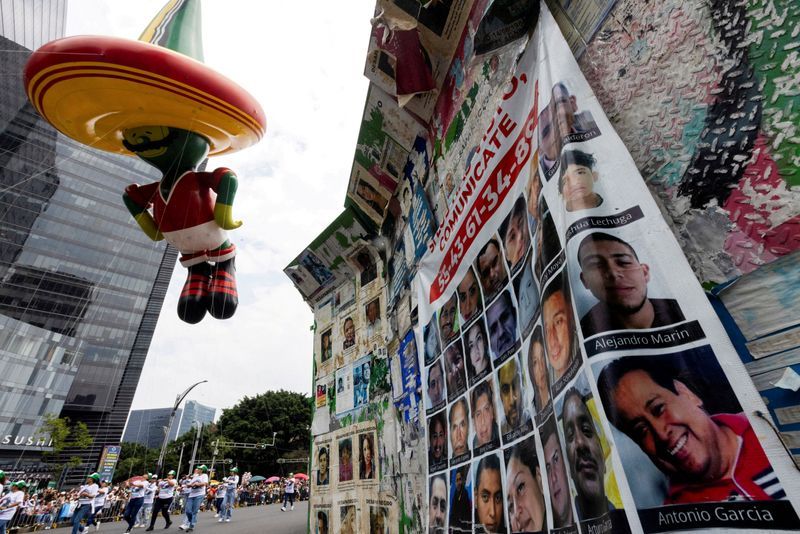
Mexico's footballing ambitions are providing a welcome psychological escape for a nation wrestling with profound social and economic challenges. The country's advancing World Cup campaign—marked by an unbeaten group-stage performance and a historic knockout victory over Ecuador—has injected a sense of national pride into the collective consciousness. Yet behind the colourful celebrations adorning Mexico City's Paseo de Reforma lies a more troubling reality: reminders of the 135,000 people missing in the country, a figure that has grown dramatically since former President Felipe Calderon initiated aggressive military action against drug trafficking organizations in 2006.
The juxtaposition reveals a nation attempting to compartmentalize joy and despair. While World Cup fever grips portions of the population, the same streets that host World Cup festivities have been periodically closed not only for celebrations but for sustained protests by groups demanding accountability and reform. This duality has forced ordinary Mexicans to navigate an uncomfortable psychological terrain—permitting themselves to experience patriotic enthusiasm while remaining acutely aware of systemic failures in governance, security, and economic management. The contrast between stadium excitement and street-level anguish has become so pronounced that it has generated significant commentary from journalists, academics, and civic leaders attempting to articulate the contradictions facing contemporary Mexican society.
Economic pressures compound the tensions underlying the tournament. Although inflation rates decelerated during early June, the Bank of Mexico's core inflation metric remains stubbornly above its three-percent target, eroding household purchasing power across income groups. The FIFA World Cup itself has become a symbol of economic exclusion, with ticket prices reaching into thousands of dollars—a barrier that has fundamentally transformed fan participation patterns. Where previous generations could anticipate attending international matches as a form of accessible national celebration, current ticket pricing has effectively restricted stadium access to wealthier demographics. This commodification of patriotism has not escaped criticism from observers who see the tournament as emblematic of broader inequality issues afflicting Mexican society.
The tragic consequences of excessive celebration underscore additional anxieties. Mexico's victory over Ecuador sparked spontaneous street celebrations that resulted in four deaths around Reforma, dampening the euphoria surrounding the nation's first World Cup knockout-stage victory in four decades. These casualties transformed what should have been an unambiguously joyful moment into a reminder of the volatility and underlying tensions within Mexican urban spaces. Anti-World Cup graffiti continues to mark walls throughout Mexico City and surrounding the Azteca Stadium, visual testimony to organized resistance against the tournament itself and its perceived disconnect from pressing national priorities.
Organized labour movements have seized upon the World Cup moment to press dormant grievances. Members of the CNTE teachers' union established protest camps throughout downtown Mexico City, blockading entire roadways to demand government action on a 2007 pension and social security reform that affected public-sector workers, alongside demands for salary improvements. The teachers' grievances reflect structural economic pressures affecting state employees and illustrate how the World Cup has temporarily pushed but not resolved underlying labour disputes. These simultaneous expressions of celebration and protest create an unusual political landscape where national pride and systemic critique occupy the same physical and temporal space.
Political dynamics surrounding the World Cup deserve careful examination from a Malaysian perspective, particularly regarding how sporting events can function as convenient distractions from substantive governance challenges. President Claudia Sheinbaum currently maintains strong domestic approval ratings, with recent polling from El Financiero indicating support at 69 percent following a slight decline that began in March. The government has publicly acknowledged that locating missing persons remains a national priority, yet critics argue that World Cup euphoria provides convenient political cover for postponing difficult decisions and allocating limited resources toward immediate crises. This pattern—where international sporting events temporarily displace domestic accountability mechanisms—has parallels in Southeast Asian governance contexts where major tournaments have similarly obscured implementation failures and structural problems.
Public intellectuals and journalists have articulated sophisticated analyses of the psychological and political dimensions of this moment. Podcaster and journalist Carlos Mendoza observed that World Cup success generates what he termed a "national dopamine rush" that permits citizens to psychologically evade uncomfortable realities, including allegations of collusion between ruling Morena party politicians and drug trafficking enterprises. However, Mendoza emphasized that this reprieve remains temporary—once the tournament concludes, underlying structural problems persist unchanged. His analysis captures a essential tension: the World Cup cannot resolve systemic issues, only postpone public focus upon them. This observation carries particular resonance for Southeast Asian nations that have similarly hosted or will host major sporting events while confronting parallel governance challenges.
The economics of ticket accessibility deserves expanded consideration given its implications for democratic participation. Mendoza specifically highlighted that the transition from limited ticket availability to prohibitive pricing represents a fundamental shift in how national sporting events function within democratic societies. Previously, economic barriers to attendance primarily reflected scarcity; contemporary pricing structures reflect deliberate commodification that privileges wealthy consumers. This transformation has implications extending beyond football, suggesting broader patterns wherein experiences of national belonging increasingly require significant financial resources. For Malaysian observers, this shift carries particular relevance given ongoing debates about accessibility, inequality, and the commercialization of public cultural spaces.
Civic leaders have attempted to synthesize these competing tensions into nuanced political positions. Rodrigo Cordera, a local politician, articulated on social media that citizens need not adopt binary positions regarding the World Cup—one can simultaneously experience joy at footballing success while maintaining critical perspectives toward FIFA, government administration, and systemic failures. This sophisticated framing acknowledges that emotional response and political critique need not exist in zero-sum relationship; citizens can compartmentalize enthusiasm and concern according to context. Cordera's intervention suggests that mature democratic citizenship involves precisely this capacity to hold multiple, sometimes contradictory perspectives simultaneously.
Local residents have expressed measured skepticism about whether World Cup celebrations will generate lasting positive transformation. Alejandra Gonzalez, reflecting on the tournament's deeper implications, suggested that while the event temporarily repositions national troubles lower on the societal priority scale, the government effectively leverages resulting euphoria to defer significant decisions. She articulated hope that positive national sentiment might catalyze constructive change, yet simultaneously emphasized the necessity of maintaining critical analytical frameworks even amid celebration. This balance between cautious optimism and critical realism characterizes much contemporary Mexican discourse surrounding the tournament.
For regional observers, Mexico's World Cup experience illuminates broader patterns regarding how sporting nationalism intersects with governance legitimacy in developing democracies. The capacity to simultaneously celebrate national achievement and critique systemic failures represents an emerging form of political maturity, one increasingly visible across Latin America and Southeast Asia. Mexico's situation demonstrates that sporting success cannot substitute for addressing endemic security challenges, economic inequality, or labour disputes—yet may provide psychological space within which citizens can maintain hope despite legitimate grievances. As the tournament progresses, the Mexican case study offers valuable insights into balancing patriotic sentiment with political accountability.

