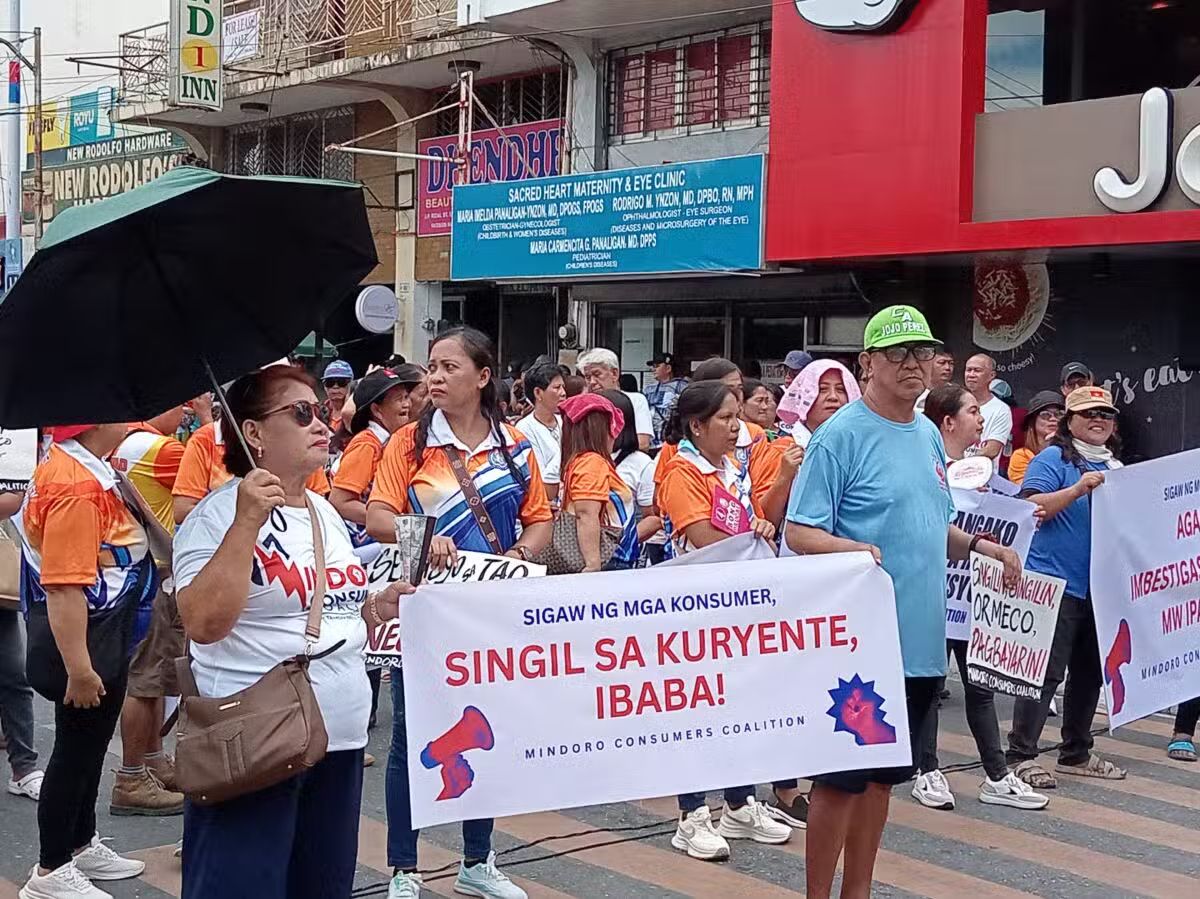
The recently established Mindoro Consumers Coalition has mounted a direct challenge to the Oriental Mindoro Electric Cooperative's public justification for a one-peso-per-kilowatt-hour rate reduction announced in July, contending that the cooperative's account fundamentally misrepresents the operational status of power supply arrangements and obscures what consumers argue are deliberate rate-setting decisions within management's control.
During a Saturday protest rally in Calapan City, the coalition disputed the cooperative's claim that cheaper electricity sourced from a new independent power producer drove the rate decrease, instead pointing out that the power supply contracts governing Lots IV and VII of the 57-megawatt Competitive Selection Process had already operated successfully for an entire year without requiring any government subsidy to remain economically viable. This timeline, the consumer advocates argued, fundamentally undermines the cooperative's narrative that the recent rate adjustment represents a sudden windfall benefit resulting from fresh operational arrangements, suggesting instead that ORMECO possessed the financial capacity to reduce rates well before July's announcement.
The coalition's statement highlighted a critical distinction often overlooked in public discourse surrounding the cooperative's statements about available power supply. ORMECO's references to only two independent power producers operating within the province specifically referred exclusively to the 57-megawatt allocation contracted through the competitive selection process, not the total generation and distribution footprint serving Oriental Mindoro's consumers. This clarification carries significant implications for understanding the actual composition of the province's energy supply mix and raises questions about what additional power sources contribute to the cooperative's operational capacity.
Beyond the disputed causation of the rate reduction, the consumer group escalated its accusations by highlighting what it characterised as systematic discrepancies in how ORMECO reports its operational metrics to regulatory authorities versus the charges it actually imposes on end consumers. The coalition specifically identified system-loss reporting as a glaring example of this alleged inconsistency, noting that while the cooperative declares system losses of approximately 10 percent to the National Electrification Administration, the actual charges reflected in consumer billing statements and internal allocations reach 17.5 percent. This seven-and-a-half percentage-point gap represents a substantial financial margin that flows from consumers' electricity payments, yet receives no transparent accounting or explanation in public statements or official filings.
The implications of this discrepancy extend beyond mere accounting irregularity. System losses in electricity distribution—encompassing both legitimate technical losses occurring during transmission and distribution, as well as non-technical losses such as theft and metering errors—represent a legitimate operational cost that utilities must recover through rates. However, when the reported figures to regulators diverge sharply from actual charges to consumers, it suggests either that ORMECO is systematically underreporting its system losses to authorities responsible for approving rate structures, or that substantial margins beyond actual documented losses are being incorporated into final consumer bills without clear regulatory justification or public disclosure. Either scenario raises fundamental questions about the integrity of the rate-setting process and the adequacy of regulatory oversight.
For Malaysian and broader Southeast Asian readers, this dispute reflects a pattern increasingly evident across regional electricity markets where consumer protection mechanisms remain underdeveloped relative to the technical complexity of modern power systems. Cooperatives and distribution utilities across the region often operate with limited transparency regarding cost allocation, system loss calculation, and rate justification methodologies. The Mindoro case demonstrates how activist consumer groups must increasingly function as shadow regulators, independently auditing and publicising utility practices that formal regulatory bodies either lack capacity to monitor effectively or have insufficient political independence to challenge.
ORMECO General Manager Engr. Humphrey Dolor maintained that the P1.06-per-kilowatt-hour rate reduction in July resulted directly from the newly operational power plants contracted under the 57-megawatt competitive selection process, suggesting that technical factors beyond management discretion drove the rate adjustment. This assertion stands in direct contradiction to the consumer coalition's evidence that these same power sources have functioned without subsidy for a full year prior to the announced rate reduction, implying that rate-setting decisions reflect policy choices rather than externally imposed cost pressures.
The coalition's formal request for investigation by Congress and relevant government agencies signals an escalation from consumer complaint to demand for institutional intervention. The group appears to be seeking not merely lower rates through negotiation, but rather a comprehensive audit of ORMECO's contractual arrangements, cost allocation methodologies, and regulatory compliance regarding system loss reporting. This approach reflects growing recognition among consumer advocates across the region that piecemeal rate disputes lack leverage without parallel institutional scrutiny of underlying utility operations and regulatory relationships.
Transparency and accountability in electricity provision represent increasingly politicised issues across Southeast Asia as consumer frustration with unexplained rate increases and opaque utility operations mounts. The Mindoro coalition's specific focus on discrepancies between reported system losses and actual charges embodies a sophisticated understanding of how utilities can legally obscure substantial cost margins within legitimately acknowledged loss categories. Rather than disputing the existence of system losses entirely, the coalition challenges the scale and documentation of these losses, creating space for regulatory discussion about whether utilities have adequate incentive to minimise losses or whether current rate structures effectively subsidise operational inefficiency.
The dispute also illuminates the structural vulnerability of electricity cooperatives operating at provincial scale in developing contexts, where technical regulatory capacity remains limited and consumer organisations must mobilise protest rather than relying on formal rate appeals mechanisms. ORMECO's apparent unease with questions about its rate-setting methodology—as evidenced by its need to issue repeated statements justifying the rate reduction—suggests that the cooperative recognises the political fragility of its position when confronted with organised consumer scrutiny. This dynamic may prove consequential for how Oriental Mindoro approaches future rate adjustments and whether it implements more transparent accounting practices to forestall further organised consumer pressure.
The broader policy implications for the Philippines electricity sector and comparable regional markets reflect ongoing tension between utility operational autonomy and consumer protection imperatives. Without more robust regulatory frameworks ensuring transparent cost accounting and independent rate review, consumer groups will continue operating as de facto regulators, using protest and public scrutiny to compensate for institutional gaps in formal utility oversight. Whether Congress and relevant agencies respond substantively to the Mindoro coalition's demands will signal the degree to which the national government prioritises consumer protection over utility operational discretion in the increasingly contentious arena of regional electricity rates.

