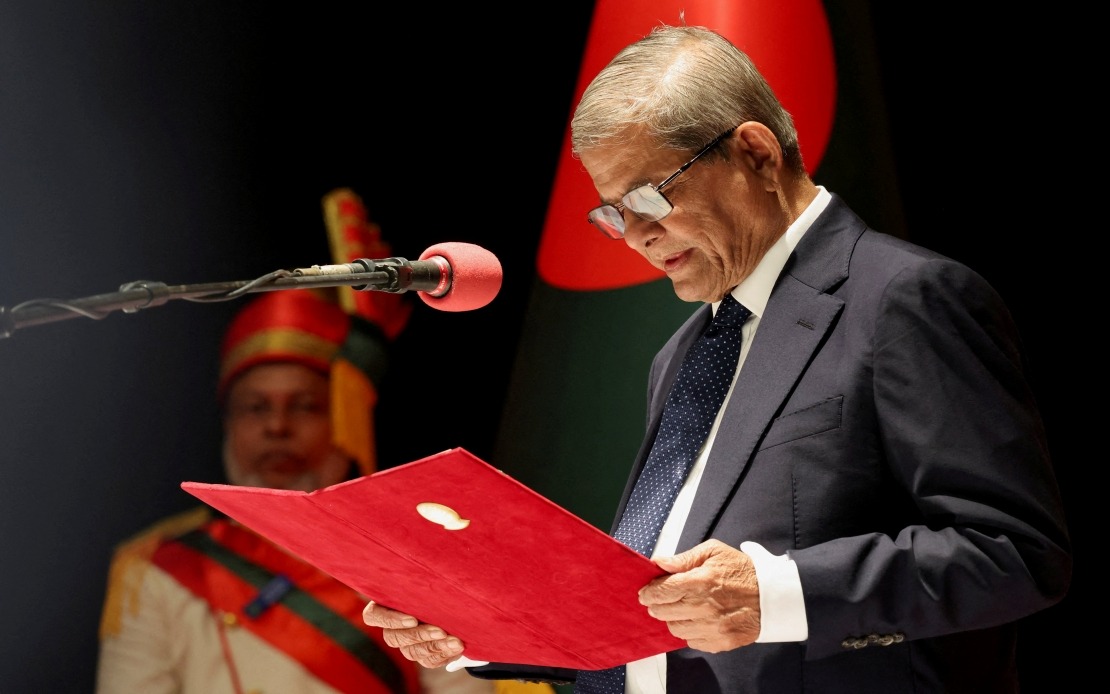
Mirza Fakhrul Islam Alamgir, one of Bangladesh's most prominent political figures, assumed office as the nation's 23rd President on Friday evening during a formal ceremony held at the presidential palace. The oath-taking took place at 7.30 pm (local time) at the Darbar Hall of Bangabhaban, marking a significant transition in the country's leadership structure as it navigates the post-interim government phase following recent political upheaval.
The swearing-in ceremony was administered by Acting Speaker Barrister Kayser Kamal, with the formal proceedings conducted according to constitutional protocols. Upon arrival at the residence, the president-elect received a formal welcome from senior state officials before being received by Acting President Hafiz Uddin Ahmad Bir Bikram. This ceremonial reception underscored the institutional continuity being maintained during Bangladesh's ongoing political transition, a matter of concern for regional observers monitoring the stability of the country's democratic institutions.
The gathering reflected the significance of the occasion, drawing an extensive roster of senior government figures. Prime Minister Tarique Rahman, the nation's chief justice, members of the Cabinet, representatives from the diplomatic corps, members of parliament, and high-ranking civil and military officials all attended the ceremony. The wide participation demonstrated formal acknowledgement of the presidential transition across Bangladesh's institutional hierarchy, though the political context surrounding this change remains complex given the country's recent constitutional and governance developments.
Fakhrul's election to the presidency represents a recognition of his extensive political experience and standing within Bangladesh's political establishment. Prior to his election, he served as secretary-general of the Bangladesh Nationalist Party (BNP), one of the country's two dominant political formations. His trajectory through senior party positions has made him a familiar figure in Bangladesh's political corridors, though his elevation to a largely ceremonial office occurs amid broader questions about the trajectory of the country's political system and institutional recovery.
The formal transfer of power followed a carefully choreographed sequence designed to emphasise constitutional regularity. Following the oath administration, the newly inaugurated President and the outgoing Acting President Hafiz Uddin Ahmad Bir Bikram symbolically exchanged their positions, a ceremonial gesture signifying the formal passage of executive responsibility. This theatrical element, while perhaps subtle, carries weight in parliamentary systems where ceremonial office-holders serve as constitutional guardians despite limited executive authority.
The constitutional requirements governing the presidential election were fulfilled through parliamentary vote. Members of parliament selected Fakhrul through the formal electoral process stipulated by the Constitution of Bangladesh, ensuring that his accession followed established legal procedures. This adherence to constitutional process carries particular resonance given international scrutiny of Bangladesh's institutional functioning and the international community's emphasis on orderly transitions and democratic propriety during the country's current political phase.
Following the administration of the oath, Fakhrul completed the formal documentation required for his new position. He signed both the oath of office and the oath of secrecy, essential components of the presidential assumption of duties in any constitutional framework. These signatures represented his legal binding to the obligations of the office and his commitment to protecting state secrets, matters taken seriously in the institutional framework of parliamentary democracies across South Asia.
For Malaysia and the broader Southeast Asian region, Bangladesh's presidential transition warrants attention given the country's regional significance and the interconnected nature of South and Southeast Asian political developments. Bangladesh, with its 170 million population and considerable economic weight in the region, influences broader stability considerations. Changes in institutional leadership often signal shifts in governance priorities that can affect bilateral relationships, trade patterns, and regional diplomatic positioning, making careful observation of such transitions important for neighbouring states.
The swearing-in ceremony concluded with the playing of the national anthem, a traditional closure emphasising national continuity and institutional dignity. While the presidency in Bangladesh's parliamentary system holds primarily ceremonial and constitutional functions rather than executive power—which rests with the Prime Minister—the office remains symbolically important as the guardian of constitutional processes and national dignity. Fakhrul's assumption of this role represents both an institutional transition and a marker of how Bangladesh's political establishment has navigated its recent turbulent period.

