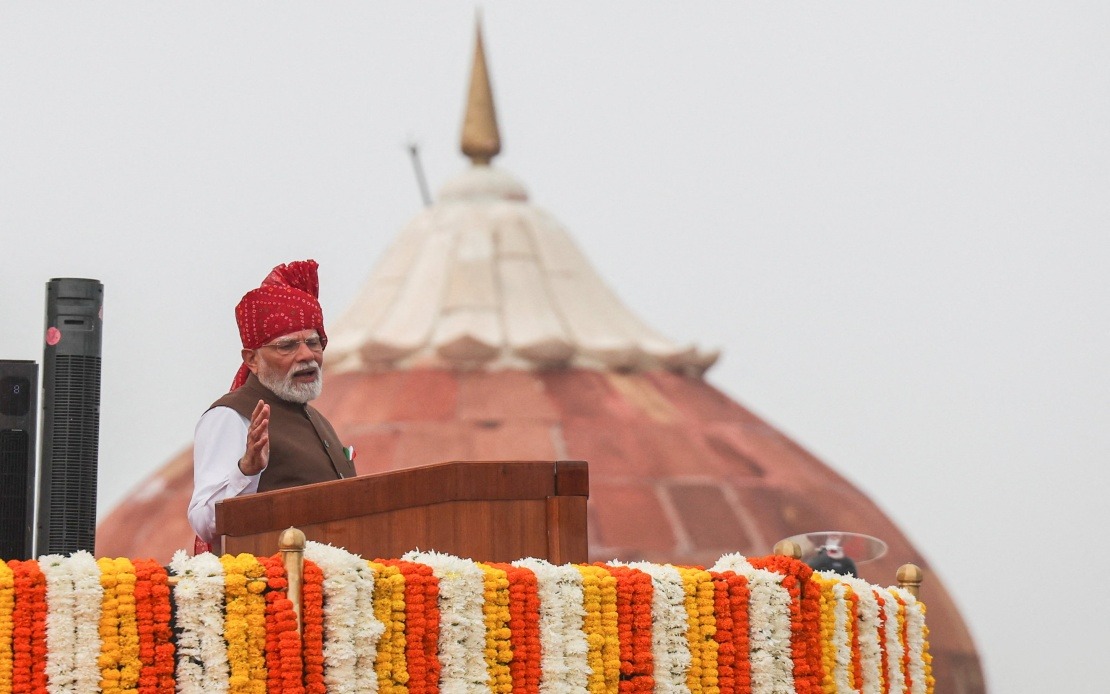
Indian Prime Minister Narendra Modi has articulated a sweeping vision for national economic autonomy, anchoring India's development trajectory to 2047 through strategic investments in technology, energy infrastructure, and manufacturing prowess. Delivering his Independence Day address from the Red Fort in Delhi, Modi framed self-reliance not merely as an economic preference but as a foundational pillar enabling India's elevation to developed-nation status within the next quarter-century. This reframing of India's growth narrative reflects a broader strategic shift across South Asia, where policymakers increasingly view domestic capability-building as essential to sustainable prosperity and geopolitical resilience.
The semiconductor sector features prominently in Modi's self-reliance architecture, with the Prime Minister announcing that three chip manufacturing plants have already commenced operations. The trajectory is aggressive: between seven and ten additional facilities are anticipated to become operational within the coming seven to eight years, representing a substantial expansion of India's onshore semiconductor capacity. For Malaysian observers, this development carries particular significance, given Malaysia's entrenched position within global semiconductor supply chains. India's push to build indigenous chip production could reshape regional dynamics, potentially creating new competition while simultaneously reducing Southeast Asia's concentration risk should geopolitical tensions disrupt existing manufacturing hubs.
Nuclear energy represents another cornerstone of Modi's self-sufficiency strategy, with the government targeting 100 gigawatts of nuclear generating capacity by 2047. Modi highlighted recent technological breakthroughs, particularly India's demonstration of fast-breeder reactor technology and advances in indigenous nuclear fuel processing. The government plans to commission five new nuclear reactors within the current decade, a pace that underscores the urgency attached to decarbonising India's energy mix whilst reducing import dependency. The mastery of fast-breeder technology is particularly significant, as it enhances fuel utilisation efficiency and addresses long-term sustainability concerns around uranium sourcing. For the broader Asian region, India's nuclear advancement could influence regional energy diplomacy and reshape competition for uranium supplies and nuclear technology partnerships.
India's renewable energy expansion has already demonstrated remarkable momentum, with solar capacity surging from 2 gigawatts to 160 gigawatts over the past dozen years. This trajectory illustrates how rapidly India's energy landscape is transforming, with Modi leveraging the achievement to underscore the feasibility of the broader self-reliance agenda. The solar expansion not only reduces India's fossil fuel imports but also positions the country as an emerging manufacturing hub for solar equipment, with implications for regional supply chains and technology transfer dynamics within Asia.
Oil and gas exploration features centrally in Modi's resource security calculus. The government has earmarked 850 billion rupees, equivalent to approximately 8.9 billion US dollars, for hydrocarbon exploration in offshore areas previously considered unviable or commercially unattractive. Modi's characterisation of these zones as historically "99 per cent no-go" regions suggests that technological advances in deep-water drilling and enhanced exploration techniques are now making previously marginal resources economically recoverable. This expansion of India's hydrocarbon frontier could marginally ease the country's import burden whilst generating ancillary economic opportunities in maritime industries and technology services.
Defence manufacturing constitutes a critical pillar of Modi's vision, with particular emphasis on drone technology, counter-drone systems, and hypersonic weapons development. The strategic rationale is evident: autonomous systems and advanced propulsion technologies are reshaping global military competition, and India's determination to develop indigenous capabilities reflects awareness that import dependency in defence procurement carries both financial and strategic vulnerabilities. The focus on these specific technologies also signals India's concern about regional security challenges and evolving threat perceptions. For Malaysia and Southeast Asia, India's defence modernisation trajectory has implications for regional balance-of-power dynamics and potential partnerships in emerging military technologies.
Modi's exhortation to Indian consumers to prioritise domestically manufactured goods introduces a cultural and behavioural dimension to the self-reliance strategy. By framing local purchasing as nation-building rather than mere consumer choice, Modi seeks to engineer a psychological shift towards supporting domestic industries. His observation that globally available goods, though cheaper and faster to acquire, do not cultivate indigenous capabilities articulates the underlying philosophy: immediate convenience must yield to long-term structural resilience. This messaging resonates particularly within India's business circles and educated urban constituencies, though implementation at mass-market level remains contingent upon competitive pricing and quality parity with international alternatives.
The 2047 timeframe itself warrants analysis. Modi has effectively anchored India's development ambitions to a centennial milestone, imbuing economic policy with historical resonance and symbolic weight. The year marks a century of independence, transforming economic objectives into nation-building narratives that transcend electoral cycles. This approach enables sustained commitment to long-term infrastructure and industrial policies that might otherwise struggle for political traction amidst shorter-term electoral pressures. For policymakers across Southeast Asia, Modi's framing offers a template for anchoring transformational economic agendas to historical or symbolic milestones that generate popular mobilisation and cross-party consensus.
The broader geopolitical context illuminates why self-reliance has ascended to such prominence in Indian policy discourse. Global supply chain disruptions during the pandemic, escalating US-China tensions, and India's own border security challenges have collectively reinforced the conviction that strategic autonomy requires reduced dependency on potentially unreliable suppliers. Modi's agenda thus reflects not ideological preference for autarky but pragmatic recognition that India's scale, resources, and technological capacity position it uniquely to reduce external vulnerabilities. The strategy implicitly acknowledges that India cannot sustain rapid growth indefinitely whilst remaining heavily reliant on imports of critical goods and technologies.
Implementation challenges, however, remain substantial. Achieving semiconductor self-sufficiency requires sustained capital investment, skilled workforce development, and technological collaboration with leading global players. Similarly, expanding nuclear capacity at the envisioned scale demands regulatory streamlining, infrastructure development, and international cooperation on fuel supplies and safety standards. The defence manufacturing ambitions necessitate substantial research and development investment alongside defence procurement reform. These complexities suggest that whilst Modi's articulation of self-reliance goals is comprehensive, translating ambitions into operational reality will demand persistent execution across multiple domains simultaneously.
For Malaysia and the broader Southeast Asian region, India's self-reliance trajectory presents both challenges and opportunities. Competition in semiconductors, renewable energy equipment, and defence systems will intensify as India develops indigenous capabilities. Simultaneously, India's growth trajectory and technological advancement could generate regional partnerships, market opportunities, and technology-sharing arrangements that benefit neighbouring economies. The calculus will ultimately depend on how India sequences its ambitions and whether it pursues self-reliance through isolationism or through selective integration into regional and global value chains where comparative advantages warrant participation.

