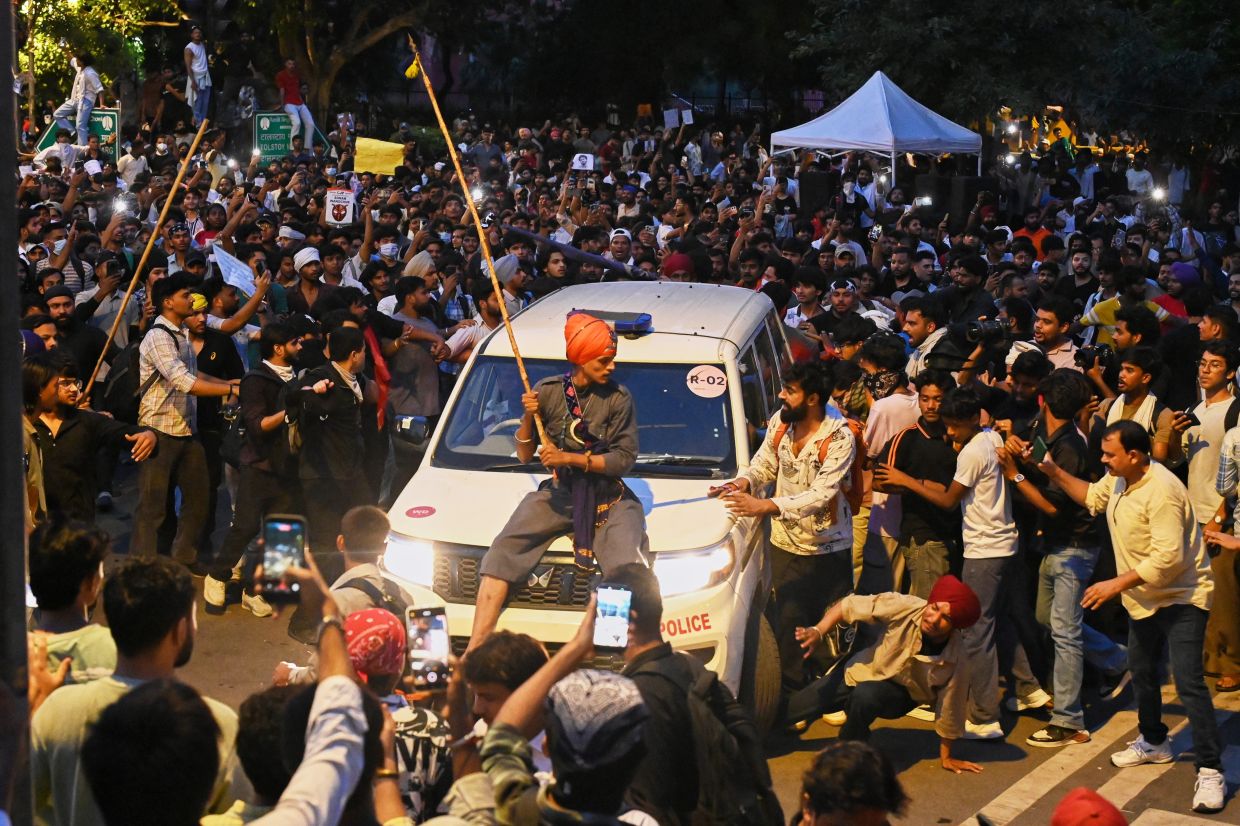
Prime Minister Narendra Modi has found himself confronting one of the most significant challenges to his administration in recent years, as thousands of angry students and young people take to the streets across India demanding accountability for widespread examination irregularities. In a rare direct acknowledgment of the unfolding crisis, Modi declared on Thursday that those responsible for exam fraud would face "stringent punishment," signalling the government's recognition that the issue has become a serious political threat that extends beyond education policy into broader questions about governance and youth welfare.
The eruption of public anger reflects deep systemic failures in India's examination system, which have accumulated over recent months and triggered a wave of demonstrations unlike anything the capital has witnessed in approximately five years. The immediate catalyst came when police personnel fired tear gas and resorted to baton charges against tens of thousands of demonstrators attempting to march towards parliament on Monday, the opening day of the monsoon legislative session. The heavy-handed police response backfired spectacularly, sparking retaliatory stone-throwing from protesters and drawing international attention to the confrontation.
The Cockroach Janta Party, which emerged as a grassroots social media movement in May, has proven remarkably effective at mobilising youth activism despite—or perhaps because of—its unconventional origins. Initially born as satirical commentary responding to Chief Justice Surya Kant's reported characterisation of young people as "cockroaches" and "parasites" during court proceedings, the movement has successfully transformed into a broader political vehicle addressing multiple grievances. The CJP's evolution from a single-issue joke into a multi-faceted movement demanding accountability on unemployment, educational access, and governmental transparency demonstrates how quickly youth-driven campaigns can reshape India's political landscape through digital platforms.
Civil unrest documentation indicates that at least 178 individuals sustained injuries during Monday's violence, encompassing both demonstrators and security personnel, a figure that underscores the intensity of the clashes. The confrontations continued into Wednesday evening, with crowds gathering outside Jantar Mantar and again engaging in volatile exchanges with Delhi Police. Internet shutdowns accompanied the crackdown, a tactic that has become increasingly common in managing dissent but also serves to amplify grievances among digitally-connected younger generations who view connectivity restrictions as authoritarian overreach.
The examination fraud saga itself encompasses multiple embarrassing incidents that have fundamentally undermined public confidence in India's testing apparatus. A leaked medical entrance examination question paper forced more than two million candidates to undergo retesting, an enormous logistical and financial burden that fell on students and their families. Compounding this debacle, irregularities in the online marking system for high school examinations affecting nearly two million additional students have created a cascading crisis of institutional credibility. These successive failures have convinced many young Indians that their futures remain hostage to systemic corruption and incompetence.
Modi's promise to establish fast-track courts specifically to prosecute those involved in question paper leaks represents an attempt to demonstrate decisive action, yet the measure may prove insufficient in addressing the deeper institutional weaknesses that permit such fraud to occur in the first place. The education minister has become the focal point of protester demands for resignation, though whether removing an individual administrator would fundamentally reform entrenched systems of examination corruption remains questionable. The government faces pressure to demonstrate not merely symbolic accountability but genuine structural reform.
Opposition parties have seized upon the protest movement to intensify their parliamentary assault on Modi, with Congress Party leader Rahul Gandhi directly confronting the Prime Minister with accusations that his policies have actively facilitated educational system deterioration. The parliamentary disruptions alongside street protests create multiple pressure points simultaneously, preventing the government from easily dismissing the movement as marginal or unrepresentative. Such convergence between legislative opposition and public protest generates considerably more political leverage than either channel could produce independently.
The geographic expansion of demonstrations beyond New Delhi's confines signals genuine nationwide discontent rather than isolated metropolitan activism. Simultaneous rallies in Mumbai, Bengaluru, and Patna indicate that examination irregularities and broader concerns about youth opportunity have resonated across India's diverse regions. The movement's evolution from single-city phenomenon into pan-Indian mobilisation represents the type of political development that typically prompts serious recalibration of government priorities.
Regional implications extend beyond India's borders, with students in neighbouring Bangladesh organising solidarity demonstrations scheduled for Thursday evening. Bangladesh's 2024 youth-led uprising, which successfully toppled Sheikh Hasina's government and forced her departure, looms large in policymakers' consciousness as a cautionary example of how youthful discontent can rapidly cascade into transformative political change. The demonstration of solidarity between Indian and Bangladeshi students creates transnational dimensions to the protest movement, potentially strengthening resolve among participants who recognise historical precedent for youth activism achieving systemic change.
Modi's re-election to a third consecutive term in 2024 suggested consolidated political dominance, yet the exam fraud protests demonstrate that electoral victories do not provide immunity from accountability pressures regarding governance failures. The convergence of specific policy failures with broader anxieties about economic opportunity and political authoritarian drift has created a political moment where traditional institutional channels and digital-age grassroots mobilisation reinforce one another. Whether Modi's promises of swift punishment satisfy escalating demands for comprehensive educational system overhaul will substantially determine whether this wave of protest eventually subsides or continues intensifying.

