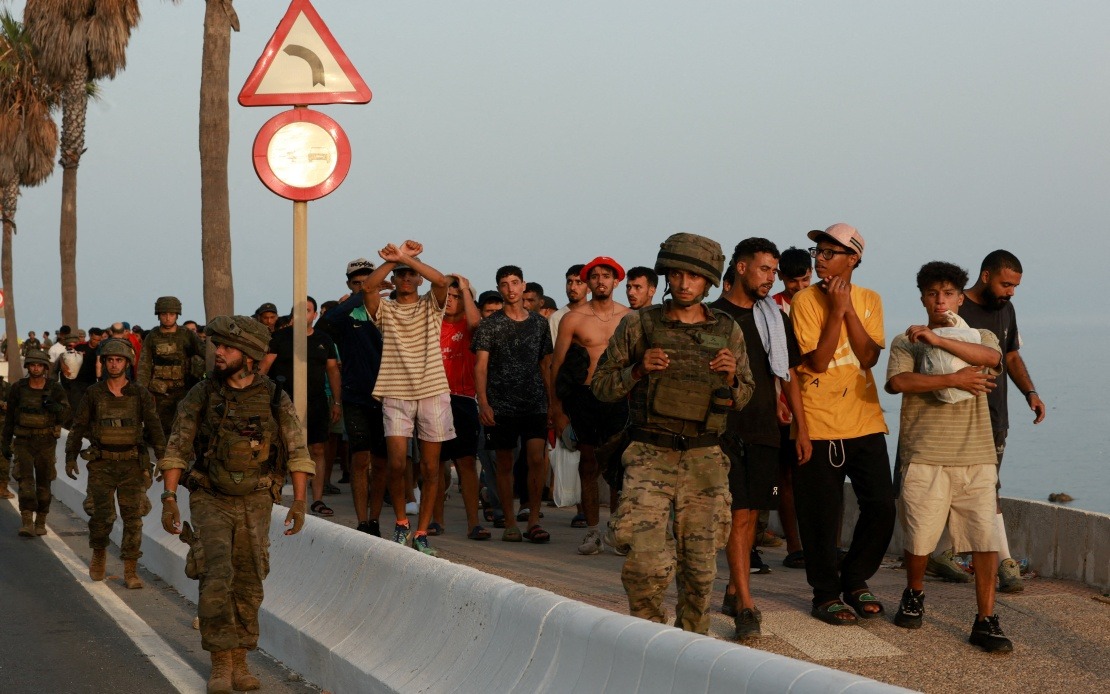
Morocco's Interior Ministry has attributed the unprecedented influx of migrants into the Spanish enclave of Ceuta to a combination of deliberate misinformation campaigns on social media platforms and the activities of organised human trafficking networks. The government's statement represents an attempt to contextualise the crisis that saw tens of thousands of people attempt to cross from Moroccan territory into Europe within a compressed timeframe, overwhelming both border infrastructure and humanitarian capacity in one of the world's most tightly controlled frontiers. The ministry further pointed to confusion arising from a Spanish court ruling that migrants allegedly misinterpreted as permitting entry to Europe without the prospect of immediate deportation, a misreading that appears to have been amplified through informal online channels.
The scale of the movement was staggering by regional standards. Official Spanish estimates indicate that between 50,000 and 60,000 migrants reached Ceuta over the course of just a few days, transforming the demographic composition of a territory home to approximately 85,000 residents. Morocco's own figure, somewhat more conservative, placed the number at roughly 40,000 arrivals into Ceuta, with an additional 1,135 individuals attempting to breach the border at the nearby Spanish enclave of Melilla. The Moroccan authorities noted that those who successfully entered Melilla were swiftly returned, suggesting a more effective containment operation at that location. The discrepancy between Spanish and Moroccan tallies underscores the chaotic conditions during the crossing period and the difficulty of establishing precise figures amid such disorder.
The humanitarian cost of the crisis has become a central point of contention between the two neighbouring states. Morocco reported that eleven people had lost their lives during the crossing attempts, a figure that stood in sharp contrast to Spanish authorities' assessment of at least 72 deaths. This dramatic disparity raises serious questions about information gathering, body recovery operations, and the conditions migrants faced during their bid to reach European territory. The Moroccan ministry stated that its authorities were continuing collaborative efforts with Spanish counterparts to verify additional reports of fatalities within Ceuta and to identify the deceased and establish their national origins. Such coordination, though essential for humanitarian purposes, has become more fraught given broader tensions in bilateral relations.
The migration surge must be understood within the context of North Africa's complex relationship with irregular movement across the Mediterranean and its land borders. Morocco, positioned as a transit nation for migrants from West and Central Africa heading towards Europe, has long grappled with the tension between maintaining territorial sovereignty and accommodating humanitarian needs. The assertion that social media misinformation played a catalytic role reflects a broader global phenomenon in which false narratives and rumours can rapidly mobilise vulnerable populations toward dangerous journeys. In this case, the notion that European borders would be open or that deportation mechanisms would be suspended appears to have gained traction quickly through informal networks, creating expectations among migrants that proved tragically unfounded.
The reference to a Spanish court ruling suggests that legal developments, even when misinterpreted, can have outsized effects on migration patterns. Migrants and smuggling networks alike closely monitor court decisions and policy shifts, treating ambiguous rulings as potential openings. When such legal developments are then amplified through social media without proper context or authoritative clarification, the resulting vacuum can be filled by trafficking networks eager to exploit migrant desperation and aspirations. The Moroccan government's emphasis on this factor appears designed to shift responsibility away from internal factors and toward external actors—both the digital manipulation of information and the criminal enterprises that profit from irregular migration.
For Malaysia and Southeast Asian nations, the Ceuta crisis illustrates dynamics increasingly familiar in the region. The intersection of migration pressure, misinformation, and human smuggling creates cascading humanitarian and security challenges that no single nation can manage unilaterally. Southeast Asian states, like Morocco, serve as conduits for irregular migration flows and face similar pressures to balance sovereignty with compassion. The Malaysian experience with Rohingya migrations, irregular movements from Myanmar, and trafficking networks operating across porous borders demonstrates that the mechanisms Morocco describes—social media rumours, tactical smuggler operations, and legal ambiguities—operate identically across different geographies and contexts.
The crisis also underscores the fragility of border management systems when confronted with coordinated or opportunistic mass movement. Ceuta's infrastructure, designed to process migrants in controlled numbers, became overwhelmed within days, a scenario that echoes challenges faced by Malaysian authorities at land and sea borders during periods of surge mobility. The difference lies partly in scale and geography; Europe's terrestrial borders can theoretically be sealed more comprehensively than maritime borders in Southeast Asia. Yet the fundamental vulnerability remains: when sufficient numbers move simultaneously, driven by false hope or authentic desperation, systems designed for orderly processing collapse.
The Moroccan government's framing of the crisis as substantially driven by misinformation and trafficking rather than structural push factors or policy failures represents a particular rhetorical stance. While human traffickers undoubtedly exploit migration pressures, and social media can amplify false narratives, attributing causation primarily to these factors downplays underlying economic disparities, conflict in origin countries, and the perceived benefits of reaching Europe. Similarly, while a court ruling may have been misinterpreted, migrants often possess fairly sophisticated understanding of border conditions and pursue movement even when risks are transparent. The Moroccan position, therefore, serves political purposes beyond mere explanation, allowing the government to present itself as a victim of external malign actors rather than as responsible for managing its own territory.
Bilateral cooperation between Morocco and Spain has emerged as essential for managing the aftermath and preventing recurrence. The joint effort to verify deaths and identify victims, while proceeding unevenly given the dispute over death tolls, represents a necessary foundation for any sustainable solution. Going forward, addressing the information landscape—through counter-messaging campaigns and more transparent communication about border policies and European asylum procedures—may indeed reduce future surges. However, without concurrent attention to the economic incentives that drive migration from Africa toward Europe, to conflict and instability in origin regions, and to the organisational strength of trafficking networks themselves, such measures will likely prove insufficient.
The Ceuta crisis reveals that modern migration management requires coordination across digital, diplomatic, humanitarian, and security domains simultaneously. Morocco's emphasis on misinformation and trafficking networks captures important elements of what occurred, yet represents an incomplete diagnosis. For Southeast Asian governments observing these developments, the lesson is clear: migration crises rarely arise from single causes and cannot be resolved through single-vector responses. Managing irregular movement demands sustained attention to information ecosystems, law enforcement capacity against trafficking, regional cooperation frameworks, and—ultimately—the structural factors that convince millions of people that dangerous journeys offer better prospects than remaining in their home countries.

