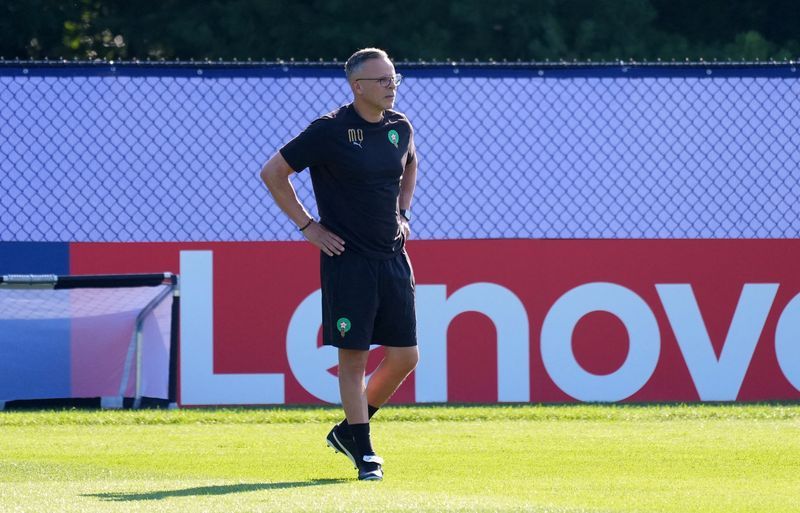
Morocco's football federation has made clear that there will be no pausing to celebrate achievements until the World Cup trophy is secured, according to head coach Mohamed Ouahbi. Speaking to journalists in Foxborough, Massachusetts, on Wednesday, Ouahbi set an uncompromising tone for his team's quarter-final encounter against France the following day, dismissing the narrative that simply progressing this far represents a triumph in itself.
The match pits the two nations against each other in a rematch of their 2022 World Cup semi-final clash in Qatar, where France extinguished Morocco's remarkable journey to the final stages. That encounter marked a watershed moment for the North African side, which had captured global imagination as an underdog nation punching above its weight. However, the intervening period has fundamentally altered the dynamic heading into this fresh confrontation. Morocco now enters as a hardened, battle-tested outfit fully convinced of its capacity to claim the sport's ultimate prize, rather than as grateful participants thrilled merely to have progressed.
Ouahbi's measured but pointed remarks emphasised that any assessment of Morocco's tournament performance would occur only once the competition concluded, not before. His refusal to engage with suggestions of accomplishment reflects a philosophical shift within the squad—one that rejects the notion that reaching the quarter-finals constitutes success worthy of acknowledgement. Instead, the coach articulated a vision where winning the World Cup represents the only genuine achievement, with everything before that point reduced to preliminary steps towards the ultimate objective.
The coach's philosophy extends to rejecting what he characterised as complacency dressed in humility. Ouahbi explicitly warned against the mentality where teams become satisfied with having exceeded expectations, treating further progress as a bonus rather than an expected continuation. He framed Morocco's entire campaign through this lens, suggesting that the mindset which had carried them to the quarter-finals—an unrelenting ambition to win, not merely to participate—must remain undiluted if they are to advance further.
France enters as nominal favourites, a designation rooted in their recent pedigree as world champions in 2018 and runners-up in 2022. The defending champions advanced past Paraguay in the round of 16 through a narrow margin, requiring a penalty kick from Kylian Mbappe to secure a 1-0 victory in a match that lacked the flowing football one might anticipate from a team of their calibre. Nevertheless, France possesses offensive weaponry of remarkable potency, with Mbappe leading the tournament's goalscoring charts alongside Argentina's Lionel Messi, having netted seven times already. Complementing the French captain is a forward contingent featuring Ousmane Dembele, Michael Olise, and Bradley Barcola—a constellation of attacking talent that specialists describe as among the most formidable ever assembled at a World Cup.
Morocco's route to the quarter-finals has displayed a different character entirely. The team navigated their group stage without undue stress, before methodically dismantling the Netherlands and dispatching Canada, the tournament's host nation, in successive knockout rounds. These victories have served to validate their status as legitimate title contenders rather than beneficiaries of a favourable draw or fortunate circumstances. The progression reflects a cohesive unit developing in real time, adapting tactically and psychologically to the escalating demands of tournament football.
Ouahbi's assertion that the encounter hinges not on comparative squad assets but rather on execution and commitment during the ninety minutes itself carries implications for how Morocco approaches their tactical preparation. The coach suggested that both France and Morocco continue to evolve as the tournament progresses, a recognition that the teams they face in later stages are qualitatively different propositions from group-stage opponents. Rather than fixating on the quality disparity between the squads—a focus that might encourage defensive pessimism—Ouahbi has instead concentrated on the variables Morocco can control: intensity, concentration, and the refusal to accept moral victories.
For Malaysian and Southeast Asian observers, the significance of Morocco's campaign extends beyond sporting achievement. The nation represents a non-European, non-South American team competing at the highest level of world football with increasing credibility, challenging traditional hierarchies in the sport. Morocco's progression serves as a reminder that football's landscape continues to shift, with emerging footballing nations capable of competing with established powerhouses when organisation, talent development, and strategic clarity align.
The psychological dimension of facing France cannot be overlooked, particularly given the circumstances of their previous encounter. Where Morocco might previously have harboured unspoken doubts about their capacity to overcome a world-class European opponent, the intervening period and additional knockout victories have fundamentally altered that calculation. Ouahbi's insistence on maintaining an aggressive mentality, rather than retreating into defensive caution, suggests Morocco will approach this quarter-final not as underdogs seeking respectability but as contenders intent on progressing further and ultimately claiming the title. The refusal to accept consolation—whether expressed through premature celebration or settling for a respectable loss—defines the gulf between tournament participation and tournament aspiration.

