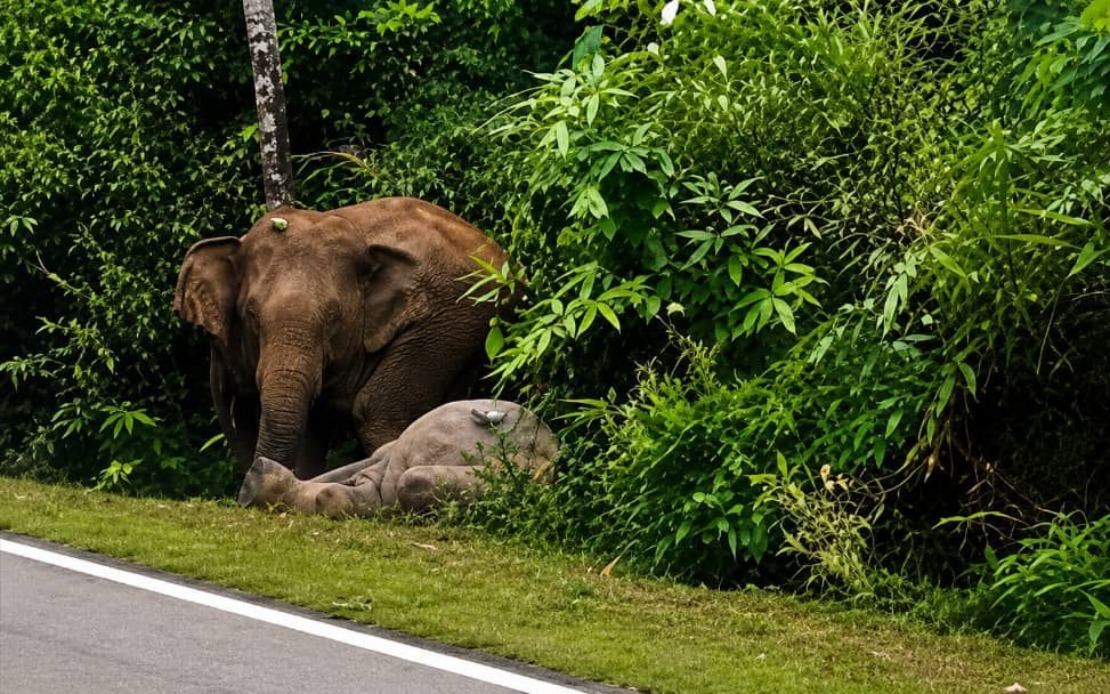
The death of a young elephant along a rural Johor highway on Monday morning has revived memories of one of Malaysia's most haunting wildlife tragedies—the Gerik incident of last year—where a mother elephant's desperate attempt to save her trapped calf captivated and devastated the nation. In the predawn hours of July 1, a female elephant calf, estimated at five years old, was struck by a Perodua Bezza near Jalan Felda Nitar in Mersing at 2.28 am. What followed was a prolonged scene of maternal grief as the mother elephant refused to abandon her dead offspring, standing guard over the body for seven hours until wildlife officers were able to coax her back into the forest.
The Johor Department of Wildlife and National Parks received notification of the incident around 8.30 am, considerably after the collision itself. When Perhilitan personnel arrived at the scene, they discovered the young female calf, approximately 150 centimetres in body length and bearing no tusks, already dead from the impact. The adult elephant present was confirmed to be the mother, part of the Jamaluang-Mersing elephant identification group that roams this part of the state. The animal's physical measurements—front footprints of 11 inches and rear footprints of 14 centimetres—were meticulously documented as part of the investigation, enabling wildlife authorities to maintain detailed records of the region's elephant population.
The incident gained immediate traction on social media after videos of the bereft mother elephant circulated online, capturing public attention once again to the fraught relationship between wildlife and human development in Malaysia. The emotional resonance of the footage—showing a grieving animal refusing to leave its dead young—struck a profound chord with Malaysians, drawing inevitable parallels to the Gerik tragedy that unfolded on Mother's Day in May of the previous year. In that incident, a baby elephant became trapped beneath a container lorry after being hit, whilst what was believed to be the mother elephant was filmed attempting to push the heavy vehicle in a desperate bid to free her calf. The Gerik incident became a watershed moment in public discourse about human-elephant conflict, generating widespread sympathy for the plight of displaced wildlife.
The Mersing collision had consequences for human occupants as well. A 31-year-old male driver suffered leg injuries when his vehicle struck the young elephant and subsequently plummeted into a five-metre-deep ravine. The Fire and Rescue Department responded to extract the injured motorist from the wreckage, highlighting how wildlife encounters on Malaysian roads pose reciprocal dangers to both animals and humans. This dual casualty aspect underscores the complexity of managing human-elephant coexistence in regions where animal habitats overlap with transportation corridors and human settlement.
The mother elephant's protracted refusal to depart the accident site presented a challenging scenario for Perhilitan officers. Rather than attempting immediate removal, the department mobilised its Elephant Capture Unit from the Johor Elephant Sanctuary to gradually guide the grieving animal back into the forest through patient and careful herding. Meanwhile, the carcass of the young elephant was interred near the accident site. This measured approach reflected lessons learned from previous wildlife management incidents and represented a compassionate methodology that prioritised the psychological state and safety of the surviving animal whilst managing the immediate crisis.
Authorities indicated that warning signs specifically designating the area as an elephant crossing had been previously installed along Jalan Felda Nitar. Despite these precautions, the road remains inherently hazardous, particularly during early morning hours when darkness limits visibility and elephant activity peaks. Perhilitan announced intentions to conduct intensive patrols throughout the night and subsequent day to monitor the mother elephant's condition and discourage her from returning to the fatal location. Such follow-up vigilance is critical, as distressed animals sometimes attempt to revisit sites of tragedy, potentially placing themselves in further danger.
The recurring nature of these tragedies points to deeper structural challenges in Malaysian wildlife management and urban-rural planning. The Johor-Pahang region, encompassing Mersing and surrounding districts, represents critical elephant habitat corridors that have been progressively fragmented by agricultural development, plantation expansion, and road infrastructure. Elephants requiring vast ranges to sustain viable populations increasingly find themselves confined to shrinking territories, forcing them to traverse human-occupied landscapes with mounting frequency. Each crossing represents a calculated risk that can turn fatal in moments.
From a regional perspective, Malaysia's human-elephant conflict mirrors challenges faced across Southeast Asia as rapid economic development collides with conservation imperatives. Countries including Thailand, Laos, and Myanmar grapple with similar dilemmas of protecting endangered megafauna whilst accommodating infrastructure expansion and agricultural productivity. Malaysia's approach—balancing wildlife protection through Perhilitan with infrastructure development through state agencies—remains inconsistent, occasionally favouring development at wildlife's expense.
The Gerik incident catalysed heightened public awareness and prompted discussions about wildlife corridors, road design modifications, and compensation schemes for affected communities. Yet the Mersing tragedy suggests that systemic reforms have not been fully implemented or have proven insufficient to prevent recurring incidents. Whilst signage and patrols provide valuable safeguards, they represent reactive rather than proactive solutions. Genuine reduction in human-elephant conflict requires more fundamental interventions: habitat restoration, wildlife passage infrastructure such as underpasses and overpasses, and potentially reconsidering road alignments through sensitive ecological areas.
The emotional impact of these incidents on Malaysian society warrants serious consideration. The image of a grieving mother elephant refusing to abandon her dead offspring transcends mere animal welfare concern—it resonates with universal experiences of loss and maternal devotion. Such moments generate political will for conservation initiatives that might otherwise languish in bureaucratic channels. The question remains whether Malaysia's policymakers will translate public sentiment into sustained, long-term wildlife protection strategies or whether future tragedies will continue to punctuate a narrative of incremental decline in wild elephant populations.
For Mersing residents and travellers using Jalan Felda Nitar, the immediate imperative remains heightened vigilance during early morning and evening hours when elephant activity concentrates. The Perhilitan reminder to exercise caution reflects the unavoidable reality that coexisting with large wild animals demands constant awareness and adaptive behaviour from human road users. Yet the deeper challenge confronting Malaysian society remains unresolved: how to sustainably accommodate both human progress and the survival of irreplaceable megafauna whose existence enriches the nation's natural heritage and ecological integrity.

