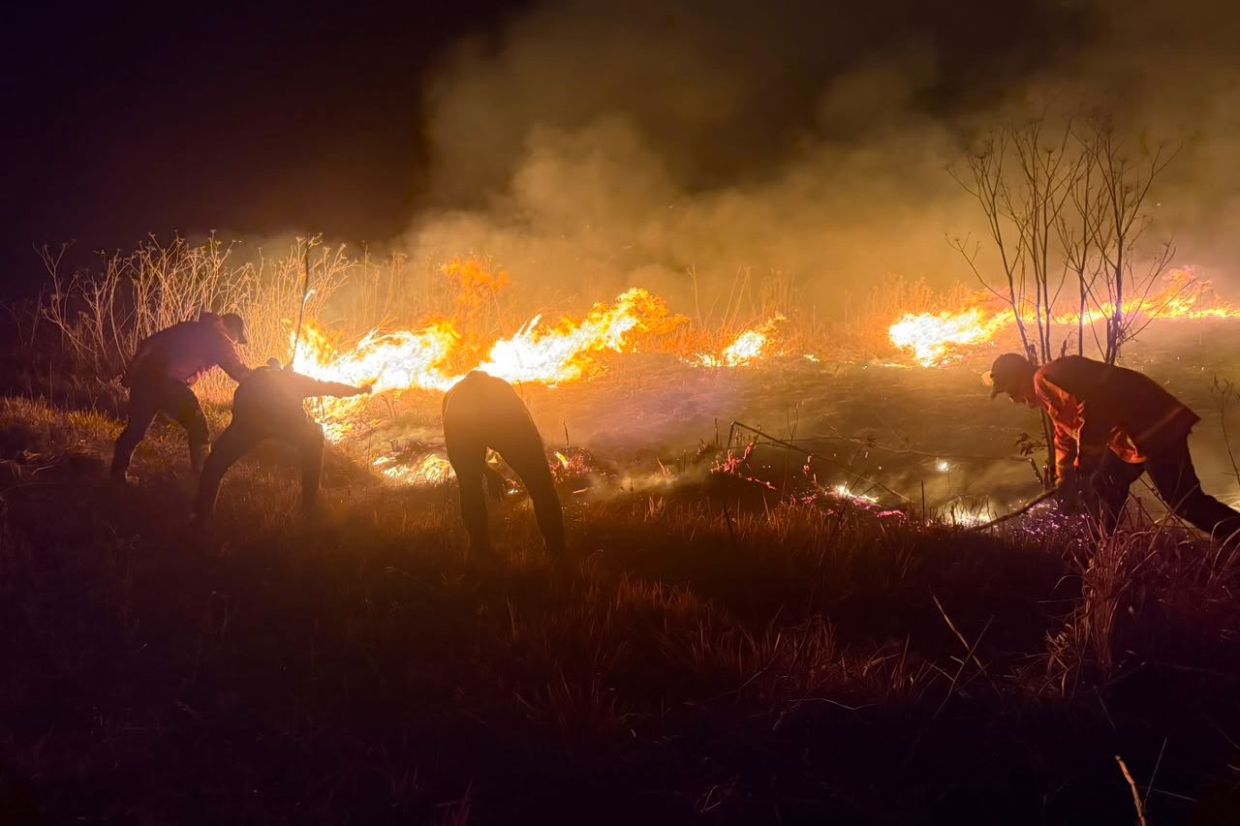
A catastrophic wildfire consuming Mount Bromo in East Java has swelled to encompass approximately 520 hectares of the national park's landscape, with authorities warning that conditions continue to deteriorate as powerful winds accelerate the fire's relentless advance across the volcano's slopes and grasslands. The crisis intensified when the blaze reignited with renewed ferocity on Saturday night, transforming what had initially appeared manageable into a sprawling conflagration that now threatens vast tracts of the ecologically sensitive Bromo Tengger Semeru National Park.
Rudijanta Tjahja Nugraha, head of the Bromo Tengger Semeru National Park Authority, described the escalating situation to local media, explaining that meteorological conditions have become the fire's greatest ally. The arrival of unusually forceful winds from Saturday afternoon onwards created ideal conditions for rapid propagation, enabling flames to sweep downhill from the mountain's upper elevations toward lower terrain with alarming speed. This directional movement represents a critical challenge for firefighting teams, as gravity combined with wind-driven momentum accelerates the fire's downslope trajectory, making containment increasingly difficult.
The vulnerability of Mount Bromo's environment to rapid combustion stems from an extended dry period that has left vegetation throughout the region parched and exceptionally flammable. Grasses, shrubs, and other plant matter that typically provide some resistance to fire now constitute highly combustible tinder, transforming the landscape into a tinderbox awaiting ignition. This seasonal desiccation, combined with the natural propensity of grassland ecosystems to burn intensely once aflame, has created precisely the conditions needed for fires to spread with unprecedented velocity across the affected terrain.
The national park administration made the difficult decision to seal all public access points beginning Saturday evening at 10pm, implementing a comprehensive closure that remains in effect indefinitely pending resolution of the crisis. This precautionary measure serves the dual purpose of removing potential safety hazards to visitors and eliminating civilian presence from areas where emergency personnel require unobstructed operational freedom. Authorities have committed to accommodating affected tourists through flexible rescheduling options or full refunds, acknowledging the substantial economic and personal disruption the closure imposes on the tourism sector that depends heavily on Mount Bromo's year-round accessibility.
The incident has triggered an active investigation into its origins, with preliminary assessments pointing toward human agency rather than natural causes such as lightning strikes. Park officials stated publicly that the fire's characteristics and location suggest deliberate or negligent human activity catalysed the initial ignition, a conclusion that carries serious legal implications given Indonesia's strict forest protection legislation. The investigative focus now centres on identifying whether the fire resulted from intentional land-clearing practices, negligent campfire management, or other anthropogenic mechanisms.
Forestry Minister Raja Juli Antoni reiterated the government's commitment to prosecuting individuals responsible for forest destruction, emphasising that perpetrators face severe penalties under applicable environmental and criminal statutes. This public commitment signals national-level attention to what authorities view as both an immediate environmental crisis and a matter warranting prosecution as a deterrent against future incidents. The minister's statement reflects broader governmental concern about recurring wildfire patterns across Indonesia, which have caused regional air quality crises and attracted international criticism in recent years.
For Malaysia and neighbouring Southeast Asian nations, Mount Bromo's wildfire carries implications extending beyond Indonesian borders. The region's interconnected atmospheric systems mean that large-scale fires, particularly those sustained across extended timeframes, can transport smoke and particulate matter across maritime boundaries, potentially affecting air quality in Malaysian states such as Johor and Sabah. The 2015 Indonesian haze crisis remains fresh in regional memory, demonstrating how uncontrolled fires in one nation-state rapidly become transnational environmental crises affecting millions across multiple countries.
The timing of this incident during what appears to be the dry season raises broader questions about Indonesia's forest and land management practices and the adequacy of preventative measures against wildfires. Climate change has reportedly extended dry seasons and intensified weather extremes across the archipelago, creating longer windows during which accumulated vegetation becomes susceptible to burning. These long-term environmental trends, combined with population pressures driving land-use conversion and agricultural expansion, create a compounding risk environment for future fire incidents of similar or greater magnitude.
The closure of Mount Bromo represents a significant disruption to East Java's tourism economy, as the volcano constitutes one of Indonesia's most recognised natural attractions, drawing both domestic and international visitors seeking sunrise vistas and trekking experiences. The uncertain timeline for reopening creates cash flow challenges for tourism operators, guides, and hospitality businesses dependent on visitor expenditure. This economic dimension adds urgency to firefighting efforts, though such considerations must necessarily remain secondary to public safety and environmental preservation imperatives.
As firefighting teams mobilise resources and coordinate response strategies, the meteorological forecast remains critical to operational planning. Sustained winds will perpetuate the fire's spread, while any precipitation could provide temporary relief. Authorities have not disclosed the specific firefighting methods being deployed, though Mount Bromo's remote and rugged terrain, combined with its volcanic composition, presents substantial obstacles to conventional ground-based suppression techniques. The coming days will likely determine whether this incident becomes a contained regional event or escalates into a more severe crisis requiring resource commitments beyond current capabilities.

