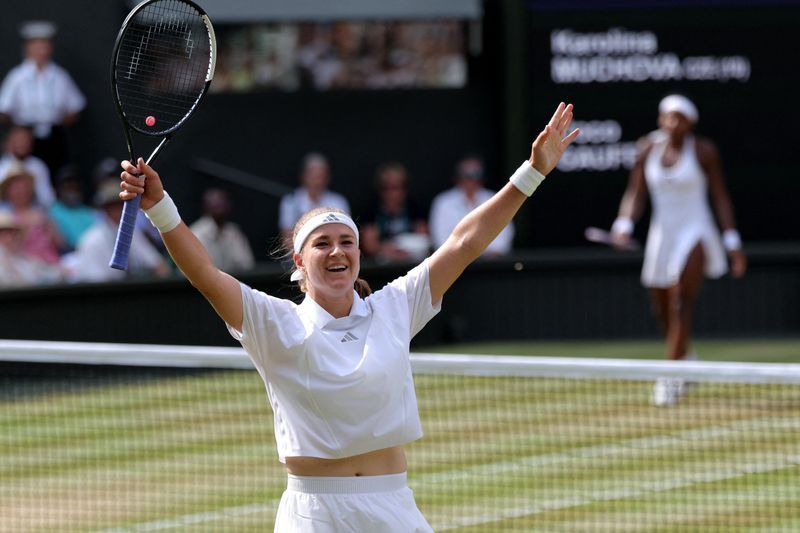
Karolina Muchova has become the latest Czech player to grace a Wimbledon final after her nervy 6-2 1-6 7-6 (12-10) victory over American seventh seed Coco Gauff on Thursday, setting up the possibility of an all-Czech championship decider. The tenth-seeded Czech saved a crucial match point during the breathtaking third-set tiebreak to secure her spot in Saturday's final, preventing what would have been a devastating loss for a player who has battled her way through three consecutive three-set matches just to reach the semifinals.
The result keeps alive the remarkable streak of Czech dominance at the All England Club, where the nation has produced champions in three of the past four years. Following Marketa Vondrousova's triumph in 2023 and Barbora Krejcikova's victory last summer, another Czech could soon claim the Venus Rosewater Dish. This prospect became more tangible when Muchova's compatriot Linda Noskova advanced through her own semifinal against Ukrainian Marta Kostyuk on Thursday, making an all-Czech showdown in the women's singles final a genuine possibility—a historic first for any country at Wimbledon.
Perhaps the most surprising aspect of Muchova's progression lies in her relationship with grass courts. The Czech player suffers from significant allergies that affect her ability to compete on the surface, requiring an arsenal of pharmaceutical interventions simply to function on what she terms the most sacred venue in tennis. Her daily regimen involves prescription pills, nasal sprays, and specialised eyedrops just to step onto Centre Court, making her physical struggle as noteworthy as her tactical brilliance.
The opening set saw Muchova impose her superior grasscourt movement immediately. Playing in stifling heat that left spectators visibly uncomfortable, she executed clean breaks in the third and fifth games, with Gauff's second service break particularly costly when the American fired a careless forehand deep into the back hoardings. A thunderous 111 mph ace punctuated the set, giving Muchova a commanding 6-2 advantage after just 28 minutes of play.
Gauff, however, demonstrated the resilience that has defined her campaign at this year's Wimbledon. The American had survived four consecutive three-set matches to reach the semifinals, and her competitive instincts were far from dimmed by a poor opening frame. After squandering her first eight break point opportunities, Gauff finally converted on the ninth to claim a 3-1 lead in the second set. Her momentum accelerated rapidly, and she raced to a 5-1 advantage before ultimately claiming the set 6-1 to force a decisive third set.
The final set transformed into a masterclass of aggressive baseline tennis. Both players unleashed their full weaponry, trading ferocious forehands and exquisite backhand constructions in rallies of breathtaking intensity. The contrast with the first two sets was stark and unmistakable, as neither player retreated into defensive tactics despite the pressure of a Grand Slam semifinal.
Gauff fashioned two break point opportunities while serving at 4-5 down, but Muchova proved equal to the challenge, denying both with composed tennis under genuine duress. The American's hopes ultimately dissolved in a tiebreak that showcased both players' technical excellence and mental fortitude. Muchova produced an outrageous diving volley winner to establish her first match point, only to see it squandered when Gauff fought back. On her second opportunity, after two hours and 35 minutes of unrelenting combat, Muchova secured victory when her opponent netted a forehand.
The semifinal result represents a significant breakthrough for Muchova, who has long possessed the technical skills to challenge the sport's elite but has struggled to translate that ability into deep Grand Slam runs. Her combination of slice, lob, and variety—the defining characteristics of her grasscourt game—ultimately overwhelmed Gauff's more straightforward power-based approach, though only after the American had pushed her to the absolute limit. The victory demonstrates that despite her considerable physical challenges on grass, Muchova possesses the tactical intelligence and competitive fire to succeed at the highest level of the sport. For Malaysian tennis enthusiasts following the Southeast Asian region's tennis development, Muchova's breakthrough also underscores how diverse pathways exist to Grand Slam success, with craftsmanship and intelligent shot selection often proving as potent as raw power in major championship tennis.

