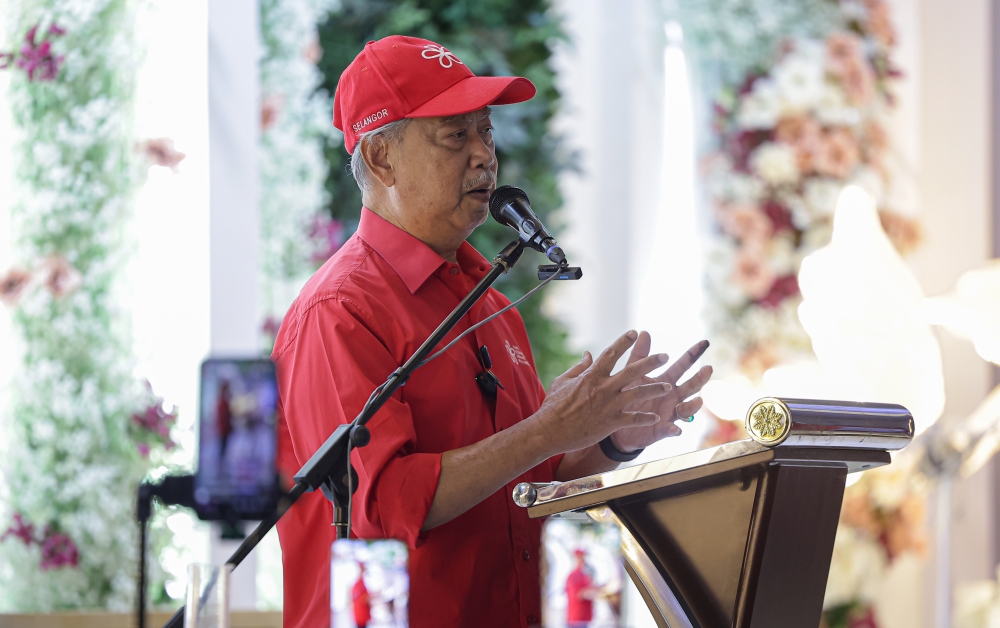
Tan Sri Muhyiddin Yassin has moved to consolidate Bersatu's political positioning by asserting the party represents Parliament's sole principled Opposition voice, a declaration that underscores deepening fragmentation within Malaysia's opposition landscape. The pronouncement reflects intensifying tensions as the country's political coalitions undergo substantial reorganisation, with traditional opposition groupings increasingly fractured by strategic government partnerships and competing interests.
Muhyiddin's positioning of Bersatu as the authentic opposition standard-bearer carries particular weight given the party's troubled history. Bersatu, founded in 2016 as a vehicle for former Prime Minister Mahathir Mohamad, has itself experienced multiple realignments since entering parliamentary politics. The party's trajectory from supporting the Pakatan Harapan administration to the Perikatan Nasional coalition illustrates the fluid nature of Malaysian political allegiances, where ideological consistency frequently yields to pragmatic coalition-building and factional advantage.
The Opposition landscape has become increasingly complicated by strategic partnerships between traditionally opposition-leaning parties and government structures. Parti Keadilan Rakyat (PKR), Democratic Action Party (DAP), and Pan-Malaysian Islamic Party (PAS)—historically the backbone of opposition movements—have engaged in varying degrees of cooperation with federal and state administrations. These arrangements, while operationally justified by their proponents as necessary for advancing specific policy objectives, have created the perception among some constituencies that these parties have abandoned principled opposition roles for governmental participation.
Bersatu's own composition presents complications to its claimed status as sole authentic opposition. The party originated from within the United Malays National Organisation apparatus and retains significant connections to establishment power structures. Muhyiddin himself served as Prime Minister under the Perikatan Nasional banner from 2020 to 2021, demonstrating the party's willingness to engage directly with executive power when circumstances permit. This history makes claims of absolute opposition purity potentially vulnerable to challenge from rival political formations.
The timing of Muhyiddin's declaration reflects broader calculations regarding parliamentary positioning ahead of anticipated political transitions. With federal elections ultimately required by 2023, though potentially occurring earlier through dissolution, opposition parties are recalibrating their public profiles and strategic narratives. Bersatu's assertion of uncompromising opposition status represents an attempt to capture political space vacated by other anti-government groupings whose compromising partnerships have eroded their oppositional credentials among sections of the electorate.
Regional and international observers note that Malaysian opposition fragmentation mirrors patterns visible elsewhere across Southeast Asia, where political polarisation intersects with coalition instability. Unlike established two-party systems where opposition roles carry relatively stable definition, Malaysia's multi-party, multi-ethnic framework produces fluid opposition configurations determined by temporary parliamentary arithmetic rather than ideological coherence. This structural reality means opposition positioning remains fundamentally provisional and subject to recalibration following electoral developments.
For Malaysian voters attempting to evaluate opposition credibility, Muhyiddin's claims demand careful contextualisation. Bersatu's parliamentary presence, while numerically meaningful, lacks the grassroots organisational depth and historical legitimacy commanded by older opposition institutions. The party's strength derives substantially from Muhyiddin's personal political capital and elite-level networking rather than deeply embedded community structures. This makes Bersatu potentially vulnerable to internal leadership transitions or factional disputes that might undermine its institutional stability.
The Declaration of Bersatu's sole opposition status also strategically positions the party relative to Perikatan Nasional, the coalition within which it currently operates alongside PAS and other parties. By emphasising independent opposition credentials, Bersatu maintains rhetorical flexibility, allowing potential repositioning should government coalition calculations shift. This ambiguity serves Muhyiddin's interests by preserving options across multiple political scenarios while maximising his leverage within existing arrangements.
Southeast Asian political analysts observe that Malaysian opposition fragmentation ultimately serves executive interests by preventing unified counter-parliamentary forces. When opposition movements subdivide along multiple axes—personal loyalty, ethnic interest, religious interpretation, and geographical location—their collective capacity to function as coherent governmental check diminishes substantially. Bersatu's claims regarding authentic opposition status must therefore be understood within this context of structurally dispersed opposition capacity that inadvertently benefits government incumbents.
For regional observers, the Malaysian situation demonstrates how demographic diversity and federal constitutional arrangements create opposition dynamics substantially different from simpler two-party frameworks. Unlike Singapore's tightly controlled opposition environment or Thailand's military-constrained political space, Malaysia permits genuine multi-party competition but fragments that competition across ethnic, religious, and personalised lines. Bersatu's positioning reflects the party's navigation of these distinctive Malaysian political parameters rather than challenging them fundamentally.
Looking forward, Muhyiddin's assertion will likely influence opposition party behaviour and voter perceptions during the approaching electoral cycle. If Bersatu can credibly maintain its positioning as uncompromising opposition force while competitors become entangled in government partnerships, the party may capture protest votes from constituencies fatigued by establishment politics. Conversely, if electoral outcomes produce significant Bersatu gains, the party will face immediate pressure to determine whether its opposition positioning represents genuine principle or primarily serves immediate electoral strategy.

