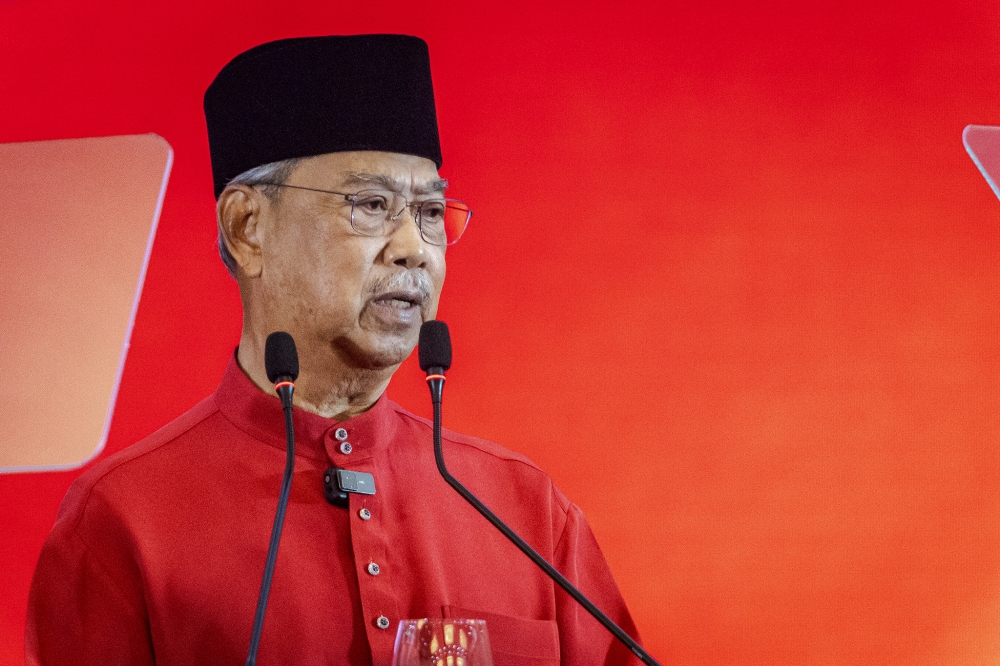
In a pointed reversal of coalition pressures, Bersatu president Muhyiddin Yassin has rejected mounting calls for his party to exit Perikatan Nasional, instead arguing that PAS bears responsibility for tensions threatening the government alliance. The former Prime Minister's combative stance underscores deepening fractures within the three-party coalition that underpins Malaysia's federal government, with each partner now openly questioning the other's commitment to the partnership.
Muhyiddin's intervention represents a significant escalation in the coalition dispute, moving beyond private mediation to public accusations about which party constitutes the real obstacle to stability. By framing the question as one of incompatibility rather than Bersatu's supposed inadequacy, the Bersatu leader has shifted the narrative terrain substantially. His argument essentially inverts the proposition that has circulated in recent weeks: rather than accepting his party's departure as a solution, Muhyiddin contends that PAS's ideological inflexibility and competing political interests have created the genuine problem.
The coalition comprising Bersatu, PAS, and Perikatan's original component parts has faced mounting strain from multiple directions. Policy disagreements, competing electoral interests at state and local levels, and differing visions for Malaysia's governance trajectory have all contributed to mutual suspicion. Within this environment, suggestions have emerged that reshuffling the coalition structure—specifically removing Bersatu—might restore harmony. Muhyiddin's response indicates he views such proposals not as serious solutions but as tactics designed to weaken Bersatu's position.
Understanding the context reveals why Muhyiddin's pushback carries weight in Malaysia's fractious coalition politics. Bersatu, though numerically smaller than some partners, brings crucial urban Malay support and strategic parliamentary seats. The party also carries the symbolic weight of Muhyiddin's own tenure as Prime Minister, a period when the coalition structure was substantially different. By contending that PAS should instead reconsider its membership, Muhyiddin implies that Bersatu's core interests—particularly its representation of moderate Malay-Muslim constituencies—remain essential to any viable government formation.
PAS, the coalition's dominant Islamic party, brings substantial support in rural Malay constituencies and holds significant influence over religious policy matters. However, its strong ideological commitments and uncompromising negotiating positions have frequently created friction with more secular-oriented partners. The party's expansion into states like Selangor and Penang, traditionally opposition strongholds, reflects ambitions that sometimes conflict with other coalition members' electoral strategies. Muhyiddin's suggestion that PAS should depart thus carries implications about whether a more ideologically diverse coalition—or one with different power balances—might function more smoothly.
For Malaysian observers tracking coalition stability, Muhyiddin's statement signals that internal negotiations have evidently failed to produce compromise. Rather than accepting the premise that Bersatu must prove its worth by departing, the party's president has instead challenged the premise itself. This argumentative stance suggests that behind-the-scenes mediation has proven ineffective, prompting public recourse to defend Bersatu's reputation and political positioning. The shift to public contestation typically indicates that private channels have become exhausted.
The implications for Malaysia's broader political architecture remain significant. Coalition governments necessarily depend on maintaining balances among partners with distinct interests and constituencies. When such balances come into public question, institutional stability becomes at risk. Muhyiddin's intervention, while rhetorically strong, does not resolve the underlying grievances that prompted coalition members to question whether current arrangements serve their interests. Instead, it amplifies tensions by forcing explicit choices about which party genuinely belongs in the structure.
Regionally, Malaysia's coalition dynamics attract attention from neighbouring governments observing how multiparty democracies manage competing pressures. A coalition that cannot internally resolve disputes without public recriminations raises questions about its durability. Southeast Asian observers monitor such developments as indicators of whether Malaysia's institutional arrangements can absorb political stress without fragmenting governance structures entirely. The current trajectory suggests continued testing of those capacities.
For Bersatu specifically, Muhyiddin's stance represents a gamble that public assertion of the party's indispensability will outweigh concerns about divisiveness. Whether this calculation proves correct depends substantially on how other coalition partners respond and whether broader circumstances—economic pressures, electoral calendars, or policy crises—force renewed negotiation. The former Prime Minister's willingness to shift responsibility toward PAS indicates his assessment that Bersatu's position remains defensible through articulated argument rather than graceful retreat. That confidence may ultimately prove decisive in determining which coalition configuration emerges from current turmoil.

