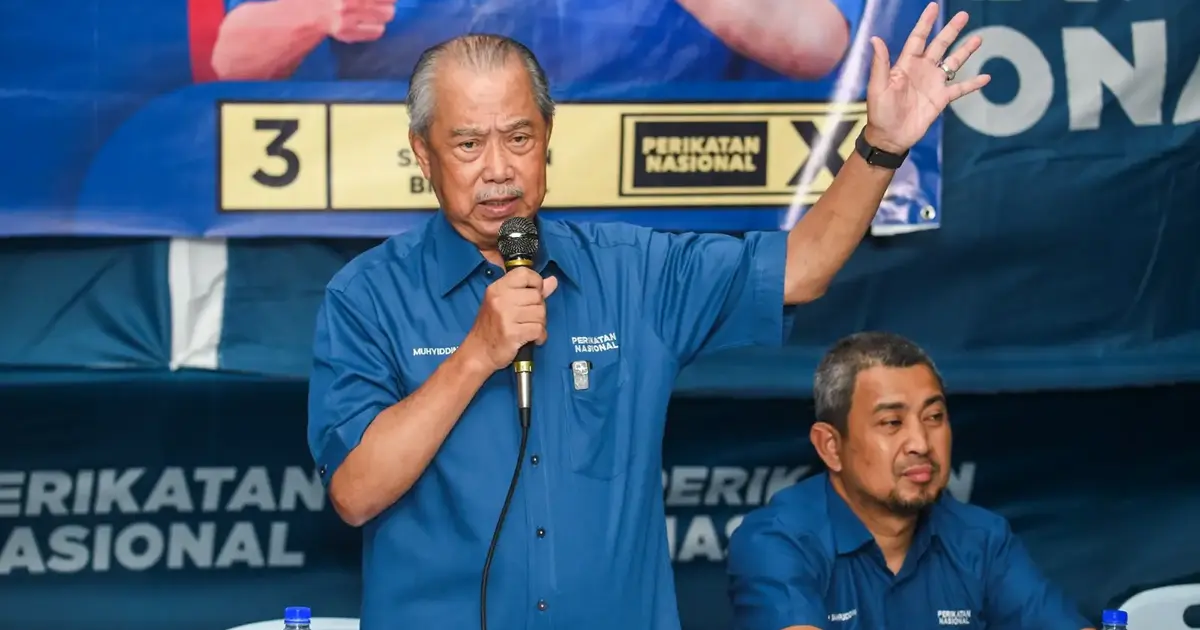
Bersatu president Muhyiddin Yassin has raised pointed questions about the relationship between potential political decisions concerning former Prime Minister Najib Razak and the impending Johor state election, suggesting electoral considerations may be influencing the trajectory of the case. Speaking publicly on the matter, Muhyiddin underscored that regardless of any procedural developments, the fundamental legal reality remains unchanged: Najib Razak carries the status of a convicted criminal whose sentence was handed down by the courts.
The Bersatu leader's comments arrive amid broader speculation within Malaysian political circles about the timing and circumstances surrounding various legal proceedings affecting prominent figures. By explicitly linking Najib's situation to Johor electoral politics, Muhyiddin has articulated what many political observers have whispered privately—that state-level election campaigns can exert considerable influence on the executive decisions that govern criminal convictions and potential sentence reductions. This observation reflects the deeply intertwined nature of Malaysia's legal and political systems, where the boundary between judicial independence and political expediency often blurs in the public perception.
Najib's conviction in 2023 represented a historic moment in Malaysian politics, marking the first time a former prime minister had faced substantial prison time. The case originated from the 1Malaysia Development Berhad scandal, which had dominated Malaysian headlines for years and exposed the country's vulnerabilities to large-scale financial malfeasance at the highest levels of government. His legal battles have continued through various appeal mechanisms, keeping the matter perpetually in the public consciousness and remaining a lightning rod for political debate across the nation.
The Johor state election looms as a significant electoral test for the coalition government led by Prime Minister Anwar Ibrahim. Johor has traditionally been a stronghold for the Barisan Nasional coalition and later the United Malays National Organisation, though political alignments have shifted considerably in recent years. Any electoral gains or losses there would reverberate through national politics and affect the balance of power within the broader governmental structure. For constituencies and political actors with ties to the former UMNO-led administration, the Najib question remains deeply resonant and emotionally charged.
Muhyiddin's strategic positioning on this issue reflects Bersatu's complex political stance. The party, which grew from a faction within UMNO, has maintained an uneasy relationship with the wider political ecosystem. Bersatu's current alliance with Anwar's coalition government sits in tension with its historical roots and the loyalty many of its members feel toward figures like Najib. By publicly questioning the connection between Najib's case and electoral considerations, Muhyiddin appears to be both signalling distance from Najib while simultaneously acknowledging the political sensitivities that surround him among certain voter segments.
The notion that executive clemency or sentence modification might be influenced by election calendars strikes at the heart of Malaysia's ongoing struggle to build institutions insulated from political interference. Southeast Asian democracies have long grappled with this tension between electoral politics and the maintenance of judicial independence. In Malaysia's case, the historical pattern of political appointments to the judiciary and the constitutional role of the Yang di-Pertuan Agong in granting pardons creates structural opportunities for political considerations to influence legal outcomes, even if not explicitly. This reality has haunted Malaysia's national discourse since the 1997 sacking of then-Chief Justice Salleh Abas, which revealed the extent to which politics could penetrate the highest judicial echelons.
Najib's supporters argue that he has already paid his debt to society through conviction and imprisonment, and they point to his various humanitarian activities while under custody as evidence of his reformed character. Critics counter that such arguments amount to an attempt to erase consequences for governance failures that resulted in the loss of billions in public funds and damaged Malaysia's international reputation for financial integrity. The debate transcends Najib himself and encompasses fundamental questions about accountability for those who hold high office and whether political capital can adequately substitute for legal consequence.
For Malaysian voters, particularly those in Johor, the broader implications of how the Najib case concludes extend beyond one individual to encompass questions about the rule of law in the country. If electoral considerations demonstrably influence decisions about convicted criminals serving time, it signals that Malaysia's legal system operates differently for the politically connected than for ordinary citizens. This perception—whether empirically grounded or not—erodes public confidence in institutions. Muhyiddin's willingness to articulate this concern publicly, despite Bersatu's own political positioning, suggests that even within the government coalition, there is recognition that such linkages, whether real or perceived, damage institutional credibility.
The coming weeks and months will provide insight into how Johor voters respond to these dynamics and whether electoral outcomes there produce unexpected shifts in policy toward Najib's case. Political observers across Malaysia and throughout Southeast Asia will be watching closely to see whether the legal and electoral dimensions remain properly separated or whether the convergence that Muhyiddin suggests becomes more explicit and consequential for Malaysia's broader democratic trajectory.

