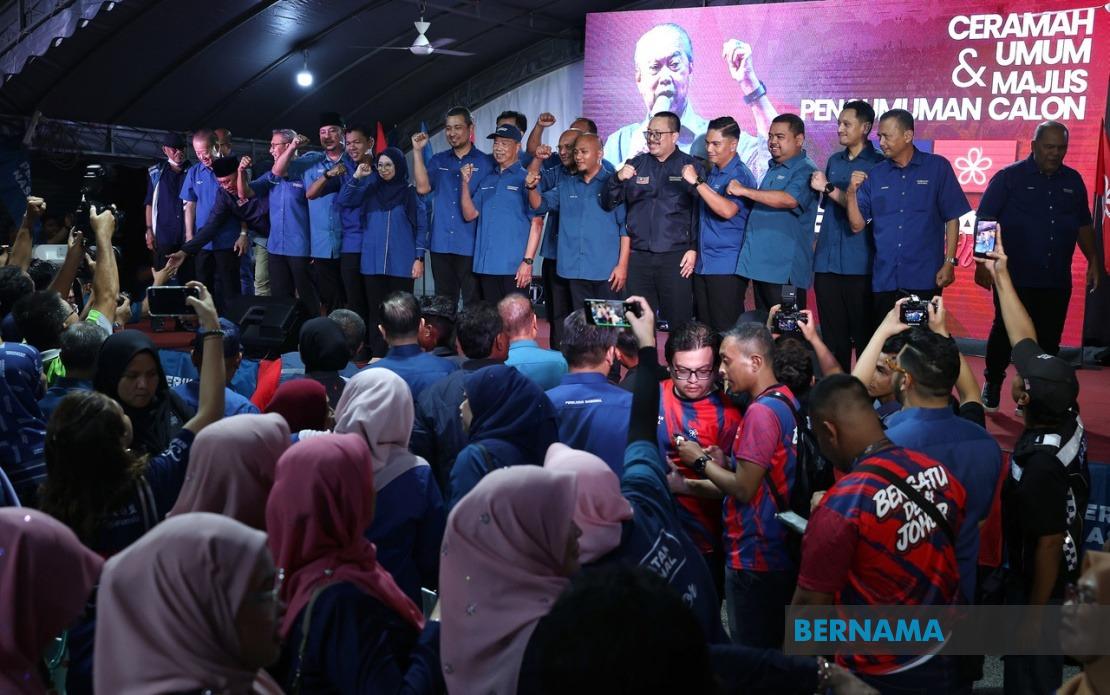
Parti Pribumi Bersatu Malaysia has formally presented its complete roster of 16 candidates for the upcoming Johor State Election, with party president Tan Sri Muhyiddin Yassin making the announcement during a candidates presentation and public ceramah event held at the Pagoh Parliamentary Service Centre in Taman Pagoh Jaya. The move marks a critical juncture in Bersatu's electoral strategy as the party positions itself within the complex political landscape of one of Malaysia's most economically significant states.
The Election Commission has structured the campaign timeline with June 27 designated as nomination day, providing candidates and their respective parties a compressed period to register officially and submit required documentation. Polling itself is scheduled for July 11, giving registered voters approximately two weeks to assess candidates and campaign messages across the 16 seats Bersatu is contesting. This calendar reflects the electoral process initiated when the Johor State Assembly was dissolved on June 1, triggering the constitutional requirement for elections to be held within a defined timeframe.
Among the announced candidates, Mohd Idzharruddin Mohd Nasirruddin will carry Bersatu's banner in the N8 Bukit Pasir state constituency. This particular seat carries historical and demographic significance within Johor's political fabric, representing a mixed rural-suburban electorate with distinct economic and social characteristics. The selection of candidates across the 16 seats suggests Bersatu's attempt to maintain a presence across both urban and rural constituencies, though the party faces the inherent challenge of resource allocation and campaign focus in a crowded electoral field.
The Johor State Election assumes considerable importance within Malaysia's broader political narrative. As the nation's second-largest state by population and a traditional powerhouse in national politics, Johor's electoral outcome carries implications beyond state-level governance. The results will provide crucial indicators regarding voter sentiment on issues ranging from economic management to political stability, particularly given the shifting allegiances and coalition dynamics that have characterised Malaysian politics in recent years.
Bersatu's positioning in this election reflects the party's evolving role within Malaysian politics following its formation in 2016. The party has navigated through multiple coalition arrangements and internal strategic shifts, and the Johor contest represents an opportunity to demonstrate sustained electoral viability at the state level. The party's presence across 16 seats, while not covering the entire assembly, indicates a calculated approach to resource deployment and candidate quality rather than an attempt at comprehensive coverage.
The compressed campaign period between nomination day and polling presents distinct challenges and opportunities for all contesting parties. Candidates must rapidly establish their platforms, engage with constituents through traditional and digital media, and build momentum despite the limited timeframe. This condensed schedule often advantages incumbent parties with established grassroots machinery while potentially disadvantaging newer entrants or those with weaker organisational structures at the ground level.
For Malaysian voters in Johor, this election offers a chance to express preferences on state governance priorities including economic development, infrastructure investment, social welfare provision, and political representation. The electorate's response will be analysed not merely for its impact on Johor's government composition but for what it signals about broader voting patterns and public sentiment across Malaysia's regions. Previous state elections have demonstrated that results in major states frequently contain surprises that reshape national political calculations.
Bersatu's announcement strategy, centred on a formal public event with the party president presiding, underscores the importance Bersatu leadership places on this election cycle. Such ceremonial occasions serve multiple purposes beyond simple candidate introduction, functioning as morale-boosting exercises for party machinery, media engagement platforms, and opportunities to articulate party messaging and vision to the electorate. The choice of Pagoh as the venue carries symbolic weight given the constituency's significance within Johor's political geography.
The 16-seat participation reflects rational electoral strategy by Bersatu's leadership. Contesting every seat would require substantial financial and human resources while potentially diluting campaign effectiveness across constituencies where the party lacks strong existing infrastructure or candidate quality. Conversely, focusing exclusively on winnable seats risks appearing too narrow in ambition. The middle-ground approach of contesting 16 of Johor's 56 state assembly seats allows Bersatu to maintain relevance as a statewide political force while concentrating resources on constituencies where victory is achievable.
Beyond the immediate electoral implications, this announcement marks a significant point in Bersatu's attempt to establish itself as a permanent fixture in Malaysian politics rather than a temporary phenomenon. The party's participation across multiple state and federal elections since its establishment has gradually built a cadre of politicians and organisational capacity, though questions persist regarding its long-term sustainability and political direction. Electoral performance in Johor will contribute to evolving assessments of whether Bersatu has successfully consolidated its position within the Malaysian political system.
The Johor election occurs within a context of broader political realignment across Malaysia. Various coalitions and political combinations have emerged and reformed with significant frequency, reflecting underlying tensions regarding governance priorities, representation, and power-sharing arrangements. Johor's electoral outcome may influence whether certain political arrangements are strengthened or whether further recalibration becomes necessary among various political players seeking optimal positioning for potential federal-level elections.
As the June 27 nomination day approaches, Bersatu and other contesting parties will accelerate campaign activities, seek to mobilise supporters, and attempt to shape media narratives favourable to their respective political positions. The announcement of Bersatu's candidacy represents merely the formal commencement of what will be an intensive two-week electoral campaign. For Johor voters, the period ahead offers opportunity for informed decision-making regarding representation and state governance priorities, while broader Malaysian political observers will watch closely for signals about shifting electoral patterns and voter preferences.

