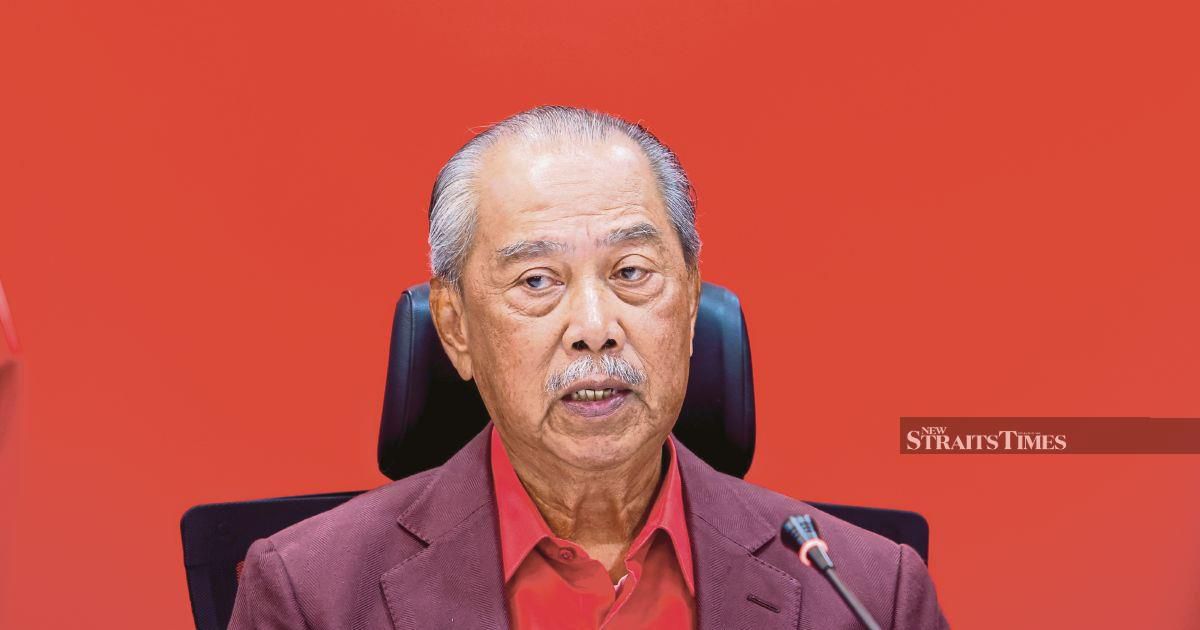
Bersatu president Tan Sri Muhyiddin Yassin has leveled serious allegations that Umno is orchestrating a coordinated campaign to destabilize the unity government, employing tactics analogous to those that precipitated the collapse of his Perikatan Nasional (PN) administration. The accusation comes amid mounting tensions within Malaysia's governing coalition, which unites Bersatu and Pakatan Harapan in what was intended to be a stabilizing power-sharing arrangement. Muhyiddin's warning underscores deepening rifts between coalition partners, suggesting that the fragile political equilibrium established following the 2022 elections faces significant strain.
The Bersatu chief's claims carry particular weight given his direct experience navigating the parliamentary mathematics that ultimately undermined his own 22-month tenure as prime minister. When the PN government fractured in August 2021, defections and strategic withdrawals by key members precipitated its collapse, forcing a transition to the unity coalition framework. Muhyiddin's assertion that Umno is now employing similar subversive approaches implies a calculated strategy of destabilization rather than isolated political maneuvering. This interpretation suggests that intracoalition antagonisms run deeper than routine policy disagreements or competing departmental interests.
Umno's position within the current coalition remains complicated and somewhat ambiguous. Historically the dominant force in Malaysian politics, the party has found itself in a constrained role following its 2022 electoral setback, which saw it lose significant parliamentary representation compared to its traditional stronghold. This diminished electoral standing has created tensions between Umno's historical expectations of political dominance and its current parliamentary influence. The party has navigated a difficult balance between maintaining coalition membership and asserting its residual authority, leading to episodic conflicts with other coalition constituents over ministerial portfolios, resource allocation, and policy direction.
Muhyiddin's warnings appear designed to galvanize coalition cohesion by highlighting the existential threat posed by potential internal sabotage. By framing Umno's actions as replicating the destabilization blueprint that destroyed PN, he attempts to remind all coalition partners of their shared vulnerability to parliamentary collapse. This rhetorical strategy aims to activate preservation instincts among coalition members who benefited from the current arrangement and whose electoral prospects depend on continued stability. The implicit message suggests that allowing internal fractures could trigger a cascade of defections leading to governmental collapse and potential realignment.
The allegations also reflect underlying ideological and policy disagreements that have simmered within the coalition since its inception. Disagreements over matters ranging from representation of religious concerns to economic policy priorities have occasionally surfaced publicly. Umno's traditional Islamic credentials and substantial rural constituency base sometimes place it at odds with Pakatan Harapan's urban-focused, pluralistic political positioning. These fundamental differences in party orientation create natural friction points where coalition cohesion becomes vulnerable to erosion. Muhyiddin's statement suggests these tensions have escalated from manageable differences to what he perceives as deliberate destabilization efforts.
The specific mechanics of any alleged Umno conspiracy remain unclear from available information, but Muhyiddin's assertion invokes the parliamentary arithmetic that has become central to Malaysian governance calculations. With the coalition commanding a working majority that depends on sustained alignment among its components, the departure of even a modest number of MPs could prove catastrophic. The 2021 PN collapse demonstrated how ostensibly secure parliamentary majorities can evaporate when defections gain momentum. This vulnerability has likely intensified internal coalition politics, with various factions attempting to secure their positions through strategic maneuvering.
Malaysian political observers have grown accustomed to cycles of coalition formation and dissolution, with stability remaining perpetually provisional. The unity government was constructed as a circuit-breaker to the instability that characterized the PN administration and its immediate predecessors. However, marriage-of-convenience coalitions inherently carry dissolution risk, particularly when partners hold substantially divergent political philosophies and electoral interests. The current arrangement has delivered incremental policy continuity and prevented the chaotic uncertainty of frequent governmental transitions. Yet it remains hostage to the ongoing calculations of political leaders assessing their party's electoral prospects and bargaining power.
For Malaysian stakeholders beyond the political establishment, the implications of potential governmental instability extend to economic policy predictability, foreign investment confidence, and the continuity of essential services. Frequent changes in governmental composition introduce uncertainty into policy implementation and create opportunities for vested interests to capture decision-making processes during transitional periods. The business community and international observers have expressed preference for stable governance, even imperfect governance, over recurrent political crises that disrupt planning and investment decisions. This consideration adds external pressure supporting coalition preservation, though it may prove insufficient if internal political calculations move toward fracture.
Muhyiddin's public allegations represent an attempt to shape coalition dynamics through transparency and public pressure. By airing disputes publicly rather than allowing them to fester as internal negotiations, he aims to constrain Umno's maneuverability and solicit support from other coalition partners and the broader public. This approach carries risks, as public accusations intensify adversarial relationships and reduce room for quiet compromise. Yet silence might allow constellation-shifting to occur behind the scenes. The choice to make accusations public suggests Muhyiddin believes the situation has deteriorated beyond the point where discrete negotiation remains viable.
The stability of the unity government will likely depend on whether coalition partners calculate that its preservation serves their individual interests better than pursuing alternative political configurations. If Umno believes that orchestrating its collapse and subsequently negotiating different arrangements would enhance its political standing, then Muhyiddin's warnings may prove unavailing. Conversely, if coalition members recognize that any governmental transition favors neither their electoral interests nor Malaysia's developmental trajectory, they may recommit to resolving disputes within existing frameworks. The coming months will reveal whether the coalition represents a durable political settlement or merely a temporary expedient among partners fundamentally incompatible on long-term vision and power-distribution priorities.

