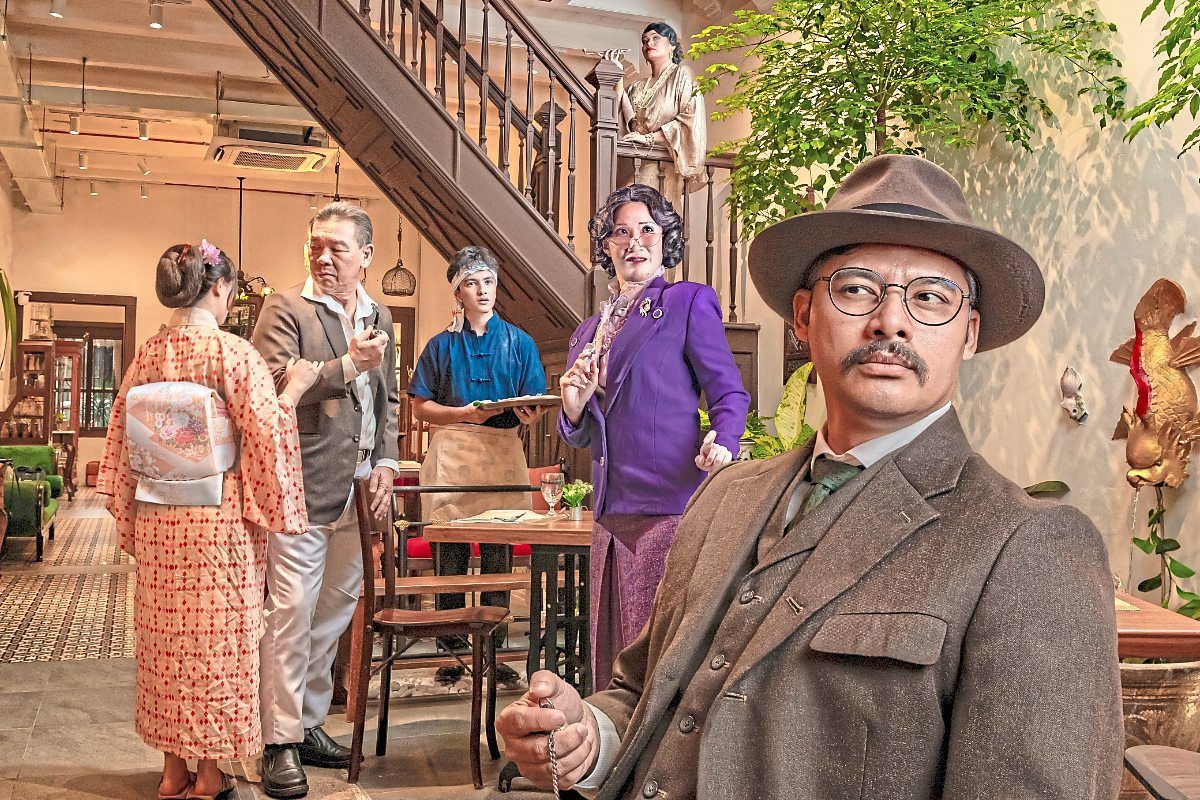
Melaka is preparing to launch an unusual cultural offering this summer that merges theatrical storytelling with culinary tradition. Over four weekends spanning July and August, audiences are invited to participate in an interactive murder mystery experience crafted specifically for the historic Peranakan landscape that defines the city. Presented by Krate Creative Space in partnership with The Garden@Heeren, a heritage venue situated on the culturally significant Jalan Tun Tan Cheng Lock, the production promises an evening where guests transition from dinner spectators to active participants in an unfolding criminal investigation.
The experience represents a deliberate departure from conventional theatre consumption. Rather than occupying seats to observe performers, participants move throughout the physical space, engage in dialogue with a professional cast, and make decisions that materially shape how the narrative concludes. The evening unfolds across two and a half hours, beginning with a carefully curated multiple-course Peranakan dinner featuring dishes such as pie tee, pongteh chicken, and cincalok omelette. As the meal progresses, the story emerges organically, with characters revealing themselves and mysteries deepening through direct interaction with guests who can choose their level of involvement—remaining peripheral observers or stepping into more prominent investigative roles.
The narrative takes place at a grand restaurant reopening celebrating the cuisine of the renowned Chef Fa. What initially appears as an occasion for celebration transforms abruptly when tragedy strikes. A detective fortuitously present at the gathering immediately assumes control of the investigation, subsequently enlisting the audience's assistance. Guests find themselves examining crime scenes, uncovering hidden clues, questioning suspects, and assembling the factual puzzle necessary to identify the perpetrator. The production culminates when audience members present their own verdicts, determining whom they believe committed the crime.
To accommodate returning audiences, Krate has developed two distinct endings that rotate across the four-weekend run. The first two weekends present one resolution, while the final two weekends reveal an alternative conclusion, ensuring that repeat attendees encounter genuinely different investigative pathways and outcomes. This structural choice reflects a sophisticated understanding of contemporary entertainment preferences, where audiences increasingly seek experiences that reward multiple engagements and offer varied narrative trajectories.
The cast includes established performers from previous Krate productions, with Francis Augustine portraying Detective Raymond, Sonia Lee as Miss Irene, Lee You Meng as Baba Pang, Elijah Skye as Peter Pang, and Neena Shu as Mama Maria. Attendees are encouraged to dress in period-appropriate or Peranakan-inspired formal attire, enhancing the immersive atmosphere. The production is recommended for audiences aged fifteen and above, suggesting an expectation of sufficient maturity to engage meaningfully with both the narrative complexity and interpersonal dimensions of the experience.
Wee, the Melaka-based writer and creative director who has developed all of Krate's interactive productions, explains that conceiving a murder mystery required identifying both appropriate collaborators and a venue with sufficient character and physical complexity. The Garden@Heeren proved instrumental in bringing the concept to fruition. According to Wee, historic houses possess inherent dramatic potential—their architectural narratives, accumulated secrets, and accumulated atmospheres naturally accommodate mysteries and suspenseful storytelling. The venue's authentic Peranakan heritage ensures that the setting itself becomes a character within the production.
Wee deliberately integrated Melaka's celebrated food culture into the theatrical framework, recognising that the city carries particular identity through its culinary traditions. Rather than divorcing performance from dining, the production uses gastronomy as an integral narrative device. Audiences experience immersion through multiple sensory channels simultaneously—visual elements including setting and costumes, auditory components such as period-appropriate music, gustatory experiences through heritage cuisine, and kinesthetic engagement through movement and roleplay. This multisensory approach transports participants to an imagined 1930s setting with considerable psychological effectiveness.
The distinguishing aspect of this particular production concerns how audience agency shapes the evening's trajectory. Because different groups ask varied questions, discover alternative clues, and interact with suspects according to their own investigative instincts, no two performances prove identical. This variability generates genuine uncertainty for performers, requiring them to genuinely respond to audience choices rather than following predetermined patterns. The alternate endings further amplify this unpredictability, permitting returning audiences to experience fundamentally transformed narratives.
Krate Creative Space, established in 2016, occupies a unique position within Melaka's cultural ecosystem as the city's first independent creative community specialising in customised, interactive, and multi-disciplinary live performance. Over its existence, the organisation has produced more than ten original works, developing a reputation for high-calibre experiences that forge meaningful connections between audiences and stories, spaces, and shared cultural heritage. Approximately half of Krate's attendees originate from Melaka itself, while significant numbers travel from the Klang Valley, Penang, Johor, and Singapore to experience productions. The company has also attracted international tourists seeking authentic cultural engagement beyond conventional heritage site tourism.
Wee acknowledges that maintaining an independent creative enterprise presents considerable challenges in Malaysia's cultural landscape. Krate has consequently diversified its revenue streams beyond ticketed performances alone. The company's creative headquarters, located in Bukit Beruang, combines rehearsal facilities, studio space, and discussion areas with a functioning café, enabling the venue to generate income through multiple channels while fostering creative community engagement.
Looking forward, Wee articulates an ambitious vision for Malaysia's cultural tourism sector. She believes immersive theatre represents significant untapped potential, particularly within heritage cities like Melaka that attract both domestic and international visitors seeking meaningful cultural experiences. Krate's strategic objective involves establishing a permanent dedicated venue in Melaka where heritage-inspired immersive experiences can operate on a scheduled, year-round basis. Such a facility would provide both local residents and visiting tourists regular access to original Malaysian narratives performed in historically resonant settings.
The organisation has already expanded geographically, bringing the original production The Best Nyonya to Penang in May of the previous year, performing at Georgetown Mansion. This expansion suggests a broader strategy of positioning Krate's work within significant heritage precincts across Southeast Asia, where audiences increasingly value experiences combining theatrical innovation with cultural authenticity. The murder mystery weekends represent the culmination of Wee's extended vision—transforming heritage conservation from passive observation into dynamic, participatory cultural engagement that simultaneously preserves Peranakan traditions while rendering them relevant to contemporary audiences seeking immersive entertainment alternatives.

