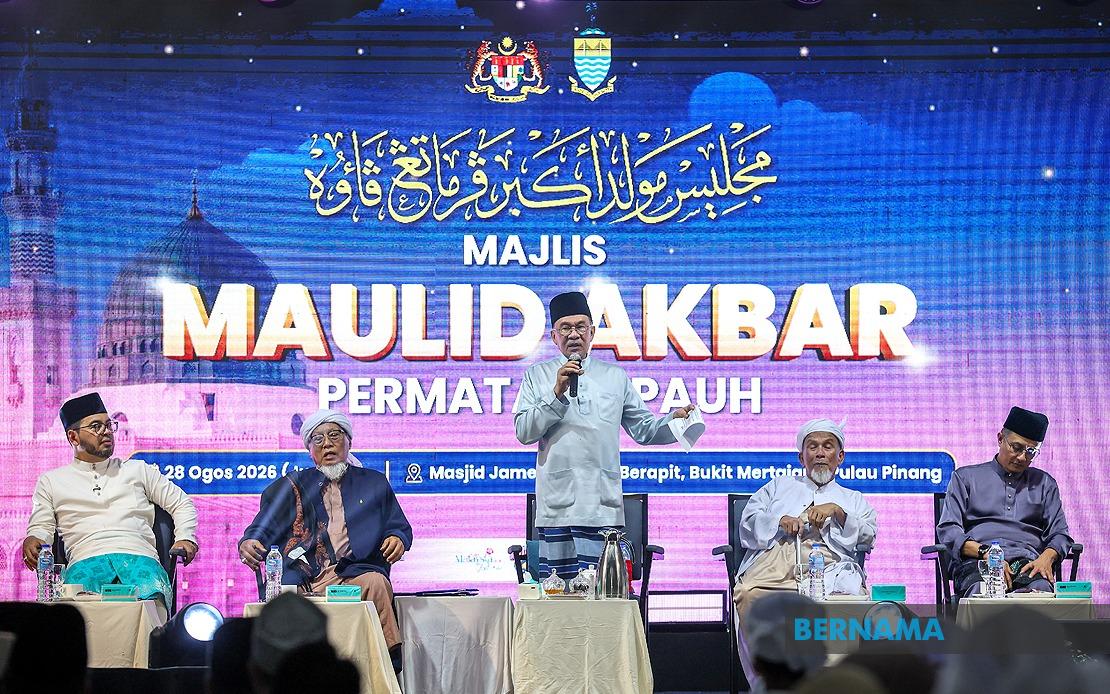
Prime Minister Datuk Seri Anwar Ibrahim has appealed to Muslims across the nation to become standard-bearers of morality and integrity, contending that the standing of Islam in society depends fundamentally on the character and conduct displayed by its followers in their daily lives. Speaking at a Maulid Akbar ceremony held in conjunction with National Day observances at Masjid Tengah in Bukit Mertajam, Anwar articulated a vision where Muslims earn societal respect not through proclamations of faith alone, but through demonstrable commitment to ethical principles including honest labour, truthfulness, and steadfast rejection of corrupt practices.
Anwar's remarks underscore a conviction that personal virtue constitutes the most persuasive argument for Islam's relevance in contemporary Malaysia. He contended that when Muslims exhibit diligence in their work, honour their commitments, and refrain from exploiting positions of authority for personal gain, they naturally command respect from their communities and beyond. This approach reflects a broader philosophy that religious credibility in pluralistic societies derives from consistency between professed values and observable behaviour. The Prime Minister's framing suggests that in Malaysia's context, where Muslim-majority populations coexist with significant non-Muslim communities, the conduct of Muslim professionals, officials, and citizens carries particular significance in shaping public perception of Islam itself.
Central to Anwar's message is the notion that Islam fundamentally embodies messages of compassion and universal welfare that transcend religious boundaries. He stressed that Muslims bear responsibility for safeguarding the wellbeing of entire communities regardless of racial or religious composition, implying that Islamic morality should inform inclusive rather than exclusionary social practices. This articulation carries weight in Malaysia's context, where questions of religious identity, communal harmony, and the role of Islam in governance remain subject to ongoing public debate and occasional tension. By framing Islamic ethics as necessarily extending to all segments of society, Anwar positions moral leadership as inseparable from social cohesion.
The Prime Minister identified what he characterized as a critical imbalance in contemporary development paradigms, one that prioritizes economic growth and technological advancement while neglecting the spiritual and moral foundations upon which sustainable societies rest. His invocation of the Malaysia MADANI framework—the government's signature development vision—served to integrate religious and ethical considerations into discussions of national progress that might otherwise focus narrowly on material metrics. Anwar's argument that Malaysia cannot achieve meaningful advancement through policy and economic strategies alone if these lack moorings in faith and character suggests dissatisfaction with purely secular models of development.
Anwar employed a metaphor of roots and sky to illustrate the balance he considers essential for national development. While aspirations for advancement and progress must reach skyward, he argued, they require grounding in foundational values to prevent societies from becoming untethered from their ethical moorings. This imagery resonates with concerns raised across Southeast Asian societies about rapid modernization and technological change potentially outpacing moral and social frameworks. The metaphor also implies that purely materialist approaches to development, however impressive in their surface achievements, risk hollowing out the character and cohesion necessary for societies to function meaningfully over the long term.
Significantly, Anwar attributed to Muslims the responsibility for balancing multiple dimensions of human development simultaneously: intellectual advancement through knowledge-seeking, spiritual growth through faith, moral development through ethical practice, physical wellbeing, and material prosperity. Rather than viewing these as competing priorities, he presented them as interconnected dimensions of a holistic vision where each strengthens rather than undermines the others. This integrative perspective challenges segmented approaches to governance where religious and spiritual concerns occupy separate spheres from economic and technological policy.
The Prime Minister emphasized the strategic importance of engagement with Islamic scholars and religious leaders, positioning their counsel as essential to maintaining the moral compass of national development. His call for strengthened ties between religious authorities and political leadership, conducted through constructive exchange of views and advice, suggests recognition that sustainable implementation of values-based governance requires sustained dialogue between these constituencies. This reflects awareness that religious scholars command credibility and influence within Muslim communities that political leaders alone cannot replicate.
Anwar's insistence that Malaysia MADANI must continue driving economic growth and technological mastery while elevating moral principles as foundational pillars attempts to resolve what he evidently perceives as a false dichotomy between material progress and ethical grounding. The framework he articulates does not reject modernization or economic development but rather insists these must proceed in tandem with deliberate cultivation of character and values. For Malaysian policymakers and publics, this positioning carries implications for how development priorities are evaluated and sequenced.
The timing and venue of Anwar's remarks—a religious ceremony coinciding with National Day celebrations—emphasized the integration of religious and national identity in his governance vision. This convergence suggests that in his conception, Islamic values and Malaysian national interests align rather than conflict, and that religious leadership constitutes a legitimate and necessary component of addressing contemporary governance challenges. The presence of Minister in the Prime Minister's Department (Religious Affairs) Dr Zulkifli Hasan underscored institutional commitment to this framework at the highest governmental levels.
For Southeast Asian and Malaysian observers monitoring the intersection of religion and governance, Anwar's interventions signal an attempt to articulate a middle path that neither marginalizes religious considerations in public policy nor permits religious governance to operate divorced from broader principles of integrity and inclusive welfare. Whether this integrative approach can be sustained amid competing pressures from different constituencies—those advocating stronger religious influence on governance and those concerned about secular principles—remains a central question for Malaysia's political trajectory in coming years.

