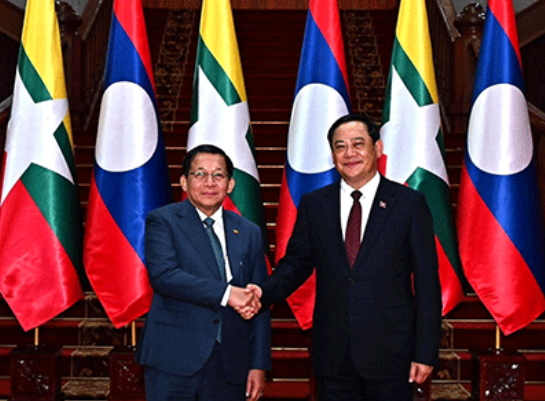
Myanmar's President Min Aung Hlaing has embarked on a significant state visit to neighbouring Laos, where leaders of both nations have reaffirmed their commitment to fortifying long-standing diplomatic and economic partnerships. The visit, which took place from July 3–5 in Vientiane, carries particular symbolic weight as it coincides with celebrations marking seven decades of formal relations between the two countries. President Thongloun Sisoulith extended a warm reception to his Myanmar counterpart, accompanied by his wife, at a state ceremony held at the Presidential Palace with full ceremonial honours.
The timing of the visit underscores shifting regional dynamics in Southeast Asia. President Min Aung Hlaing has selected Laos as his first official Asean destination since assuming office, a deliberate diplomatic signal of Myanmar's renewed emphasis on strengthening ties with its immediate neighbours. This choice reflects the strategic importance both countries place on maintaining stability and cooperation within the region, particularly as they navigate complex geopolitical currents affecting the broader Mekong region.
During formal talks between the two presidents, discussions ranged across a comprehensive agenda encompassing bilateral cooperation frameworks, regional security concerns, and international affairs. Both leaders acknowledged the substantial progress already achieved in deepening their political relationship, citing mutual trust, consistent high-level exchanges, and coordinated diplomacy as cornerstones of their partnership. The emphasis placed on these foundational elements suggests both governments view their connection as resilient and mutually beneficial, even as each nation faces distinct domestic and regional challenges.
Cooperation in defence and security constitutes a particularly significant dimension of the bilateral relationship. The two nations agreed to enhance collaboration in border security management, intelligence sharing, and coordinated responses to transnational challenges affecting their shared frontier regions. Such measures carry substantial relevance for Myanmar and Laos alike, given historical patterns of cross-border movement and the persistent security concerns faced by both countries. Additionally, both governments committed to deepening their involvement within multilateral frameworks including Asean, the United Nations, and the Mekong-Lancang Cooperation mechanism, signalling their intention to exercise collective influence on regional and global issues.
Economic cooperation featured prominently in discussions between President Thongloun and Prime Minister Sonexay Siphandone with their Myanmar counterpart. The two sides pledged to intensify efforts in trade expansion, investment promotion, transport connectivity, and energy sector development. These sectors represent areas where meaningful growth potential exists, particularly as both nations pursue infrastructure development and seek to harness their natural resources more effectively. Transport infrastructure improvements, in particular, could facilitate greater people-to-people exchange and commercial activity across their shared borders.
Cultural and tourism cooperation received tangible expression through the signing of a Memorandum of Understanding between Laos' Ministry of Culture and Tourism and Myanmar's Ministry of Hotels, Tourism and Culture. This agreement acknowledges the substantial tourism potential within both nations, particularly given Laos' designation as a Unesco World Heritage site for Luang Prabang and Myanmar's rich cultural heritage. For Malaysia and other Southeast Asian nations, enhanced tourism cooperation between these two neighbours creates opportunities for regional tourism circuits that could channel visitors through multiple destinations.
A second significant agreement established "friendship city" relations between Vientiane and Naypyidaw, formalizing a people-to-people connection between the two capitals. Such arrangements typically facilitate cultural exchanges, educational partnerships, and municipal-level cooperation that extend beyond traditional government-to-government frameworks. This people-centric approach to diplomacy reflects a broader understanding that sustained relations require engagement across multiple societal levels.
Parliamentary cooperation emerged as another crucial pillar of the expanded partnership. President Min Aung Hlaing's meeting with National Assembly President Xaysomphone Phomvihane centred on strengthening institutional connections between the Myanmar Union Parliament and Laos' legislative body. Both leaders recognised that robust parliamentary relations facilitate the monitoring and effective implementation of bilateral agreements, ensuring that commitments translate into practical benefits for their populations. This emphasis on legislative oversight and accountability demonstrates sophisticated appreciation for the importance of institutional frameworks in sustaining long-term cooperative relationships.
The visit included ceremonial gestures reinforcing the cultural and historical dimensions of the relationship. President Min Aung Hlaing laid wreaths at Vientiane's Unknown Soldier Monument, honouring Lao revolutionary fighters, an act rich with symbolic significance for both nations' histories. He subsequently participated in a traditional Baci ceremony and attended a state banquet hosted by President Thongloun and his wife, Naly Sisoulith. These cultural engagements serve important functions in building personal rapport between leaders and demonstrating respect for each nation's historical legacy.
A public health dimension to the visit manifested through the handover of snake antivenom serum to the Lao Ministry of Health, addressing a practical humanitarian concern affecting both nations' populations. This transfer of medical resources exemplifies cooperation on issues affecting citizen welfare, demonstrating that bilateral engagement encompasses addressing immediate public health challenges alongside broader strategic objectives.
For Malaysian observers and policymakers, this strengthening of Myanmar-Laos relations carries implications for broader regional stability and Asean cohesion. As two nations navigating distinct challenges—Myanmar rebuilding international relationships following recent political transitions, and Laos pursuing economic development—deepen their partnership, the precedent of sustained cooperation despite external pressures becomes relevant. The emphasis both countries place on addressing cross-border air pollution through joint mechanisms also reflects recognition of transnational environmental challenges requiring coordinated regional responses.
The visit's conclusion with planned tours of Luang Prabang's temples and cultural landmarks provided President Min Aung Hlaing and his delegation opportunity to experience the region's cultural heritage firsthand. Such experiences potentially foster deeper appreciation for shared Southeast Asian values and historical connections transcending formal diplomacy. For the Myanmar delegation, exposure to Laos' development trajectory and tourism infrastructure may inform thinking about Myanmar's own economic recovery and regional positioning.
Looking forward, the cooperation agreements signed and commitments reiterated during this state visit establish a foundation for sustained bilateral engagement across multiple sectors. Both nations have signalled determination to move beyond symbolic gestures toward tangible outcomes in trade, security cooperation, and people-to-people exchange. The three-day visit represents not a conclusion but rather a platform upon which further development of Myanmar-Laos relations will build, with implications reverberating across Southeast Asia's interconnected political and economic landscape.

