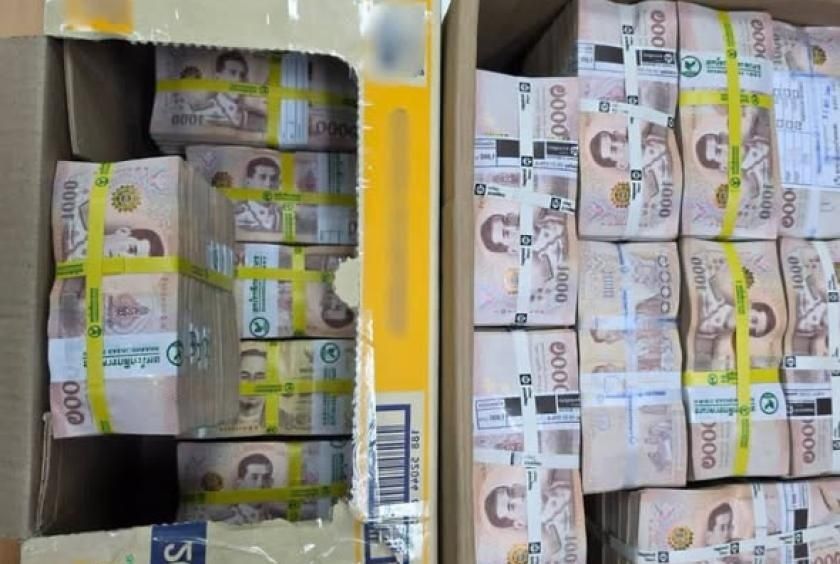
A 31-year-old Myanmar driver was arrested by Thai customs officials at the Mae Sai border crossing after authorities discovered more than 23 million baht hidden inside ordinary food packaging. The incident highlights ongoing efforts by Thai authorities to intercept illicit currency movements across one of Southeast Asia's busiest land borders, where financial smuggling remains a persistent enforcement challenge.
The arrest occurred at the Mae Sai checkpoint on the Thai side of the Thai-Myanmar Friendship Bridge when customs inspectors decided to conduct a thorough examination of a vehicle bearing Myanmar registration plates. This routine inspection proved consequential, as officers uncovered bundles of high-denomination 1,000-baht banknotes carefully concealed within cartons purportedly containing dried fish and potatoes, commodities that regularly cross the border for legitimate trade.
The concealment method demonstrated considerable planning. The currency had been systematically packed into plastic bags and distributed across multiple food containers to avoid detection during standard inspection procedures. The first carton examined contained approximately 17 million baht, while a second container yielded an additional 6.023 million baht, bringing the total seized amount to 23.023 million baht, equivalent to roughly US$689,077 at current exchange rates.
Thailand's strict foreign exchange regulations prohibit the movement of large sums of Thai currency across borders without proper authorization and documentation. This case represents a clear breach of both the Customs Act and Thailand's foreign exchange control framework, which governs the cross-border movement of all currencies and financial instruments. Such regulations exist to maintain monetary stability and prevent the use of border checkpoints for money laundering or financing of illicit activities.
The arrest underscores the vulnerability of the Thai-Myanmar border to financial smuggling operations. Despite increased surveillance and inspection protocols at major checkpoints like Mae Sai, criminal networks continue developing increasingly sophisticated methods to move money across the frontier. The use of foodstuffs as cover goods exploits the high volume of legitimate agricultural and processed food trade between the two countries, making detection more difficult for already-stretched customs personnel.
For Malaysian readers and regional observers, this incident reflects broader patterns of financial crime affecting Southeast Asia's porous borders. The region's multiple land crossings, combined with varying regulatory frameworks and enforcement capacity across nations, create opportunities for organized smuggling operations. Myanmar's ongoing political instability and economic challenges have made it a transit point for illegal financial flows, with proceeds sometimes destined for neighboring countries including Thailand, Laos, and potentially further afield.
The 31-year-old suspect is now being detained at Mae Sai Police Station while Thai authorities pursue further investigation. Investigators are attempting to identify additional individuals potentially involved in the smuggling operation, as such large-scale currency movements typically involve multiple parties across supply chains. These may include financiers, brokers, transport coordinators, and recipients at the final destination, suggesting this arrest may uncover a more extensive network.
Thailand has intensified border enforcement in recent years, particularly targeting currency smuggling and money laundering activities. The Mae Sai checkpoint, located in Chiang Rai province where Thailand meets Myanmar, is one of the kingdom's most critical trading points but also a known vulnerability point for illegal cross-border activity. Thai customs has deployed advanced detection equipment and increased staffing levels, yet the volume of daily traffic—thousands of vehicles crossing legitimate borders—means comprehensive inspection remains challenging.
The implications extend beyond bilateral Thai-Myanmar relations. As Association of Southeast Asian Nations members seek to harmonize border security and financial oversight through frameworks like the ASEAN Regional Forum, individual enforcement actions at specific checkpoints contribute to broader regional security objectives. Smuggling operations that succeed in moving large sums can fund criminal networks operating across multiple countries, from human trafficking to drug production.
The case also raises questions about the source and intended destination of the smuggled funds. Whether the currency originated from Myanmar's parallel money market, commercial businesses seeking to move profits, or other sources remains under investigation. The destination—whether Thailand's informal economy, onward regional movement, or accumulation for specific criminal purposes—could significantly influence the scale and nature of any broader operation authorities uncover.
Thailand's handling of this case may set precedents for addressing similar smuggling attempts. The visible commitment to prosecution sends deterrent signals to organized crime networks, though the persistence of such attempts suggests profit margins remain attractive despite enforcement risks. For regional financial authorities and law enforcement agencies monitoring cross-border crime, each arrest provides intelligence about shifting smuggling routes, methods, and trafficking organizations.
As investigations continue, Thai authorities will likely pursue asset tracing procedures and examine the suspect's communications and financial records to build cases against accomplices. Regional cooperation mechanisms, including liaison with Myanmar authorities where circumstances permit, may yield additional leads. The incident serves as a reminder that Southeast Asian borders require sustained, resourced enforcement efforts to manage both legitimate trade flows and criminal activities that exploit trading corridors for illicit purposes.

