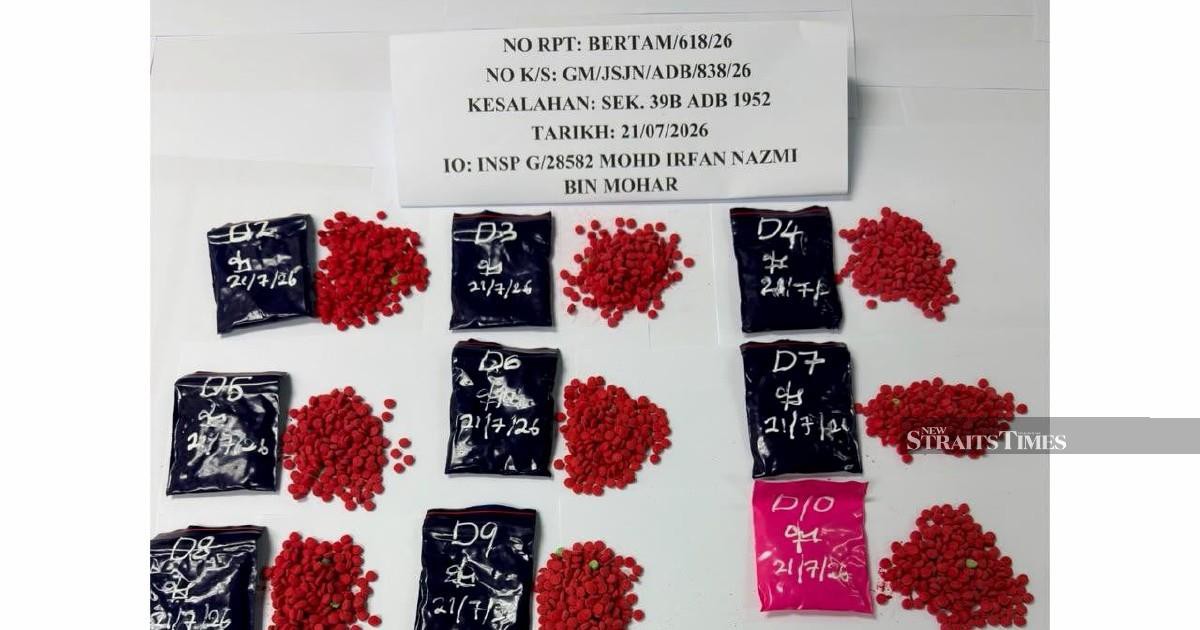
Law enforcement authorities in Kelantan have arrested two Myanmar nationals following a vehicle pursuit in the Gua Musang district, leading to the confiscation of a substantial cache of methamphetamine tablets. The operation, conducted yesterday, resulted in the seizure of 6,000 yaba pills with an estimated street value of RM60,000, marking another significant interdiction in the state's ongoing battle against cross-border drug trafficking.
The apprehension comes as Malaysian authorities continue to grapple with methamphetamine trafficking originating from production facilities in Myanmar and other Southeast Asian locations. Yaba, a combination of methamphetamine and caffeine typically produced in tablet form, has become increasingly prevalent across the region, with trafficking networks exploiting porous borders and established smuggling routes. The drug represents one of the most serious narcotics challenges facing enforcement agencies from Thailand through Malaysia to Singapore.
Gua Musang's strategic location in Kelantan places it within a critical corridor for illicit substances moving southward from Myanmar and northern Thailand. The district's proximity to less-developed border regions makes it a natural transit point for organised drug trafficking operations seeking to penetrate Malaysian markets and supply chains extending toward Singapore and beyond. Police operations in this area consistently yield significant seizures, reflecting both the volume of trafficking activity and the resource commitments authorities have made to counter it.
The pursuit itself underscores the operational tactics employed by enforcement personnel in interdicting suspect vehicles before they can distribute narcotics throughout population centres. Swift action by police prevented the estimated 6,000 tablets from reaching distribution networks, disrupting what would likely have supplied multiple street-level transactions across Kelantan and possibly neighbouring states. Such operational successes depend on intelligence gathering, strategic checkpoint placement, and rapid response capabilities.
The RM60,000 valuation reflects current market conditions for yaba in Malaysia, where demand remains sustained despite law enforcement efforts and public health campaigns. This pricing indicates the substantial profit margins fuelling trafficking operations and the economic incentives driving criminal networks to maintain supply lines. For distributors and retailers operating at street level, individual yaba tablets command prices significantly higher than their wholesale cost, enabling traffickers to generate substantial revenues even after accounting for operational expenses and enforcement risks.
Myanmar's status as a major production source for methamphetamine stems from multiple factors, including limited regulatory capacity in remote border regions, availability of precursor chemicals, established laboratory infrastructure, and the involvement of armed groups controlling territory where production occurs. The country's complex political situation has affected government capacity to suppress drug manufacturing, creating conditions favourable for traffickers. Intelligence agencies across the region have identified multiple facilities producing yaba and other methamphetamine variants, yet production capacity consistently outpaces enforcement efforts.
The arrest of nationals from Myanmar operating within Malaysian territory reflects a common trafficking pattern where foreign nationals are recruited to transport drugs through Malaysia's land borders. Their apprehension enables authorities to investigate supply chain connections, operational methods, and downstream distribution networks. Intelligence gathered from such arrests contributes to larger enforcement strategies targeting trafficking organisations rather than solely focusing on individual transactions.
Kelantan's law enforcement agencies have increased border-area operations in response to trafficking pressures, deploying personnel to strategic locations and establishing intensive checkpoint regimes. The state recorded numerous significant seizures in recent years, yet the continuing flow of yaba suggests that enforcement, while effective at individual intercepts, has not substantially reduced overall supply reaching Malaysian communities. This dynamic reflects the broader regional challenge where production capacity and trafficking sophistication often outpace interdiction capabilities.
The methamphetamine problem extends beyond enforcement considerations into public health, crime prevention, and social welfare domains. Yaba consumption drives addiction, criminal activity, and social disruption across affected communities. Treatment facilities throughout Malaysia report increasing admission rates for methamphetamine-related disorders, suggesting expanding user populations despite seizure successes. Prevention and demand-reduction initiatives remain underfunded relative to enforcement efforts, creating imbalances in overall drug control strategies.
Regional cooperation has improved significantly in recent years, with ASEAN countries coordinating intelligence sharing and joint enforcement operations targeting transnational trafficking networks. Bilateral arrangements between Malaysia and neighbouring nations have facilitated intelligence exchange and coordinated border operations. However, enforcement coordination faces challenges stemming from varying political situations, resource constraints, and differing institutional capacities across Southeast Asian nations.
The case highlights how methamphetamine trafficking increasingly involves organised criminal syndicates with international reach rather than small-scale operations. These networks maintain sophisticated supply chains, financial mechanisms, and distribution hierarchies capable of sustaining operations despite enforcement setbacks. Individual seizures, while valuable for disrupting street-level availability temporarily, represent limited interventions against trafficking organisations operating across multiple national borders.
Moving forward, authorities emphasise that sustained success requires integrating enforcement with supply-side reduction, demand-side interventions, and treatment access. Community-based prevention programmes and education initiatives targeting potential users remain underemphasised compared to police operations. The Myanmar nationals' arrest contributes important intelligence to law enforcement databases and operational planning, yet represents a single instance within a larger, persistent trafficking phenomenon characterising the Malaysia-Myanmar border region.

