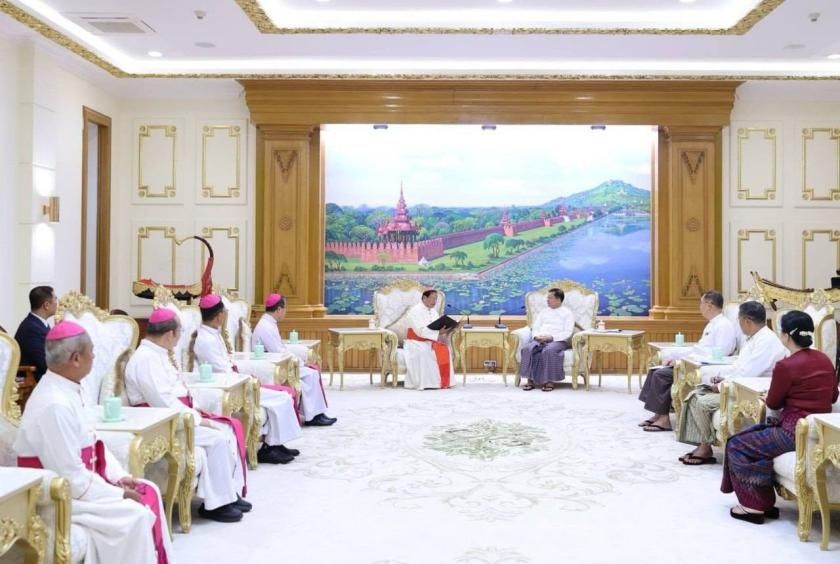
President U Min Aung Hlaing received Cardinal Charles Bo, the head of Myanmar's Catholic Bishops' Conference, at the Presidential Palace in Yangon on Wednesday, August 5, for discussions centred on religious liberty, peacebuilding, and social cohesion. The high-level engagement marks an important diplomatic moment for a nation navigating complex religious, political, and humanitarian challenges following years of internal conflict and international scrutiny.
Cardinal Bo, one of Southeast Asia's most prominent Catholic figures, expressed deep satisfaction with the opportunity to engage directly with the President. His remarks reflected appreciation for Myanmar's leadership in confronting significant national difficulties whilst attempting to uphold constitutional obligations. The Cardinal's constructive tone suggested an attempt to build productive bridges between the Catholic community and the state apparatus, a symbolic gesture in a country where religious institutions have historically played crucial mediating roles during periods of social turbulence.
A notable focal point of their discussion involved gratitude for governmental support provided to the Catholic church in Myanmar's capital. The President's administration has reportedly granted land in Naypyidaw for Catholic place of worship construction, signalling tangible commitment to facilitating religious infrastructure development. Cardinal Bo's appreciation for this gesture underscores how practical, material support for religious communities can strengthen state-faith relations, particularly in a nation where institutional trust remains fragile.
President U Min Aung Hlaing used the platform to emphasise that Myanmar's constitutional framework guarantees equal religious practice across all faiths without state-sponsored discrimination. This assertion carries particular weight given international human rights organisations' ongoing concerns regarding treatment of certain religious minorities, particularly the Rohingya Muslim population and other marginalised communities. The President's explicit reference to non-discriminatory religious policy represents an attempt to position Myanmar's governance within international human rights standards, though implementation gaps remain a point of contention for international observers.
The broader infrastructure commitment extends beyond Catholicism. The President indicated that land allocation for multiple faith communities' worship facilities throughout Naypyidaw demonstrates systematic, inclusive religious accommodation at the capital level. Such tangible provisions for diverse religious expression suggest governmental acknowledgment that national cohesion depends partly on visible, material recognition of religious pluralism—a principle increasingly important as Myanmar undergoes political reconstruction.
President U Min Aung Hlaing's statements regarding Myanmar's commitment to multi-party democracy contextualise these religious discussions within a larger political framework. His emphasis that national peace emerges through dialogue rather than coercion, and that political disputes require political solutions, reflects international pressure for Myanmar to pursue inclusive governance structures. This rhetorical positioning attempts to reinforce narratives of democratic progression, though scepticism persists regarding implementation sincerity given Myanmar's recent political history.
The President's appeal to religious leaders transcends ceremonial courtesy, instead reflecting instrumental recognition of faith communities' societal influence. By requesting that religious institutions reinforce moral teachings and promote national reconciliation, the state appears to view religious leadership as essential partners in post-conflict social healing. This dynamic is particularly significant in Myanmar, where Buddhist monasteries have historically served as educational, social, and political anchor institutions, and where Catholic, Christian, and Islamic communities occupy increasingly visible public roles.
For Malaysia and the broader Southeast Asian region, this diplomatic exchange carries implications worth monitoring. Myanmar's approach to religious pluralism and state-faith relations influences regional stability and international standing within ASEAN. As Myanmar navigates reconstruction following internal displacement and communal tensions, the extent to which religious minorities receive genuine protection and recognition affects regional migration patterns, cross-border religious community dynamics, and ASEAN's collective credibility regarding human rights commitments.
Cardinal Bo's presence and constructive engagement reflects global Catholic institutional priorities regarding religious freedom advocacy and grassroots peacebuilding. The Catholic Church's international networks and diplomatic reach position it as a significant actor in Myanmar's reconciliation processes. Such high-level ecclesiastical engagement can either facilitate genuine reform or provide symbolic legitimacy to governance structures facing credibility questions—a distinction requiring careful analytical scrutiny.
The meeting concluded with the President inquiring into monastic communities' material needs and providing requested support, a gesture emphasising personal accessibility and religious sensitivity. Gift exchanges and commemorative photographs served conventional diplomatic functions whilst documenting the engagement for domestic and international audiences. These ceremonial elements, though routine in diplomatic contexts, carry symbolic weight in nations where presidential visibility and perceived religious respect significantly influence public confidence in governance.
Moving forward, the substantive implications of this meeting depend entirely on implementation. Verbal commitments to religious freedom require translation into legislative protections, institutional accountability mechanisms, and enforcement procedures that insulate minority communities from state harassment or majoritarian pressure. Myanmar's international credibility increasingly hinges on narrowing gaps between articulated religious freedom principles and ground-level lived experiences of diverse faith communities seeking genuine security and recognition.

