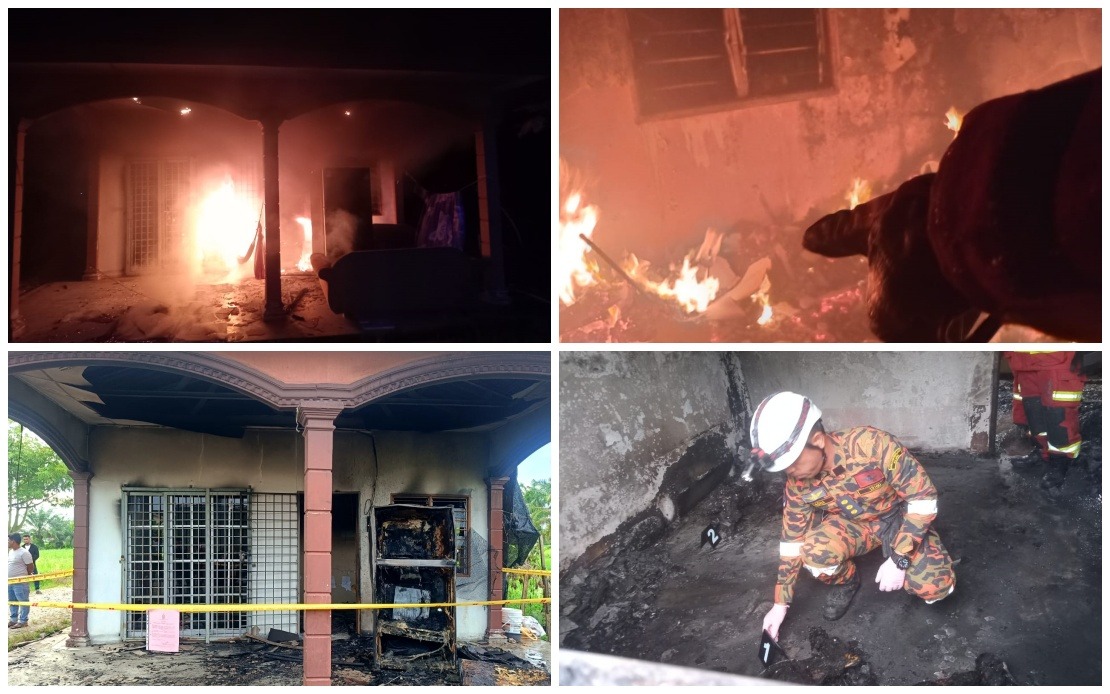
A tragic fire in Taman Serai Maju, Bagan Serai, claimed the lives of three Myanmar refugees early on Friday, leaving behind a grieving family and raising fresh concerns about living conditions among vulnerable migrant communities in Malaysia. The deceased were identified as Mohd Yunus Nor Ali, 27, along with his two young sons Muhammad Woheed Mohd Yunus, aged six, and Mohamad Aheed Mohd Yunus, aged three. The family's mother, Saniya Jahan Juma Abul Kasim, 24, survived the blaze but sustained burn injuries to her hands and feet and was transported to hospital for treatment.
Emergency responders from the Perak Fire and Rescue Department received the distress call at 5:17 am through the MERS 999 emergency line, with the first fire truck reaching the residential address just thirteen minutes later. Upon arrival at the scene, firefighters discovered a single-storey residential structure, measuring approximately 20 feet by 40 feet, already engulfed in flames. The building housed seven foreign nationals at the time of the incident. Initial damage assessments indicated that roughly 70 percent of the structure had been consumed or severely damaged by the fire, making it essentially uninhabitable.
According to Datuk Sayani Saidon, the director of the Perak Fire and Rescue Department, the rescue operation began immediately upon arrival. Mrs Saniya, who had managed to escape the burning building, was discovered outside and informed rescue personnel that her husband and two children remained trapped inside. Operating under standard emergency protocols, the firefighting team executed a methodical search and rescue operation, focusing their efforts on the most heavily affected areas of the residence.
The search proved devastating. Rescue workers located all three male family members in the first room where the fire had originated. Medical officers from the Ministry of Health, who arrived at the scene as the fire continued to burn, confirmed that all three individuals had already succumbed to the flames. The causes of death were consistent with severe burn injuries sustained in the intense heat. Meanwhile, the surviving family member received preliminary medical care at the scene before being transported by the Emergency Medical Rescue Services vehicle to a hospital for comprehensive treatment of her injuries.
The fire suppression operation proceeded with considerable urgency and professionalism. Firefighters brought the blaze under control by 6:20 am, approximately one hour after the initial emergency call. The complete operation, including final checks, dampening of embers, and initial investigation procedures, was concluded by 7:35 am. Following standard procedures, police personnel from the Royal Malaysia Police took custody of the three deceased individuals for further investigation and formal processing.
The circumstances surrounding the fire's ignition remain the subject of ongoing investigation. According to preliminary findings by the Perak Fire and Rescue Department's forensic team, evidence indicates that the fire originated in the first room of the residence—precisely where the three victims were discovered. However, the specific cause that ignited the blaze has not yet been determined. Investigators are examining multiple potential factors, including electrical faults, cooking accidents, or other common residential fire triggers. The forensic team is conducting a thorough examination of the fire scene to establish a definitive cause and calculate the full extent of material losses.
This tragedy underscores the precarious living situations faced by Myanmar refugees and undocumented migrants throughout Malaysia. The Rohingya community, in particular, has faced systematic persecution in their homeland and often resides in overcrowded, substandard housing in Malaysia where they remain unregistered and vulnerable. Residential fires represent a persistent hazard in densely populated informal settlements, where fire safety equipment is frequently absent and building codes may not be strictly enforced. The concentration of seven individuals in a relatively modest 20-by-40-foot structure hints at the economic constraints forcing such families to share limited space.
The loss of a young father and his two small children represents not merely individual tragedy but reflects broader humanitarian concerns regarding the treatment and welfare of displaced persons in Southeast Asia. Malaysia hosts one of the largest refugee populations in the region, with significant communities from Myanmar, Syria, and other conflict-affected nations. Many live in precarious circumstances, lacking formal recognition, stable employment, or adequate access to basic services. Fire safety awareness and prevention measures are often inadequate within these communities, partly due to language barriers and limited communication channels between authorities and foreign residents.
For the surviving mother, the path forward will be extraordinarily difficult. Beyond recovering from her physical injuries, she faces the profound grief of losing her spouse and children while navigating an uncertain legal status in a foreign country. Support systems for refugee families in Malaysia remain limited, though humanitarian organizations occasionally provide assistance. The incident will likely prompt renewed discussions among policymakers, humanitarian groups, and community leaders about housing standards for migrants and refugees, emergency preparedness in informal settlements, and mechanisms to prevent future tragedies among vulnerable populations.
The Perak Fire and Rescue Department's swift response highlighted the professionalism of Malaysia's emergency services, yet the incident demonstrates how even rapid intervention cannot always prevent loss of life in severe fire situations, particularly when victims are trapped in confined spaces. As investigations continue, questions will inevitably arise about building safety standards, whether adequate fire suppression equipment was present, and what systemic improvements might protect vulnerable communities from similar disasters in the future.

